Camp Constitution Report for the First Half of 2026

2026 has proven to be a busy and productive year so far for us.
Co-Sponsoring 7th Annual Patriot Camp in Rockport, Maine

This event held in late June and hosted by the Memorial Baptist Church is the result of the efforts of Jessicas Whitworth and Victoria It is a free three day camp for children ages 5-12 where they learn about our nation’s history and have much fun while doing so. This year, we averaged 25 campers per day. On the last day, campers recited the Declaration of Independence in Downtown Rockland, and then it ended with a barbecue.

Info Tables at Homeschoolers of Maine’s and Mas HOPE’s Annual Convention
We have been attending these two homeschool shows since 2010, and they have proven to be very productive venues for us.
For the first time since the Covid lockdown, the Homeschoolers of Maine returned to its Rockport venue with a three-day event for vendors. There were close to 400 attendees at the event. Victoria Buckland helped work the table giving Civics Savey tests to young people who visited the table. We donated numerous copies of “Alpha-Phonics” to young families. And we met a family of ten, and a family of three that will be attending our annual camp this year.
Mass Hope Homeschool Convention
This event is held in late April in historic Sturbridge< MA. We spoke to dozens of homeschoolers and those planning to home school where we introduced the Sam Blumenfeld Archives and Sam’s “Alpha-Phonics. And we distributed pocket copies of the U.S. Constitution. As a result of our donation of a camp “tuition” to their silent auction, we got two new campers.
Ladies Annual “Spring Fling”
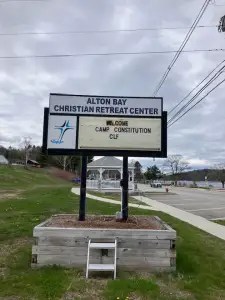
Our annual ladies retreat took place at the Alton Bay Christian Conference Center Alton, NH in early May. It was a full weekend of speakers including author Michelle Gallagher, crafts, devotions and fellowship.
Keynote Speaker at Constitution Party of New Hampshire
Hal Shurtleff was the keynote speaker at the Constitution Party of New Hampshire’s state conference which took place on the birthday of George Washington. The topic: The Presidents of the United States and the Constitution
We also had seven speaking engagements in Aroostook County Maine in early April, and we spoke at a homeschool cooperative in Cornish, Maine.
YouTube and Rumble
Our channel had 221.100,000 views, giving us a total of 2.4 million. 540 new subscribers giving us a total of 17,540. We uploaded 126 videos on our YouTube channel.
Our Rumble channel received 7,371 views and uploaded 25. All time views 175,504 with 384 followers
Camp Constitution Report Podcast
We did ten shows including interviews of authors Dr. Chase Spears and Dr. Owen Andesron. Due to our show being listed by FeedSpot as one of the top 15 best Constitution based podcasts, we have received a number of invitations to interview authors and activists.

The Blumenfeld Archives
The Sam Blumefeld Archives:
728,500 hits with 680 “Alpha-Phonics” books and 325 Instruction Manuals downloaded
Podomatic
This is our platform for podcasts, our former radio show and classis and historical recording that included the Dan Smoot Report, Sam Blumenfeld’s lectures and many speeches by Gary Allen.
We received 71 plays and 790 downloads. May of our audios and videos have been embedded on websites. And we remain in the top ten for the category of conservative/right.
Website
We received 15,126 views and 5.4 thousand visitors. While the vast majority of the visitors are from the U.S, a good 20% come from around the world. We had eighty-one articles posted on the site. We are always looking for writers. Readers who would like to have their articles posted, please contact Hal Shurlleff at campconstitution1@gmail.com
Camp Constitution Media
We uploaded twenty videos which included interviews of the Gideons, a Tuttle Twins rep, a leader of a local chapter of Turning Point USA, and a professor of Revolutionary War history. we made a video of an Education Option Fair in Dover, NH. In early March, we attended the Rhode Island First Rally where we videotaped presentations by Ramona Bessinger, a public-school teacher whistleblower, and Matt Light, former player for the New England Patriots.
Camp Constitution in the Media:
We were return guests on SouthCoast Now hosted by Chris McCarthy which is heard in the New Bedford, MA area, return guests on the Tamara Scott Show, the Duke Pests Show and first time guests on “Don’t Drink the Kool-Aid” hosted by Pastotr David Whitney, and several others
Facebook
We had 9,246 views with 3.6 thousand followers.
Special Projects
We have been working with the Matrix Coalition; a New Hampshire group whose goal is to get copies of Guidebook to the Forefathers Monument and a framed poster of the monument into schools and libraries. So far this year, we donated copies of each to the Cornerstone Christian School in Ossipee and Prospect Mountain High School in Alton, NH.
We have been donating copies of James Perloff’s book Tornado in a Junkyard which refutes evolution to Christian youth groups.
Like last year, Freedom Project Academy will offer an essay with winners getting their fees for our annual family camp paid.
We got permission from the New Hope Chapel in Alton, NH to use a sizeable room in the church both to house the hard copy filed of the Sam Blumenfeld Archives but more importantly to start a literacy center using Sam’s “Alpha-Phonics.” Our plan is to have the room ready for reading classes in the fall.

Van Fund Raising:
In late February, we had to scrap our 2019 Van. We had over 180,000 miles and it needed a new transmission and other repairs that would have cost us well over $7,000. We raised over $22,00 and in late April, we purchased a 2026 Toyota Sienna costing us approximately $41,000. Thank you to all those who donated.
Looking into the 3rd Quarter:
We will have an information table at the August 1, Rededication of the Forefathers Monument in Plymouth, a trip to Aroostook Country to have an info table at the Crown of Maine Balloon Festival and speaking engagements and a float in the Alton Old Home Day Parade, an info table at OP Ed NH and, of course our annual family camp.

18th Annual Family Camp
Camp Constitution will hold its 18th Annual Family Camp at the Singing Hills Christian Camp https://www.singinghills.net/ Plainfield, NH. from Sunday July 12 to Friday July 17, 2026
Returning instructors include Pastor David Whitney of the Institute on the Constitution, Catherine White of The Constitution Decoded, Alex Newman, author and host of the Sentinel Report, Kurt Hyde, retired U.S. Air Force Lt, Col, and Rev. Steve Craft, Camp Constitution’s chaplain.
Guest instructor is Julie Wilkinson who played the ABORTION NURSE IN THE MOVIE “UnPlanned.” In addition to the classes, the camp will offer marksmanship courses, martial arts, hiking, basketball, volleyball, wiffleball, and optional field trip and swimming, chess, gaga and corn hole tournaments. Campers and staff end the day with an evening campfire.
Our theme: Celebrating our nation’s 250th Birthday
Camp Constitution’s annual camp is a family camp open to entire families, unaccompanied minors, and adults. The cost for the week, which includes lodging, meals and class handouts, is $300 for those 13 and over. $200. For campers 12 and under, and three and under with parents are free. The camp offers an “Early Bird” discount of $50, per person by registering by May 1. A link to the camp registration: https://campconstitution.net/camp-registration/
For more information contact Hal Shurtleff (857) 498-1309 campconstitution1@gmail.com
How You Can Help
Pray for our Nation
Pray for Camp Constitution
Consider becoming a Camp sponsor for your business or like-minded non-profit.
Volunteer at some of our events.
Share our videos and blog articles everywhere.
Sponsor a camp speaker.
Thank you for all you do to make Camp Constitution possible.
No, Paris, US air conditioners did not cause Europe’s heat wave


|
Happy 250th Birthday United States
Happy 250th Birthday United States.
Campers from the Annual Patriot Camp-a Three-Day Annual Day Camp Held in Rockland Maine and co-sponsored by Life Church and Camp Constitution and hosted by the Litchfield Memorial Baptist Church- recite the Declaration of Independence at Chapman Park in Rockland, Maine Wednesday June 24, 2026.
Camp Constitution’s 18th Annual Family Camp Schedules are now available

Camp Constitution’s general schedule and its schedules for its junior campers are now posted on our website:
https://campconstitution.net/wp-content/uploads/2026/06/Camp-Constitution-Schedule-2026.pdf


John Langdon: A Courageous Founding Father – American Minute with Bill Federer


John Langdon was born in Portsmouth, New Hampshire, in 1741 and grew up as a member of the North Congregational Church, where his distant relative, future Harvard President Rev. Samuel Langdon was pastor from 1747-1774.


Other notable individuals who had worshiped at the North Congregational Church include:
-William Whipple – Signer of Declaration of Independence;
-Daniel Webster – Secretary of State;
-John Paul Jones – Navy hero; and
-George Washington – first President.

At the age of 22, John Langdon became a sea captain, like his older brother Woodbury Langdon.
They sailed back and forth to the West Indies for trade.

Then the British imposed trade restrictions with the Revenue Act of 1764 and the Stamp Act of 1765.

John Langdon sailed back into Portsmouth harbor, the British seized his cargo of sugar and rum, similar to how the British in Boston’s harbor seized John Hancock’s ship Liberty.

By this time, tea from India and China was the most popular drink in the British Empire, out-selling coffee and chocolate, as tea was purported to have health benefits.

Portugal was the first European country to trade in India, till it was pushed out by the Dutch and French, who were then pushed out by the British.
After the Anglo-Mughal Wars, Anglo-Dutch Wars, and the Carnatic War, the British East India Company began to dominate Bengal and most of India.

The Bengal Famine of 1770 killed an estimated 10 million people – a third of Bengal’s population. This brought the British East India Company to the verge of bankruptcy.
Company expenses skyrocketed while Bengal’s labor productivity plummeted, all occurring at a time when an economic downturn dried up trade in Europe.

To avoid bankruptcy, the directors of the British East India Company appealed to Parliament, which responded by giving it a competitive advantage over colonial American tea importers.

The British East India Company also began to grow opium in India and drug-traffick it into China.

American colonists boycotted British tea and instead bought 85 percent of their tea from supplies smuggled in by Dutch merchants, estimated at 900,000 lbs a year.
The Townsend Acts of 1767 bailed out the debt-ridden British East India Company by allowing it to sell its tea directly to consumers at a cheaper price, but even more troublesome, it would legitimize Britain’s ability to directly tax the colonies.
This was a hotly contested issue since the colonies had no representation in the British Parliament.

To compound the issue even further, the British Parliament passed the Tea Act of 1773 , which provoked the Boston Tea Party, December 16, 1773.
It also provoked the Annapolis Tea Party and the burning of the ship Peggy Stewart.
New Hampshire citizens refused to allow any British ship carrying tea from landing in the Portsmouth harbor.

King George III then issued a royal order, October 19, 1774, banning the export of gunpowder and arms to America.

When word reached Portsmouth, John Langdon led 400 men to capture British Fort William and Mary in New Castle, seizing arms and 100 barrels of gunpowder.

In 1775, John Langdon was elected a delegate to the Continental Congress, as was later his brother, Woodbury Langdon.

In 1776, John Langdon oversaw the building of American warships, including the Ranger, which he recommended be captained by John Paul Jones.

John Langdon was elected Speaker of the New Hampshire House, 1776-1782, where he championed fiscal responsibility, recommending the use of silver and gold instead of paper currency.

When the British recaptured Fort Ticonderoga, Speaker John Langdon reportedly told the Legislature:
“I have 3,000 dollars in hard money. I will pledge the plate in my house for 3,000 more, and I have 70 hogsheads of Tobago rum which shall be disposed of for what it will bring.
These and the avails of these are at the service of the state. If we defend our homes and our firesides, I may get my pay; if we do not defend them, the property will be of no value to me.”

John Langdon built seven ships with which he raided British ships.

As a colonel, John Langdon led a voluntary company of soldiers to fight at Saratoga where they witnessed the surrender of British General Burgoyne.
John Langdon commanded soldiers in 1778 with John Sullivan’s army in Rhode Island.

In 1784, John Langdon was a State Senator, and in 1785 he was elected President (Governor) of New Hampshire.
As President of New Hampshire, John Langdon issued A Proclamation for a Day of Public Fasting and Prayer. February 21, 1786:
“That the citizens of this State may with one heart and voice, penitently confess their manifold sins and transgressions, and fervently implore the Divine benediction,
that a true spirit of repentance and humiliation may be poured out upon all orders and degrees of men, and a compleat and universal reformation take place …
that He would be pleased to bless the great Council of the United States of America, and direct their deliberations to the wise and best determinations …
and above all, that He would rain down righteousness upon the earth, revive religion,
and spread abroad the knowledge of the true GOD, the Saviour of man, throughout the world.”

In 1787, John Langdon was a delegate to the Constitutional Convention in Philadelphia where he signed the U.S. Constitution.
On February 13, 1788, New Hampshire convened a convention to ratify the U.S. Constitution, but disagreements almost caused the State to vote against it.
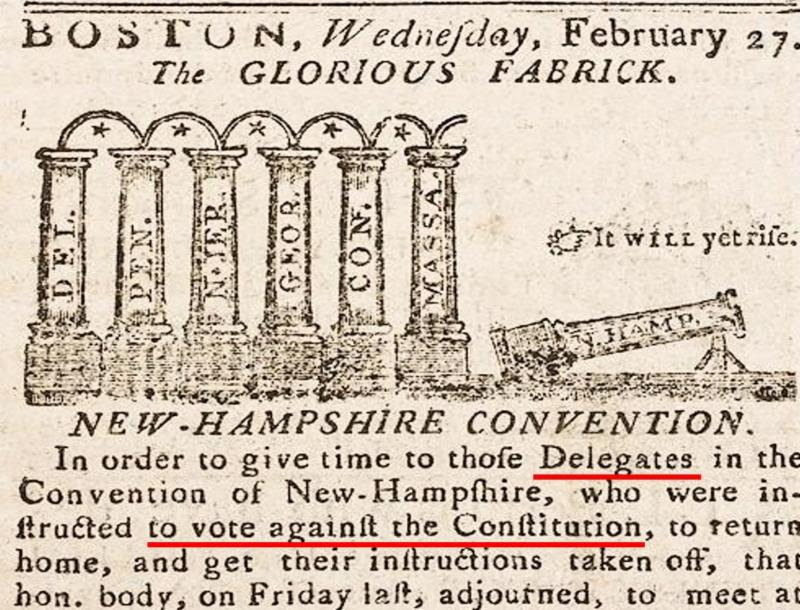
Many states had annual days of fasting.
Governor John Langdon decided to temporarily postpone the convention and schedule New Hampshire’s annual Fasting Day, a date fixed by the Governor, to be observed April 10, 1788:
“to be … kept as a day of fasting of humiliation and prayer.”

After the Day of Fasting, New Hampshire reconvened its ratifying convention on June 18, 1788.
After hearing Harvard President Rev. Samuel Langdon’s address “The Republic of the Israelites an example to the American States” the New Hampshire delegates voted to ratify the U.S. Constitution, June 21, 1788.

New Hampshire was the 9th State to ratify the U.S. Constitution. This fulfilled the necessary requirement of 2/3’s of the States, and thus the Constitution officially went into effect.

After ratifying the U.S. Constitution, the Delegates of New Hampshire thanked God:
“Acknowledging with grateful hearts the goodness of the Supreme Ruler of the Universe in affording the People of the United States in the Course of his Providence an Opportunity, deliberately & peaceably without fraud or surprise of entering into an explicit and solemn compact with each other
by assenting to & ratifying a new Constitution, in order to form a more perfect Union, establish justice, insure domestic tranquility, provide for the common defense, promote the general welfare and secure the Blessings of Liberty to themselves & their Posterity-

Do In the Name & behalf of the People of the State of New-Hampshire assent to & ratify the said Constitution for the United States of America …”
The Delegates of New Hampshire continued, recommending that the new Federal Government should be restricted:
“And as it is the Opinion of this Convention that certain amendments & alterations in the said Constitution would remove the fears & quiet the apprehensions of many of the good People of this State & more Effectually guard against an undue Administration of the Federal Government …
That all Powers not expressly & particularly Delegated by the aforesaid Constitution are reserved to the several States to be, by them Exercised …
That there shall be one Representative to every 30,000 persons …
Nor shall Congress in any Case make regulations contrary to a free and equal Representation …
That Congress do not lay direct Taxes …
That no standing Army shall be Kept up in time of Peace … nor shall Soldiers in Time of Peace be quartered upon private Houses without the consent-of the Owners …
Congress shall make no Laws touching Religion, or to infringe the rights of Conscience …
Congress shall never disarm any Citizen …”
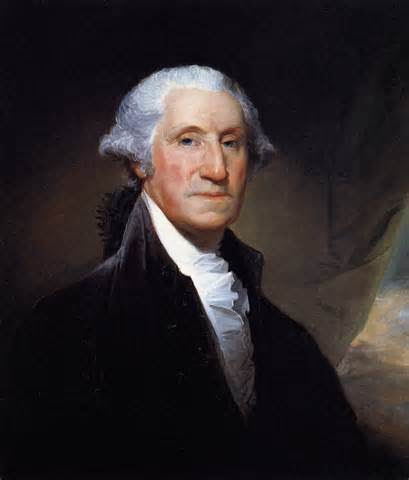
Governor John Langdon wrote to George Washington:
“I have the great pleasure of informing your Excellency that this State has this day adopted the Federal Constitution … thereby placing the Key Stone in the great arch.”

In 1788, John Langdon was elected New Hampshire’s first U.S. Senator where he traveled to the U.S. Capital in New York City.
The U.S. Senate elected him President of the Senate, where he counted the votes of the electoral college where George Washington was elected the first President.
Langdon wrote the letter informing George Washington that he had been elected.

On April 30, 1789, John Langdon administered the oath of office to the nation’s first Chief Executive, George Washington, and Vice-President John Adams.

Returning to New Hampshire, John Langdon was elected Governor, where he issued a Proclamation, October 10, 1805, acknowledging the nation’s victory over the Muslim Barbary Pirates of North Africa:
“It has been customary … to set apart a certain day … for … publicly recognizing their dependence upon Almighty God for protection,
and that they might express their gratitude to Him for all blessings and mercies received and implore a continuance of them;-
I therefore … appoint Thursday, the 28th day of November … as a day of public Thanksgiving and Prayer … in praising and adoring Almighty God, and in offering up our thanks to Him as the great author of every good and perfect gift …
For the termination of our contest with one of the African powers; the liberation of our fellow-citizens from bondage …”

Governor Langdon continued:
“But above all, for the inestimable blessings of the Gospel of Peace and Salvation, the means of grace and hopes of future glory, through the merits of a crucified Savior …
That He would bless the means used for the promulgation of His word, and make pure religion and morality more and more abound.”

In 1797, John Langdon helped save an escaped slave, Oney Judge, from being taken by slave-catchers.
Oney Judge learned to read and became a Christian.

Four years before the American Bible Society was founded, John Langdon founded the New Hampshire Bible Society in 1812, and served as its first President.
The Bible Society’s goal was to put a Bible in every New Hampshire home.

In retirement, John Langdon was visited in 1817 by President James Monroe, as the newspaper reported:
“While at Portsmouth, the President spent that part of the Sabbath which was not devoted to public divine service, with that eminent patriot and Christian, John Langdon.
His tarry … was probably longer than the time devoted to any individual in New England.”
John Langdon died September 18, 1819.
While Governor, John Langdon had issued a Proclamation, October 21, 1785:
“It therefore becomes our indispensable Duty, not only to acknowledge, in general with the rest of Mankind, our dependence on the Supreme Ruler of the Universe,
but as a People peculiarly favoured, to testify our Gratitude to the Author of all our Mercies, in the most solemn and public manner …
To celebrate the Praises of our divine Benefactor; to acknowledge our own Unworthiness, confess our manifold Transgressions, implore his Forgiveness,
and intreat the continuance of those Favours which he had been graciously pleaded to bestow upon us;
That he would … bless our Seminaries of Learning, and spread the Gospel of his Grace over all the Earth.”
—

American Minute posts brought to you by American Priorities 501(c)3.
American Minute is a registered trademark of William J. Federer. Permission granted to forward, reprint, or duplicate.
Help Needed for Camp Constitution’s Annual Family Camp Coming Up In Two Weeks

Our 18th Annual Camp starts in two weeks, and we have some families that need financial help. Please consider donating to their camp fees. Thanks to the generosity of our camp supports, we have never had to turn away any worthy families or campers for lack of funds. Our costs for the week are those 13 and older $300, and 12 and under $200. Please prayerfully consider donating to help give these people a potential life changing experience at our camp. Donations can be made via our PayPal account accessed from our website’s homepage www.campconstitution.net or by check payable to Camp Constitution and mailed to us at 146 Powder Mill Rd. Alton, NH 03809. And, we still have space available. If you plan to attend, please reach out by Thursday July 2 as we have to give Singing Hills a final count on Friday July 3rd. Here is info on the camp:
Camp Constitution 18th Annual Family Camp will be held at the Singing Hills Christian Camp https://www.singinghills.net/ Plainfield, NH. from Sunday July 12 to Friday July 17, 2026
Returning instructors include Pastor David Whitney of the Institute on the Constitution, Catherine White of The Constitution Decoded, Alex Newman, author and host of the Sentinel Report, Kurt Hyde, retired U.S. Air Force Lt, Col, and Rev. Steve Craft, Camp Constitution’s chaplain.

Guest instructors include Mrs. Julie Wilkinson who played in the movie “”UnPlanned: The Abby Johnson Story.” In addition to the classes, the camp will offer marksmanship courses, martial arts, hiking, basketball, volleyball, wiffleball, and optional field trip and swimming, chess, gaga and corn hole tournaments. Campers and staff end the day with an evening campfire.
Our theme: Celebrating our nation’s 250th Birthday
Camp Constitution’s annual camp is a family camp open to entire families, unaccompanied minors, and adults. The cost for the week which includes lodging, meals and class handouts is $300 for those 13 and over. $200. For campers 12 and under, and three and under with parents are free. A link to the camp registration: https://campconstitution.net/camp-registration/
For more information contact Hal Shurtleff (857) 498-1309 campconstitution1@gmail.com

American Minute with Bill Federer Supreme Court, 1892 – America a “Christian Nation”

|
|
|
|
|


|

|

|

|
|
|

|

|
|

|

|

|

|
|
|

|
|
|
|

|
|

|

|

|

|

|

|
|

|

|

|

|
|

|

|

|
Major League Baseball puts itself in bull’s-eye of new federal discrimination investigationby Bob Unruh World Net Daily

Confirmation comes after officials threaten players for writing a Bible verse reference on ‘Pride’-themed caps


Major League Baseball, like a lot of other leftist institutions and organizations, promotes the LGBT lifestyle choices adopted by a small minority of Americans.
Its teams create rainbow-themed jerseys or hats or whatever, and then demand that players wear them, to promote the team’s ideologies.
Some players have declined. In fact, a minor league team was forced to forfeit a game this week when the players simply rejected the gay-promoting jerseys.
Others, in the MLB, have adopted a different strategy. They wrote a Bible verse reference on the gay-promoting caps.
The reference was from Genesis where God describes how he uses the rainbow as a promise not to flood the earth again. And of course it addresses the “rainbow” used by the leftists.
The MLB threatened those players with punishment, and now is in hot water.
The Department of Justice has entered the fight brought by MLB against its Christian players.
The agency’s Civil Rights Division has referred the league to federal investigators over warnings issued to San Francisco Giants pitchers who wrote Bible verses on their “Pride Night” caps.
Among the players participating in a protest are Landen Roupp, JT Brubaker and Ryan Walker.
The MLB immediately warned that “further writing” could result in “discipline.”
Of course, the league previously promoted the Black Lives Matter agenda, and annually mandates the promotions for LGBT lifestyle choices.
Fox said, “In a June 18 letter to MLB Commissioner Rob Manfred, Assistant Attorney General for Civil Rights Harmeet Dhillon announced that her division had referred the matter to the Equal Employment Opportunity Commission (EEOC) ‘for further investigation.'”
The suspicion is that MLB violated Title VII of the Civil Rights Act.
“The Civil Rights Act prohibits MLB and its franchises from unreasonably burdening the rights of players with religious objections to serving as the League’s vehicle for pro-Pride messages,” said Dhillon.
She warned the league: “This double standard – under which players may not inscribe Bible verses on hats for one game only but may wear ‘Black Lives Matter’ patches for one game only — calls MLB’s true motives into question and raises serious concerns about MLB’s compliance with Title VII.”
MLB also has learned fans aren’t pleased.
The Texas Rangers don’t have a “Pride Night,” and Terry, a fan, said, “I’m so thankful that the Rangers are recognizing family, faith, and everything good about this country.”
Todd from Waxahachie, Texas, agreed with the players’ faith message and felt the league should be supporting free speech, Fox said.
“I think it’s about re-centering on what a rainbow means; It’s a promise from God that he would never flood the earth again,” he said. “So, I think that it also supports freedom of speech as well.”
“Everyone has their own belief system, their own faith system, whether it’s for Pride Month or for religious beliefs,” Emily from Rockwall, Texas, said. “And I think we all should be allowed to support what we believe in.”
Content created by the WND News Center is available for re-publication without charge to any eligible news publisher that can provide a large audience. For licensing opportunities of our original content, please contact licensing@wndnewscenter.org.
SUPPORT TRUTHFUL JOURNALISM. MAKE A DONATION TO THE NONPROFIT WND NEWS CENTER. THANK YOU!

(The above reposted with permission from World Net Daily
What the Constitution Means to Me By Sergei Stahl

(This essay was written by a student at the Freedom Project Academy-FPA. FreedomProject Academy | K-12 Online School. Live or self-paced classes.
For the second year in a row, FPA sponsored an essay contest with the winner and his or her family getting a free week at Camp Constitution’s annual family camp. This was the winning essay.)
Freedom Project Academy
Entering Grade 5
May 31, 2026
The Constitution means freedom. When people started living under the Constitution, they became to more free. The government can’t do whatever it wants. This is different from other countries. This is why people want to come to the United States from other countries. They want to be free.
The Constitution helps us serve the Lord. The Constitution says that the Congress can’t stop us from serving the Lord in the way that we want. This helps us become better people.
The government doesn’t have the power to take away rights. Our rights come from God, not from government. For example, we have the right to serve the Lord. Government doesn’t give us that right. It comes from God. So, it’s not right for the government to tell us how to do that.
The Constitution means we don’t have a king. A king controls everyone in his kingdom. A king can do whatever he wants. If you disagree with the king, he can kill you, or put you in jail without a trial. He can bomb countries. The Constitution gives us a president. The President can’t do whatever he wants. There’s a list of things he can do. That’s it. The President’ doesn’t have the right to go to war.
We have a responsibility to learn about the Constitution. We should learn about it so that we know what it says. If we don’t know what it says, we won’t know if someone is following it. If someone asks you to tell them about a book, and you’ve never read it, you won’t be able to tell them. It’s the same way with the Constitution.
The Constitution shows us that we can change our government. It has changes called amendments. When people found things that needed to be changed in the Constitution, they changed them. The first ten amendments are called the Bill of Rights. The first amendment says that the government can’t make you pay taxes to support any church.
Without the Constitution, government would be more powerful. We wouldn’t be able to say whatever we want. We could only go certain places. We would have to get permission from the government to go certain places. We would pay more taxes. We would have to work more to pay for our needs.
The Constitution means stability. Some countries have had over 20 constitutions. This means they are unstable. But we’ve had our Constitution for almost 240 years. It has only been changed twenty-seven times. So our country is much more stable.
Some countries don’t even have a written constitution. If it’s not written down, the people can’t read it. If the people can’t read their constitution, they don’t know what’s in it. If they don’t know what’s in it, the people can’t know if they government is doing what it’s supposed to do.
The Constitution limits the government. It won’t allow the government to freely bomb places. It even says that if the government wants to take your house, they have to pay you for it. If the government wants to search for things in your house, they can’t just do it without permission. They need to ask a judge to approve it and get permission to only search for certain things.
The Constitution doesn’t work unless we follow God. This is because it’s just words on paper. If we just do whatever we want, we won’t have a good world and the world would be wicked. And, we would have to have lots and lots of government to stop people from hurting each other. We would be less free.
I’m grateful for the Constitution. It helps us make sure that people don’t have too much power. When people have too much power, they do whatever they want, and they could tell everyone not to worship God. This is not a good thing.
If you read the Constitution, you’ll be more educated. You’ll learn how our government should work. You’ll also learn how our government should not work. You’ll also appreciate our Founding Fathers, and they will not be forgotten. You’ll also learn new words. You’ll learn what’s good and bad in government. You can learn about the people who signed the Constitution.
God helped with the Constitution. He helped people know how to put it together. He gave the people examples of things to write. He helped them learn from history. I hope we can all learn more about the Constitution.

The Weekly Sam: The Founding Fathers on Education and Morality

It is a pity that American children are not being taught more about the Founding
Fathers of America and what their vision of America was. Even when I was going to
public school back in the 1930’s and ’40’s, very little was taught about our Founding
Fathers concerning their religious and moral beliefs. We learned about George
Washington as a great soldier and a great leader, but virtually nothing about his
religious convictions. The same was true of all the other noted Founding Fathers:
Jefferson, Adams, Hancock, Franklin, Hamilton. They were great revolutionary leaders
who crafted the Declaration of Independence, fought a six-year war against Great
Britain, crafted the Articles of Confederation and then the Constitution which is the
basis of our political system. Surprisingly you can teach a great deal about all of that
with virtually no mention of religion.
In fact, we were taught more about the atheist Tom Paine than about any of the great
American religious and intellectual leaders, such as Jonathan Edwards, Timothy
Dwight, George Whitefield, Jotm Witherspoon, John Dickinson, George Mason,
Jonathan Mayhew, Nathanael Emmons, Jedidiah Morse, Noah Webster, and others.
Why was this the case? Because by the 1930’s the progressives had already made
sure that religion was removed from American public schools. Yet, in those days it was
still possible for a school principal to read a psalm from the Bible at assembly. Of
course, that is no longer the case. In fact, the schools have become so anti-Christian
that it is forbidden to even mention the word Christmas.
John Leo in U.S. News & World Report (Jan. 6, 97) wrote that in Fayette County,
Kentucky, school bus drivers were warned not to say Merry Christmas to any of the
children, and in West Orange, N.J. a student was reprimanded by the high school
dean for singing “God Rest Ye Merry, Gentlemen” on school property. And the
principal of Loudoun High School in Virginia told student editors to keep the
newspaper as secular as possible and “to be careful that they don’t associate the
upcoming holiday with any particular religion.” One wonders how they were supposed
to do that inasmuch as the upcoming holiday celebrated the birth of Jesus Christ! Talk
about censorship. I wonder what the ACLU or People for the American Way are going
to·do about that.
Some schools now only allow instrumental versions of traditional carols. The words
are too controversial and violate the sacred separation of church and state.
And that’s why the religious convictions of our founding fathers cannot be taught to
American children in our public schools. These poor children no doubt get the
impression — if they are taught at all about the founding fathers — that they were men
with no religious convictions at all and that religion simply did not exist as a vital
spiritual force in America when in reality it was the very force that made America
possible. If they are taught anything at all about religion in early America it is usually
about those mean, bigoted Puritans who hounded the poor witches of Salem.
And yet, what the Founding Fathers had to say about God is so inspiring that I wish
there were a way that American children could be made aware of this. It’s easy
enough for homeschoolers to get this knowledge. David Barton has written books
which deal with this subject, and an excellent book by William J. Federer, titled
America’s God and Country, Encyclopedia of Quotations, is filled with wonderful
quotations from Columbus to the present day, proving that Belief in God and doing
work to fulfill God’s promises is the most important theme in the entire American
enterprise. Christopher Columbus wrote in his Book of Prophecies:
It was the Lord who put into my mind (I could feel His hand upon me) the fact that it would be possible to
sail from here to the Indies … .
There was no question that the inspiration was from the Holy Spirit. because he comforted me with rays of
marvelous illumination from the Holy Scriptures . .. encouraging me continually to press forward. and
without ceasing for a moment they now encourage me to make haste.
In a letter written in 1493 to Spain’s General Treasurer Gabriel Sanchez, Columbus
wrote:
That which the unaided intellect of man could not compass, the spirit of God has granted to human
exertions, for God is wont to hear the prayers of His servants who love His precepts even to the
performance of apparent impossibilities. Therefore, let the king and queen, our princes and their most
happy kingdoms, and all the other provinces of Christendom , render thanks to our Lord and Saviour
Jesus Christ.
In June of 1630, ten years after the Pilgrims founded the Plymouth Colony, Gov. John
Winthrop landed in Massachusetts Bay with 700 people in 11 ships, thus beginning
the Great Migration, which lasted 16 years and saw more than 20,000 Puritans embark
for New England. In a sermon aboard the ship Arbella before disembarking on the
shores of New England, Winthrop said:
We are a Company, professing ourselves fellow members of Christ, and thus we ought to account
ourselves knit together by this bond of love .. ..
Thus stands the cause between God and us: we are entered into covenant with Him for this work. We
have taken out a Commission, the Lord hath given us leave to draw our own articles … .
We must hold a familiar commerce together in each other in–all meekness, gentleness, patience, and
liberality. We must delight in each other, make one another’s condition our own, rejoice together, mourn
together, labor and suffer together, always having before our eyes our Commission and Community in this
work, as members of the same body .. ..
We shall find that the God of Israel is among us, when ten of us shall be able to resist a thousand of our
enemies, when He shall make us a praise and glory, that men of succeeding plantations shall say, “The Lord
make it like that of New England.”
For we must Consider that we shall be as a City upon a Hill, the eyes of all people are upon us.
That’s the kind of religious fervor and covenantal love that permitted the Puritans to
create a Christian civilization in the wilderness of the new world. And from that
community came some of the most learned men of God that Christendom has ever
known. Harvard College was founded in 1636 for the purpose of training up a learned
clergy. And indeed it did. Increase Mather, who became President of Harvard, was
one of the first to criticize the British monarch, Charles II, for demanding in 1684 the
return of the charter which had given the colonists the right to govern themselves. He
wrote:
To submit and resign their charter would be inconsistent with the main end of their fathers’ coming to New
England.. .. [Although resistance would provoke] great sufferings, [it was] better to suffer than sin. Let
them trust in the God of their fathers, which is better than to put confidences in princes. And if they suffer,
because they dare not comply with the wills of men against the will of God, they suffer in a good cause.
Already you can see the seed of the War for Independence being planted in the soil of
New England.
Jonathan Edwards, the great theologian whose preaching began the revival known as
the Great Awakening, was the third President of Princeton University. Concerning the
Great Awakening, he wrote:
And then it was, in the latter part of December, that the Spirit of God began extraordinarily to … work
amongst us . . .. In every place, God brought His saving blessings with Him , and His Word, attended with
Spirit … returned not void.
George Whitefield, the famous dynamic evangelist of the Great Awakening, preached
up and down the Eastern seaboard of America. Benjamin Franklin wrote that he was
able to hear Whitefield’s voice nearly a mile away. Whitefield wrote:
Those who live godly in Christ, may not so much be said to live, as Christ to live in them … . They are led by
the Spirit as a child is led by the hand of its father ….
They hear, know, and obey his voice . … Being born again in God they habitually live to, and daily walk with
God.
Sarah Edwards, wife of Jonathan Edwards, wrote of Whitefield:
It is wonderful to see what a spell he casts over an audience by proclaiming the simplest truths of the Bible .
. Our mechanics shut up their shops, and the day laborers throw down their tools to go and hear him
preach , and few return unaffected . Franklin wrote:
It was wonderful to see the change soon made in the manners of our inhabitants. From being thoughtless
or indifferent about religion, it seemed as if ali the world were growing religious, so that one could not walk
thro ‘ the town in an evening without hearing psalms sung in different families of every street.
On matters of education, in 1750 Franklin wrote to Dr. Samuel Johnson, the first
president of King’s College (now Columbia University):
I think with you , that nothing is of more importance for the public weal, than to form and train up youth in
wisdom and virtue .. .. I think also, general virtue is more probably to be expected and obtained from the
education of youth, than from the exhortation of adult persons; bad habits and vices of tt’,e mind being,
like diseases of the body, more easily prevented than cured.
I think, moreover, that talents for the education of youth are the gift of God; and that he on whom they are
bestowed, whenever a way is opened for the use of them, is as strongly called as if heard a voice from
heaven.
Franklin wrote in his Autobiography this prayer that he prayed every day:
o powerful goodness! Bountiful Father l Merciful Guide l Increase in me that wisdom which discovers my
truest interest. Strengthen my resolution to perform what that wisdom dictates. Accept my kind offices to
thy other children as the only return in my power for thy continual favours to me.
Wouldn’t that be a wonderful nonsectarian prayer for school children to recite each
day? It is said that Franklin was a Deist. He had been brought up and educated as a
Presbyterian, but he rejected many of the doctrines of the Presbyterian faith. But he
writes in his Autobiography:
I never doubted , for instance, the existence of the Deity; that he made the world , and governed it by his
Providence; that the most acceptable service of God was the doing good to man; that our souls are
immortal; and that all crime will be punished, and virtue rewarded, either here or hereafter.
In July 1776, Franklin was appointed to a committee to draft a seal for the newly
formed United States. He proposed:
Moses lifting up his wand, and dividing the red sea,and pharaoh in his chariot overwhelmed with the
waters. This motto “Rebellion to tyrants is obedience to God”
In 1787 Franklin wrote in a letter:
Only a virtuous people are capable of freedom. As nations become corrupt and vicious, they have more
need of masters.
At the Constitutional Convention in 1787, Franklin, disturbed by the bitter debates
among the delegates, said in a speech to the convention:
I have live, Sir, a long time, and the longer I live, the more convincing proofs I see of this truth–that God
Governs in the affairs of men . .
We have been assured, Sir, in the Sacred Writings, that “except the Lord build the House, they labor in
vain that build it.” . .
I therefore beg leave to move–that henceforth prayers imploring the assistance of Heaven, and its
blessing on our deliberations, be held in this Assembly every morning before we proceed to business,
and that one or more of the clergy of this city be requested to officiate in that service.
It should be noted that prayers have opened both houses of Congress ever since.
It would take a full day to talk of the religious character of George Washington who was
so deeply conscious of his Christian faith. He believed that he was miraculously
saved from death after a battle in 1755. He wrote to his brother:
But by the all-powerful dispensations of Providence, I have been protected beyond all human probability
or expectation; for I had four bullets through my coat, and two horses shot under me, yet escaped unhurt,
although death was leveling my companions on every side of me’
As Commander-in-Chief of the Continental Army Washington often prayed and fasted,
invoking God’s protection and providence during the entire War of Independence. He
appointed chaplains for every regiment. In 1789, at his inauguration as the first
President of the United States, Washington said :
Such being the impressions under which I have, in obedience to the public summons, repaired to the
present station, it would be peculiarly improper to omit, in this first official act, my fervent supplications to
the Almighty Being who rules over the universe, who presides in the councils of nations and whose
providential aids can supply every human defect,
that his benediction may consecrate to the liberties and happiness of the people of the United States a
Government instituted by themselves for these essential purposes; .
No people can be bound to acknowledge and adore the Invisible Hand which conducts the affairs of men
more than the people of the United States.
Every step by which they have advanced to the character of an independent nation seems to have been
distinguished by some token of providential agency .
Washington’s inaugural address should be required reading in every American public
school. But, of course, all of Washington’s references to God would send the ACLU
and People for the American Way screaming to the Supreme Court that such an act
would be a violation of the separation of church and state. That’s how far we’ve come.
On Oct. 3, 1789, Washington issued a National Day of Thanksgiving Proclamation in
which he stated :
Whereas it is the duty of all nations to acknowledge the providence of Almighty God, to obey His will , to be
grateful for his benefits, and humbly to implore His protection and favor . .
Now, therefore, I do recommend and assign Thursday, the twenty-sixth day of l\Jovember next, to be
devoted by the people of these United States .. . . that we then may all unite unto him our sincere and
humble thanks for His kind care and protection of the people of this country previous to their becoming a
nation; for the Signal and manifold mercies and the favorable interpositions of His providence in thecourse
and conclusion of the late war;
for the great degree of tranquility, union, and plenty which we have since enloyed; for the peaceable and
rational manner in which we have been enabled to establish constitutions of government for our safety
and happiness, and particularly the national one now lately instituted; for the civil and religious liberty with
which we are blessed
The proclamation goes on for another long paragraph. But it is obvious where the
hearts of the American people turned to for their blessings. Today, our school children
think that the Pilgrims thanked the Indians on Thanksgiving Day. Our children are
being lied to by our educators, and I ask you, what good can come from such lies?
One merely has to read the prayers that Washington wrote in his own personal prayer
book to understand how deeply he was imbued with the Holy Spirit and how deeply
he relied on God for all matters of importance in his life. And it is this aspect of
Washington’s character that is rarely if ever referred to in history textbooks. Even so
great a man as Washington could fall to his knees and pray for forgiveness. In one
prayer, he wrote:
I have sinned and done very wickedly, be merciful to me, 0 God, and pardon me for Jesus Christ sake.
Thou gavest Thy Son to die for me; and has given me assurance of salvation, upon my repentence and
sincerely endeavoring to conform my life to His holy precepts and example
Praise God for such a man as George Washington, the father of our country. Isn’t it a
tragedy that American children are no longer taught about this tower of a man who
should be their hero. I remember when I was in first grade, there was a portrait of
George Washington in our classroom. That portrait looked down upon us children and
we revered him. It was the Stuart portrait, in which the bottom part was unfinished. But
to me it looked as if George Washington were in heaven.
Americans revered George Washington with good reason. But today he is just a figure
on a one dollar bill.

Another great American whose godly influence was felt by millions of children was
Noah Webster, whose blue-backed speller taught millions to read and spell. In 1828,
Webster completed his American Dictionary of the English Language. In this
dictionary are constant references to God and the Bible, for Webster was an orthodox
Christian. He stated:
Education is useless without the Bible.
God’s Word, contained in the Bible, has furnished all necessary rules to direct our conduct
He also wrote:
In my view, the Christian religion is the most important and one of the first things in which all children, under
a free government ought to be instructed . … No truth is more evident to my mind than that the Christian
religion must be the basis of any government intended to secure the rights and privileges of a free
people
great
This strong American adherance to Biblical religion impressed the French historian
Alexis de Tocqueville who traveled throughout America in the early 1830’s and wrote a
marvelous book about his observations. He wrote:
In the United States the sovereign authority is religious, . . there is no country in the world where the
Christian religion retains a greater influence over the souls of men than in America, and there can be no
greater proof of its utility andof its conformity to human nature than that its influence is powerfully felt over
the most enlightened and free nation of the earth.
America is great because America is good, and if America ever ceases to be good, America will cease to be
The safeguard of morality is religion, and morality is the best security of law as well as the surest pledge of
freedom .
The Amerians combine the notions of Christianity and of liberty so intimately in their minds, that it is
impossible to make them conceive the one without the other.
It is hard for us to believe that thirty years later this Christian nation would be torn
asunder and plunged into a civil war that took a half million American lives. Men
prayed to the same God on both sides of the conflict. In his second inaugural address
after the defeat of the Confederacy, Lincoln said:
The prayers of both [sides] could not be answered. That of neither has been answered fully. The
Almighty has His own purposes. “Woe unto the world because of offenses; for it must needs be that
offenses come, but woe to that man by whom the offense cometh.” .. .
And then Lincoln concluded with these famous words :
With malice toward none, with charity for all, with firmness in the right, as God gives us to see the right, let
us strive on to finish the work we are in, to bind up the nation’s wounds, to care for him who shall have
borne the battle, and for his widow, and his orphan–to do all which may achieve and cherish a just and
lasting peace among ourselves and with all nations.
Indeed, only Christian charity could restore the United States as one nation, under
God, with liberty and justice for all.
America’s Christian heritage is so rich, so powerful, so sustaining, that even President
Clinton felt compelled to end his second inaugural address, stating:
May God strengthen our hands for the good work ahead, and always, always bless our America.
(The above article was written in the mid 1990s, and comes from the Sam Blumenfeld Archive:
http://blumenfeld.campconstitution.net/main.htm
The Blumenfeld Archives