Camp Constitution Report for the Third Quarters of 2026

|


Co-Sponsoring 7th Annual Patriot Camp in Rockport, Maine
This event held in late June and hosted by the Memorial Baptist Church is the result of the efforts of Jessicas Whitworth and Victoria It is a free three day camp for children ages 5-12 where they learn about our nation’s history and have much fun while doing so. This year, we averaged 25 campers per day. On the last day, campers recited the Declaration of Independence in Downtown Rockland, and then it ended with a barbecue.

Info Tables at Homeschoolers of Maine’s and Mas HOPE’s Annual Convention
We have been attending these two homeschool shows since 2010, and they have proven to be very productive venues for us. For the first time since the Cod lockdown, the Homeschoolers of Maine returned to its Rockport venue with a three-day event for vendors. There were close to 400 attendees at the event. Victoria Buckland helped work the table giving Civics Savey tests to young people who visited the table. We donated numerous copies of “Alpha-Phonics” to young families. And we met a family of ten, and a family of three that will be attending our annual camp this year.
Mass Hope Homeschool Convention
This event is held in late April in historic Sturbridge. We spoke to dozens of homeschoolers and those planning to home school where we introduced the Sam Blumenfeld Archives and Sam’s “Alpha-Phonics. And we distributed pocket copies of the U.S. Constitution. As a result of our donation of a camp “tuition” to their silent auction, we got two new campers.
Information Tables at Other Venues
We had information tables at eight New Hampshire Education Options Fairs.

Ladies Annual “Spring Fling”
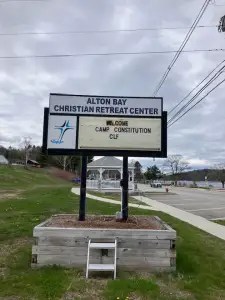
Our annual ladies retreat took place at the Alton Bay Christian Conference Center Alton, NH in early May. It was a full weekend of speakers including author Michelle Gallagher, crafts, devotions, and fellowship.
Keynote Speaker at Constitution Party of New Hampshire
Hal Shurtleff was the keynote speaker at the Constitution Party of New Hampshire’s state conference which took place on the birthday of George Washington. The topic: The Presidents of the United States and the Constitution
We also had seven speaking engagements in Aroostook County Maine in early April, and we spoke at a homeschool cooperative in Cornish, Maine.
YouTube and Rumble
We have experienced a large increase in views and subscribers in the last few months. We had 5,000 new subscribers and 480,000 views Our channel now has 22,300 subscribers and a total of 2.6 million all time views We uploaded 225 videos on our YouTube channel this year.
Our Rumble channel received 11,509 views and uploaded 57. All time views 175,504 with 390 followers
Camp Constitution Report Podcast
We did twelve shows including interviews of authors Dr. Chase Spears and Dr. Owen Andesron. Due to our show being listed by FeedSpot as one of the top 15 best Constitution based podcasts, we have received a number of invitations to interview authors and activists.
The Sam Blumefeld Archives:
728,500 views. All time views 4.5 million. We have been running promotional spots on WORD Rado-Christian Radio stations in Southern Maine, and New Hampshire

Podomatic
This is our platform for podcasts, our former radio show and historical recording that included the Dan Smoot Report, Sam Blumenfeld’s lectures and many speeches by Gary Allen.
We received 506 plays and 3606 downloads. Many of our audios and videos have been embedded on websites. We are now in the top five for the category of conservative/right.
Website
We received 23.4 thousand views and 17.9 thousand visitors. While the vast majority of the visitors are from the U.S., we had views from people in 83 countries. We had 115 articles posted on the site.
Camp Constitution Media
We uploaded sixty-three videos which included activities and classes at our annual camp, videos from the August 1 Pilgrims to Patriots event in Plymouth, including presentation by actor Kirk Cameron, MA, a Revolutionary War monument dedication in Wolfeboro, NH and interviews of the Gideons, a Tuttle Twins rep, a leader of a local chapter of Turning Point USA, and a professor of Revolutionary War histrry. we made a video of an Education Option Fair in Dover, NH. In early March, we attended the Rhode Island First Rally where we videotaped presentations by Ramona Bessinger, a public school teacher whistleblower, and Matt Light, former player for the New England Patriots.
Camp Constitution in the Media:
We were return guests on a number of radio shows, podcasts and Cable TV shows including several appearances on the Christ McCarthy Show, The Duke Pesta Show, The Sentinel Report with Alex Newman, and the Tamara Scott Show. First time media appearances included The Christian Homeschoolers of PA, Goffstown, NH Homeschoolers and The Principle Academy with Heather Hall podcasts.
While not exactly in the media, a few months ago, a friend called me to tell me that a question about our “Shurtleff v Boston” lawsuit appeared in the BAR exam that he just completed. And my daughter Emily told me that one of her roommates-a student at Liberty University told her that her law class spent tine discussing our case.
Camp Constitution Speaker’s Bureau:
Hal Shurtleff was the keynote speaker at the Constitution Party of New Hampshire’s state conference which took place on the birthday of George Washington. The topic: The Presidents of the United States and the Constitution
We also had eight speaking engagements in Aroostook County Maine in early April and August. We spoke at a homeschool cooperative in Cornish, Maine earlier this year.
On September 17, we hosted two speaking engagements for David Arthur, former “Transgender” at the Lane House in Lexington, MA
Facebook:
We had 9,246 views with 3.6 thousand followers.
Special Projects:
We had a busy information table at the Pilgrims to Patriots event on August 1. We co-hosted a 250th with the Alton Business Association in Alton Village July 3. Camp Director Hal Shurtleff was a guest “reenactor at a U.S. 250 event in Union, Maine in late September. In June, we had an info table at the Manchester Community College’s 250th Celebration. For the sixth year in a row, we had a float in the annual Alton, Nh Old Home Day Parade. We held our 7th annual Independence Day Barbecue at my home in Alton. In late August, we returned to the Crown of Maine Balloon Festival to man an info table.

We have been working with the Matrix Coalition; a New Hampshire group whose goal is to get copies of Guidebook to the Forefathers Monument and a framed poster of the monument into schools and libraries. So far this year, we donated copies of each to the Cornerstone Christian School in Ossipee and Prospect Mountain High School in Alton, NH.
We have been donating copies of James Perloff’s book Tornado in a Junkyard which refutes evolution to Christian youth groups.
We are preparing a room to use a in the church both to house the hard copy filed of the Sam Blumenfeld Archives but more importantly to start a literacy center using Sam’s “Alpha-Phonics.” Our plan is to have the room ready for reading classes in the fall.
We have donated approximately 500 books to a homeschool family in Maine that is opening a lending library.
We have partnered with WORD Radio, a Christian radio network in Maine and New Hampshire where they have been promoting our events and the Sam Blumenfeld Archives.
Van Fund Raising:
In late February, we had to scrap our 2019 Van. We had over 180,000 miles and it needed a new transmission and other repairs that would have cost us well over $7,000. We raised over $22,00 and in late April, we purchased a 2026 Toyota Sienna costing us approximately $41,000. Thank you to all those who donated.

Looking into the last quarter of 2026 and our 2027 annual family camp
We will be holding a ladies fall retreat in Alton, NH October 23-25, an info table at several events in October, and hosting our annual Thanksgiving and Christmas dinners at the Lane House in Lexington. Our 19th annual family camp will run from Sunday July 11-Friday July 16. Applications are being accepted.

How You Can Help
Pray for our Nation
Pray for Camp Constitution
Consider becoming a Camp sponsor for your business or like-minded non-profit.
Volunteer at some of our events.
Share our videos and blog articles everywhere.
Sponsor a camp speaker.
Thank you for all you do to make Camp Constitution possible.
Study: Kids who got COVID shots reporting surge in autism, ADHD, special ed needs, MUCH MORE

‘We analyzed official U.S. government data from 21,990 children and found a consistent association’


There’s a new study out, called “Neurodevelopmental Outcomes in COVID-19-Vaccinated Versus Unvaccinated U.S. Children: Analysis of the National Health Interview Survey, 2022–2024,” with very bad news for parents who followed the political agenda during COVID and had their children given shots.
Those children now are being seen with “various health conditions, including increases in autism, Attention-deficit/hyperactivity disorder (ADHD), neurodevelopmental disorders, special education needs, asthma, anxiety,” and more, according to a report at the Gateway Pundit, which spoke with one of the authors, Nicolas Hulscher.
He said, “We analyzed official U.S. government data from 21,990 children and found a consistent association between childhood COVID-19 vaccination and higher odds of autism ADHD, anxiety, special-education use, and mental health treatment.”
The shots delivered, often on the orders of government and corporate political players, for individuals during that time frame actually are more like DNA treatment or therapy than “vaccinations.”
There have been confirmed waves of heart trouble in young men, and more, from the shots. Many of the side effects have proven fatal.
The report said data was sourced from the National Health Interview Survey, a leading provider of health information for the U.S. civilian population.
The report explained, “Specifically, the Epidemiologist and Foundation Administrator at the McCullough Foundation said the findings revealed a 32 percent increase in autism diagnoses, a 33 percent rise in ADHD cases, and a 23 percent uptick in any neurodevelopmental disorders.
“Furthermore, there was a 19 percent increase in the use of special education services, a 24 percent rise in asthma cases, and a 27 percent increase in anxiety disorders among vaccinated children. The study also indicated a 57 percent increase in the use of mental health medications and a 60 percent rise in the need for mental health therapy.”
Hulscher told the Pundit, “The autism association persisted across numerous adjustment strategies, strengthened with increasing dose count, and reached its largest estimate in some of the youngest multiply vaccinated children. Among ages five to seven, three or more COVID shots were associated with 154 percent higher adjusted odds of current autism.”
He warned against ignoring such a “safety signal.”
“Endangering the developing brain is a red line. COVID-19 ‘vaccination’ of children should cease immediately,” he said.
The study said, “In a direct comparison of COVID-19-vaccinated with unvaccinated children in a nationally representative U.S. sample, COVID-19 vaccination was associated with higher adjusted odds of autism, ADHD, anxiety, special-education use, and mental-health treatment. The autism association persisted across every adjustment tier; was unchanged under propensity-score balancing that removed all measured covariate imbalance and nullified the acute-care negative controls; was robust to restriction to physically healthy children; increased monotonically with dose count; was largest in the youngest exposed cohorts, including children vaccinated before the school-entry diagnostic window; and exceeded that of influenza vaccination in direct comparison. These properties satisfy the strength, consistency, biological gradient, plausibility, and coherence considerations for causal inference, and no measured confounder explains them. Because the cross-sectional design cannot order exposure and diagnosis, a global scheduled combination childhood vaccine effect on neurodevelopment cannot be evaluated. A linked birth-cohort study of toddlers before age 3 capturing co-administered vaccines, incident diagnoses, and pre-specified negative controls would be the next step in evaluating this concerning association.”
The Pundit’s own warning was, “As parents and healthcare providers weigh the benefits and risks of vaccination, it is essential to approach this data with concern and a commitment to prioritizing the well-being of the nation’s youth. Ensuring the safety and well-being of children should remain the top priority, prompting immediate reassessment of vaccination strategies and policies to safeguard their developmental health.”
The use of the COVID treatments also have triggered multiple legal disputes, including in which the state of Florida is suing a manufacturer for deceptive practices:
Content created by the WND News Center is available for re-publication without charge to any eligible news publisher that can provide a large audience. For licensing opportunities of our original content, please contact licensing@wndnewscenter.org.SUPPORT TRUTHFUL JOURNALISM. MAKE A DONATION TO THE NONPROFIT WND NEWS CENTER. THANK YO
(Reposted with permission from World Net Daily
Happy Birthday U.S. Constitution

September 17 marks the 239 anniversary of the U.S. Constitution. After its approval by the delegates of the Constitutional Convention, the Constitution was sent to the 13 states for ratification; 3/4ths of the states were needed for ratification. Delaware was the first state to ratify it on December 7, 1787, with all its 30 delegates at its state ratifying convention approving it, and on June 21, 1788, New Hampshire became the ninth state to ratify the Constitution making it the law of the land.
Background to the Convention:
The United States became an independent nation on July 4, 1776. The Continental Congress approved of the Articles of Confederation and Perpetual Union-our nation’s first constitution. It was ratified by the states in March of 1781. The Articles of Confederation had many weaknesses which included:
It had no means to enforce its laws
It was authorized to conduct foreign policy including making treaties conduct war, receive, and send ambassadors but it had no way of enforcing any of it actions
States could impose its own tariffs.
It did not have a steady stream of revenue and could not pay down its debts or pay its bills.
Congress rarely had a quorum, and any changes in the Articles needed all states to concur.

A number of people realized that the Articles was defective. An early attempt to address the issue took place at the Annapolis Convention held in September 1786. Delegates from five states attended which wasn’t enough for a quorum. However, the delegates proposed that a full convention be held. Congress asked the states to send delegates to a convention in Philadelphia. Twelve states agreed to send delegates to Philadelphian. On May 25, the Constitutional Convention began.
The delegates were made up of the most qualified America had to offer. All together there were 55 delegates that participated in the convention. They included George Washington, the “Indispensable Man” who served as of the president of the convention, Benjamin Franklin, James Madison, who became known as the “Father of the Constitution,” Roger Sherman, Edmund Randolph, and George Mason.

There was much debate and compromise between states with large populations vs. states with small populations including how the chief executive was to be chosen, how the senate would be chosen, and counting slaves in the census. Today, there are many that believe that the delegates considered blacks to be less that human, hence counting five blacks as three men. States with large slave populations wanted to count slaves as full people which would have given slave states more members in the House of Representatives. Free states and states with small slave populations objected which resulted in the 3/5ths compromise which was repealed when the 14th Amendment was passed.
There were times when the convention almost dissolved, but by mid-September the debates were over and on September 17th, 39 delegates signed the constitution. The Constitution was sent to the 13 states for ratification in which 3/4ths of the states were needed for ratification. Delaware was the first state to ratify it on December 7, 1787, with all its 30 delegates at its state ratifying convention approving it. and on June 21, 1788, New Hampshire became the ninth state to ratify the Constitution making it the law of the land.
Comments on the U.S. Constitution:
“The Adoption of the Constitution will demonstrate as visibly the finger of Providence as any possible event in the course of human affairs can ever designate it.” George Washington
“I regard it [the Constitution] as the work of the purest patriots and wisest statemen that ever existed, aided by the smiles oof a benignant Providence…It almost appears as a Divine interposition in our behalf.” Daniel Webster
“Our Constitution was made only for a moral and religious people. It is wholly inadequate to the government of any other.” John Adams
Recommended reading: Miracle at Philadelphia: The Story of the Constitutional Convention by Catherine Drinker Bowen.

A Worthy Company by M. E. Bradford

The Weekly Sam: What’s Wrong With Government Education? by Samuel L. Blumenfeld

The enormous failure of our government school system was nicely
summed up by a Boston high school teacher in a recent issue of Education
Week (12/9/98). He said:
“I have about 30 kids in my U.S. history class. They come from nine
different countries; most of them can’t read. Even if they can read the text,
they don’t know what it means. How am I supposed to teach U.S. history to
kids who can’t read? I could come in here every day for 20 years and still
not figure out how to do it.”
Obviously, this particular teacher had no idea how these kids got into
high school without knowing how to read. He had no idea what goes on in
primary school that prevents these children from learning to read, and he
had no idea what to do with older students who are functionally illiterate.
Clearly, the teacher himself is part of the problem. His ignorance of how the
system functions prevents him from helping his students get through it in
one piece. In other words, the compartmentalization of teachers explains
why so many of them have no idea of how the total system works and why
the system can lurch from crisis to crisis without any effective change taking
place.
The real blame for the system’s dysfunction, however, must lie with the
professors of education, the state departments of education, and the
administrators who have all conspired to create the functional illiteracy that
plagues the public schools of America — once considered the most literate
and advanced nation on earth. Deliberately induced illiteracy among
students is a vital part of the plan to dumb down Americans so that they will
be unable to resist the imposition of social and political control by an
arrogant universitarian elite determined to create a new world order based
on humanist-socialist values.
This “education” plan is part of the utopian socialist agenda set down
by the progressives at the turn of the century. The progressives were
members of the Protestant academic elite who no longer believed in the
religion of their fathers. They put their new faith in science, evolution, and
psychology. Science explained the material world (matter in motion),
evolution explained the origin of life (organisms crawling out of the
primordial ooze), and psychology explained human nature and provided
the elite with the scientific means of controlling human behavior.
These men were also socialists. Why? Because they had to deal with
the problem of evil. The Bible tells us that evil is the result of man’s innate
depravity, his innate sinful nature. But since the progressives did not
believe in the Bible, they decided that evil was caused by ignorance,
poverty, and social injustice. And what was the cause of social injustice?
Why, it was this horrible capitalist system with all of its inequities. Socialism,
it was believed, would remove these inequities and thereby solve the
problem of evil. By the way, the progressives did not get their model of
socialism from Karl Marx. They got it from an American by the name of
Edward Bellamy whose book, Looking Backward, published in 1888,
projected the fantasy of a socialist America in the year 2000.
And so, the progressives, dedicated to their utopian ideal, decided to
do all in their power to change America from an individualistic, capitalist,
and religious society into a socialist, collectivist, humanist or atheist society.
How were they to accomplish that? Through the education system. They
would change the curriculum and teaching methods in the public schools so
that American children would emerge as young socialists willing to change
our way of life into a socialist one.
The socialists realized that the transformation might take as much as a
hundred years to complete. In fact, John Dewey wrote in 1898: “Change
must come gradua.lly. To force it unduly would compromise its final success
by favoring a violent reaction .” Dewey then outlined the long-range strategy
which the progressives were to adopt:
What is needed in the first place is that there should be a full and frank statement
of conviction with regard to the matter from physiologists and psychologists and from
those school administrators who are conscious of the evils of the present regime.
Educators should also frankly face the fact that the New Education, as it exists today, is
a compromise and a transition: it employs new methods but its controlling ideals are
virtually of the Old Education. Wherever movements looking to a solution of the
problem are intelligently undertaken, they should receive encouragement, moral and
financial, from the intellectual leaders of the community.
There are already in existence a considerable number of educational “experiment stations,” which
represent the outposts of educational progress. If these schools can be adequately
supported for a number of years they will perform a great vicarious service. After such
schools have worked out carefully and definitely the subject-matter of the new
curriculum,–finding the right place for language-studies and placing them in their right
perspective,–the problem of the more general educational reform will be immensely
simplified.
One hundred years later we can see how successful the Dewey plan
has been in transforming our educational system into one that serves the
needs of the atheist socialist state. Dewey was aided and abetted by a
cadre of reformers that included such luminaries as Edward L. Thorndike,
James McKeen Cattell, Elwood P. Cubberly, George D. Strayer, Charles
Judd, James R. Angell and a host of others. Thorndike, Cattell, and Strayer
ra~ an educational mafia out of Teachers College (Columbia), Cubberly
reigned at Stanford, and Angell became president at Yale.
Change in the curriculum of public education has happened so
gradually that most parents haven’t the faintest idea what is happening to
their children, four million of whom are being drugged daily with Ritalin so
that they can sit in their classroom seats and be socialized without
resistance.
What is truly amazing is the coherence and continuity of the
progressive agenda which is as much alive today at it was when Dewey and
company were pontificating. For example, The Whole Language Catalog, a
sort of bible of the whole-language movement published in 1991, has 15
entries for John Dewey in its index. After citing his debt to Dewey, Kenneth
Goodman, the leading guru of whole-language philosophy, writes:
Whole language picks up where the progressives left off . … [It] takes the
philosophy and positive, child-centered view of the progressive educators and adds
the knowledge of language, of learning, of child development, and of teaching, and
builds a strong scientific base under them . It is this combination of science and
humanistic educational and social philosophy that forms the foundation for whole
language curriculum . … We use the psychological concepts of Piaget and Vygotsky to
underscore Dewey’s concept of learning as transaction: pupils making sense of their
world and being changed themselves in the transactions. (p. 281)
In the early days, the progressives were mainly supported by the major
philanthropic foundations. Today the reforms are being underwritten by
federal and state governments. Three recent federal programs are funding
the massive restructuring of American education in accordance with the
progressives’ plans: Goals 2000 (enacted 3/31/94), School-to-Work
Opportunities Act (enacted 5/4/94), and the Improving America’s Schools
Act, a reauthorization of the Elementary and Secondary Education Act of
1965 (enacted 10/20/94). Thus, the Congress of the United States has
become an accomplice in the progressive plan to restructure American
education in the socialist mold.
Apart from needing the funds to carry out their plan, the progressives
also realized that coherence and continuity of their agenda over a hundred
years was vitally necessary if the plan was to be successful. Thus, in 1901
they created the National Society for the Study of Education, wherein the
progressive leaders would be able to formulate their programs of reform,
debate their effectiveness, and pass on the baton to their loyal disciples. By
studying their yearbooks, the first of which was published in 1902, one can
follow the inexorable progress of the socialist takeover of American
education.
All of this was accomplished by tenured professors of education and
behavioral psychologists, working within a maze of well funded professional
organizations, publishing journals, writing textbooks, holding hundreds of
conferences, seminars, and conventions each year. None of this has been
visible to the average parent who puts a child in a public school. Parents
assume that their schools are run by local school boards, superintendents,
principals, and teachers. What they don’t see is the invisible hand behind
this constant pressure for reform that keeps recreating the curriculum .
The average teacher may feel that there is some kind of invisible hand
at work, but teachers would rather blame failure on cultural trends,
excessive television viewing, dysfunctional parents, and such student
disabilities as attention deficit disorder and dyslexia.
Obviously, this is a system of education that cannot be supported by
any Christian. Local control no longer exists. It was inevitable that a
government education system would become a federal system controlled
by those who have been leading us toward totalitarian socialism. Do I
exaggerate? To be convinced that the end goal is a totalitarian system, all
one has to do is read the Student Data Handbook for Early Childhood,
Elementary, and Secondary Education (NCES 94-303). This is the official
guidebook for the computerized data-gathering system dreamed up by our
totalitarian bureaucrats.
The data will include massive information on
health, family, religion, attitudes, psychological assessments, etc. For
example, the attitudinal test is described as: “An assessment to measure
the mental and emotional set or patterns of likes and dislikes or opinions
held by a student or a group of students. This is often used in relation to
considerations such as controversial issues or personal adjustments.”
All of this sensitive, personal data will be housed in a central computer
in Washington making it easy for “educators” to control just about everyone.
But the question is simply this: does the government of a free people have
the right to collect this kind of information on all of its citizens for its own
political or social purposes? Should the government of a free people record
the attitudes and opinions of its citizens so that it can engineer thei r
personal adjustment?
The time has come for Christians to realize what has become of the
“land of the free and the home of the brave.” If Christians want to restore
the full measure of our freedoms, they will have to do what they are
reluctant to do: remove their children en masse from the public schools.
What is needed now is not accommodation to the plans of the American
Pharoah but a full-fledged exodus of Christian children. That’s the easiest
and most peaceful way to put an end to the socialist agenda and return
America to its basic constitutional principles. Will Christians have the
courage to do what must be done? That test will be upon us sooner than
anyone anticipated.
(The above was written in 1999 and it part of the Sam Blumenfeld Archives:
http://blumenfeld.campconstitution.net/main.htm

American Minute with Bill Federer LABOR DAY: Railroad Strikes, Grover Cleveland, Eugene Debs, Socialist Party of America, Outsourcing

|
|
|
|
|


|

|
|

|

|

|

|

|

|

|
|
|

|
|

|

|

|

|
|

|
|
The Weekly Sam: Make America Literate Again. Help Distribute “Alpha-Phonics”

Welcome to the “Alpha-Phonics workbook by Samuel L. Blumenfeld.
This book has been used by thousands of parents who have taught their
children to be excellent readers, which includes my children.

It is arranged in 128 easy to follow lessons. Sam rightfully pointed out that
pictures of puppets popping out of trash cans are not needed to teach children
how to read.
This book may also be used for adults who have been taught the
whole word or look-say method and therefore are functionally illiterate.
While this is a free resource, we would like to be able to make this resource
known far and wide. A donation of $5.00 would go a long way, and you can
donate more to help our cause, too.
Go to https://campconstitution.net/product/alpha-phonics-workbook
acquire it.
to
Additional donations to the Camp can be made via your PayPal account
accessed from our website’s homepage: https://www.campconstitution.net
Hal Shurtleff, Director
Camp Constitution

Camp Constitution’s Fall “Fling” Retreat at the Alton Bay Christian Conference Center Friday October 23 to Sunday October 25, 2026

Camp Constitution’s Fall “Fling” Retreat at the Alton Bay Christian Conference Center Friday October 23 to Sunday October 25, 2026
Activities include arts and crafts, Bible studies, optional marksmanship, an evening campfire, and fellowship.
The cost for the weekend which includes two nights of lodging, five meals and materials will be $220. per person.
For More Information and/or an application call (857) 498-1309 or E-mail campconstitution1@gmail.com

The Weekly Sam: Defining Whole Language By Samuel Blumenfeld

The other day, I received an e-mail from a lady in California who asked, “What on earth
is the whole-language system?” She had read my article on the making of the black
underclass http://blumenfeld.campconstitution.net/1987/BEL%2002-06%20198706.pdf
in which I had identified whole language as the primary cause of reading
failure among so many black students.
Fortunately, the answer is easy to give, because whole-language professors have been
quite open in defining what they mean by their pedagogic philosophy. So I shall quote
some salient passages from their writings.
In a book entitled “Whole Language, What’s the Difference?” written by three
whole-language professors in 1991, we read on page 32:
Whole language represents a major shift in thinking about the reading process.
Rather than viewing reading as “getting the words,” whole language educators
view reading as essentially a process of creating meanings … Meaning is created
through a transaction with whole, meaningful texts (i.e., texts of any length that
were written with the intent to communicate meaning).
It is a transaction, not an extraction of the meaning from the print, in the sense that
the reader-created meanings are a fusion of what the reader brings and what the
text offers … Although students who learn to read in whole language classrooms
are, like all proficient readers, eventually able to “read” (or identify) a large
inventory of words, learning words is certainly not the goal of whole language.
Another passage from page 19 of the same book may be even more illuminating:
From a whole-language perspective, reading (and language use in general) is a
process of generating hypotheses in a meaning-making transaction in a
sociohistorical context. As a transactional process … reading is not a matter of
“getting the meaning” from text, as if that meaning were in the text waiting to be
decoded by the reader.
Rather, reading is a matter of readers using the cues print provides and the
knowledge they bring with them (of language subsystems, of the world) to
construct a unique interpretation.
Moreover, that interpretation is situated: readers’ creations (not retrievals) of
meaning with text vary, depending on their purposes of reading and the
expectations of others in the reading event. This view of reading implies that there
is no single “correct” meaning for a given text, only plausible meanings.
Now you might think that all of this pedagogical insanity is taking place in some kind of
political vacuum. Nothing could be farther from the truth. Whole language practice is
very politically oriented. We read on page 23:
Learning is a social process … Although whole language educators accept the
importance of learning through individual interactions with the environment
(Piaget 1967), they lean more heavily on Vygotsky’s ideas about the social nature
of learning (Vygotsky 1978).
Whole language takes seriously Vygotsky’s notion of the Zone of Proximal
Development (Engstrom 1986) which entails stressing the importance of
collaborations (between students and teachers and between peers) through which
students can transcend their own individual limitations.
You might ask: Who is Vygotsky? Vygotsky (1896-1934) was a Soviet psychologist who
worked with Pavlov’s colleagues at the State Institute of Experimental Psychology in
Moscow in the 1920s and ’30s. James Wertsch, Vygotsky’s biographer, writes:
[It] is important to note that Vygotsky was a staunch advocate of dialectical and
historical materialism. He was one of the creators of Marxist psychology …
People such as Vygotsky and his followers devoted every hour of their lives to
making certain that the new socialist state, the first grand experiment based on
Marxist-Leninist principles, would survive.
Vygotsky’s colleague, Alexander Luria, wrote: “Vygotsky was … the leading Marxist
theoretician among us … in [his] hands, Marx’s methods of analysis did serve a vital role
in shaping our course.”
Apparently, these same methods of analysis are also serving to shape the course of the
whole-language agenda. The three professors, cited earlier, state on page 67:
The whole language theoretical premise underlying which topics are pursued and
how they are treated is: “All knowledge is socially constructed.”
Therefore all knowing is political. In an effort to promote critical literacy and thus
to help children learn to read the world, not only the word (Shor & [Marxist
revolutionary] Freire 1987), teachers who work with theme cycles try – no matter
whether the topic is overtly “political” or not – to show how the topic is related to
other more general questions.
They try to demystify social institutions by helping children investigate
connections between surface facts and underlying social structures, between lived
experience and structural features of class, gender and race. They know that not
making connections is as political as making connections.
No further explanation needed. But what about phonics, you might ask? Here’s a view of
phonics given in another book on whole language, “Evaluation: Whole Language, Whole
Child.” We read on page 19:
The way you interpret what the child does will reflect what you understand
reading to be. For instance, if she reads the word feather for father, a
phonics-oriented teacher might be pleased because she’s come close to sounding
the word out.
However, if you believe reading is a meaning-seeking process, you may be
concerned that she’s overly dependent on phonics at the expense of meaning.
You’d be happier with a miscue such as daddy, even though it doesn’t look or
sound anything like the word in the text. At least the meaning would be intact.
My response to that kind of imbecilic pedagogy is that any child who looks at the word
“father” and says “daddy” can’t read. It’s as simple as that. But tell that to a
whole-language teacher. Meanwhile, we the taxpayers are paying for it all.
(The above is from the Sam Blumenfeld Archives
http://blumenfeld.campconstitution.net/main.htm

The Blumenfeld Archives
Pilgrims to Patriots: A Celebration and Rededication to the Forefathers Monument

A delegation from Camp Constitution were honored to attend the Pilgrims to Patriots celebration and rededication of the Forefathers Monument last Saturday August 1, 2026. This daylong event took place in ‘America’s Hometown”-Plymouth, MA. Our well-staffed information table was busy with attendees from all over the United States stopping by to pick up T-shirts, books, pocket copies of the U.S. Constitution and get their pictures taken holding our Brown Bess firing replica musket.

The program stared at 10:00 AM at the Pilgrim Memorial Park-the original site of Plymouth Plantation with the Massachusetts 1775 Colonial Navy Fife and Drum from Fall River presenting their colors, and an opening prayer offered by Pastor Matthew Dembinsky. The event had an excellent line up of speakers which included Leo and Nancy Martin of the Jenney Museum, https://thejenney.org/ Bill Federer of the American Minute, Dr. Jerry Newcombe of Coral Ridge Ministries, Tim and David Martin of WallBuilders, and actor and author Kirk Cameron who produced the documentary “Monumental.” The Pilgrims to Patriots Band performed between the speakers which included a rendition of “My Country Tis of Thee.”

After an afternoon break, the group reconvened at the nearby Forefather’s Monument where the monument was rededicated. Nancy Martin read the original dedication which took place on August 1, 1889 and Kirk Cameron gave an historical and spiritual overview as well as his personal connection to the Monument which inspired the creation of his documentary.

At 6:00 PM, we participated in a sold-out testimonial dinner for Leo and Nancy Martin and a fund raiser for the Jenney Museum at the 1620 Hotel in Plymouth. (Readers who would like to donate to the Jenney: https://www.networkforgood.org/donation/MakeDonation.aspx?ORGID2=900133398&vlrStratCode=9wKJQGl1rasPHo7YmGMedYfKNEvpeEocIQHRRM0CdWr%2fy%2fEA375LpFfLe%2fqTi8%2bf
Thanks to Maura Shurteff, Penny Stevens, Kathy Mickel, Bonnie Manchester, Jessica and Willow Whitworth, Rev. Steve and Edith Craft for helping out at the info table or with videotaping, and a special thanks to Roberta Stewart
Chappaquiddick Cover Up: An Interview of Diver John Farrar: July 18, 1969 Marks the Death of Mary Jo Kopechne at Chappaquiddick

Today, marks the anniversary of the drowning of Mary Jo Kopechne. This is an interview of the diver who recovered her body and explains the cover up by Ted Kennedy’s handlers.
The interview was conducted by Mayor Sam Yorty on KGBS Radio in Los Angeles 1972.