No, Paris, US air conditioners did not cause Europe’s heat wave


|
Happy 250th Birthday United States
Happy 250th Birthday United States.
Campers from the Annual Patriot Camp-a Three-Day Annual Day Camp Held in Rockland Maine and co-sponsored by Life Church and Camp Constitution and hosted by the Litchfield Memorial Baptist Church- recite the Declaration of Independence at Chapman Park in Rockland, Maine Wednesday June 24, 2026.
Camp Constitution’s 18th Annual Family Camp Schedules are now available

Camp Constitution’s general schedule and its schedules for its junior campers are now posted on our website:
https://campconstitution.net/wp-content/uploads/2026/06/Camp-Constitution-Schedule-2026.pdf


John Langdon: A Courageous Founding Father – American Minute with Bill Federer


John Langdon was born in Portsmouth, New Hampshire, in 1741 and grew up as a member of the North Congregational Church, where his distant relative, future Harvard President Rev. Samuel Langdon was pastor from 1747-1774.


Other notable individuals who had worshiped at the North Congregational Church include:
-William Whipple – Signer of Declaration of Independence;
-Daniel Webster – Secretary of State;
-John Paul Jones – Navy hero; and
-George Washington – first President.

At the age of 22, John Langdon became a sea captain, like his older brother Woodbury Langdon.
They sailed back and forth to the West Indies for trade.

Then the British imposed trade restrictions with the Revenue Act of 1764 and the Stamp Act of 1765.

John Langdon sailed back into Portsmouth harbor, the British seized his cargo of sugar and rum, similar to how the British in Boston’s harbor seized John Hancock’s ship Liberty.

By this time, tea from India and China was the most popular drink in the British Empire, out-selling coffee and chocolate, as tea was purported to have health benefits.

Portugal was the first European country to trade in India, till it was pushed out by the Dutch and French, who were then pushed out by the British.
After the Anglo-Mughal Wars, Anglo-Dutch Wars, and the Carnatic War, the British East India Company began to dominate Bengal and most of India.

The Bengal Famine of 1770 killed an estimated 10 million people – a third of Bengal’s population. This brought the British East India Company to the verge of bankruptcy.
Company expenses skyrocketed while Bengal’s labor productivity plummeted, all occurring at a time when an economic downturn dried up trade in Europe.

To avoid bankruptcy, the directors of the British East India Company appealed to Parliament, which responded by giving it a competitive advantage over colonial American tea importers.

The British East India Company also began to grow opium in India and drug-traffick it into China.

American colonists boycotted British tea and instead bought 85 percent of their tea from supplies smuggled in by Dutch merchants, estimated at 900,000 lbs a year.
The Townsend Acts of 1767 bailed out the debt-ridden British East India Company by allowing it to sell its tea directly to consumers at a cheaper price, but even more troublesome, it would legitimize Britain’s ability to directly tax the colonies.
This was a hotly contested issue since the colonies had no representation in the British Parliament.

To compound the issue even further, the British Parliament passed the Tea Act of 1773 , which provoked the Boston Tea Party, December 16, 1773.
It also provoked the Annapolis Tea Party and the burning of the ship Peggy Stewart.
New Hampshire citizens refused to allow any British ship carrying tea from landing in the Portsmouth harbor.

King George III then issued a royal order, October 19, 1774, banning the export of gunpowder and arms to America.

When word reached Portsmouth, John Langdon led 400 men to capture British Fort William and Mary in New Castle, seizing arms and 100 barrels of gunpowder.

In 1775, John Langdon was elected a delegate to the Continental Congress, as was later his brother, Woodbury Langdon.

In 1776, John Langdon oversaw the building of American warships, including the Ranger, which he recommended be captained by John Paul Jones.

John Langdon was elected Speaker of the New Hampshire House, 1776-1782, where he championed fiscal responsibility, recommending the use of silver and gold instead of paper currency.

When the British recaptured Fort Ticonderoga, Speaker John Langdon reportedly told the Legislature:
“I have 3,000 dollars in hard money. I will pledge the plate in my house for 3,000 more, and I have 70 hogsheads of Tobago rum which shall be disposed of for what it will bring.
These and the avails of these are at the service of the state. If we defend our homes and our firesides, I may get my pay; if we do not defend them, the property will be of no value to me.”

John Langdon built seven ships with which he raided British ships.

As a colonel, John Langdon led a voluntary company of soldiers to fight at Saratoga where they witnessed the surrender of British General Burgoyne.
John Langdon commanded soldiers in 1778 with John Sullivan’s army in Rhode Island.

In 1784, John Langdon was a State Senator, and in 1785 he was elected President (Governor) of New Hampshire.
As President of New Hampshire, John Langdon issued A Proclamation for a Day of Public Fasting and Prayer. February 21, 1786:
“That the citizens of this State may with one heart and voice, penitently confess their manifold sins and transgressions, and fervently implore the Divine benediction,
that a true spirit of repentance and humiliation may be poured out upon all orders and degrees of men, and a compleat and universal reformation take place …
that He would be pleased to bless the great Council of the United States of America, and direct their deliberations to the wise and best determinations …
and above all, that He would rain down righteousness upon the earth, revive religion,
and spread abroad the knowledge of the true GOD, the Saviour of man, throughout the world.”

In 1787, John Langdon was a delegate to the Constitutional Convention in Philadelphia where he signed the U.S. Constitution.
On February 13, 1788, New Hampshire convened a convention to ratify the U.S. Constitution, but disagreements almost caused the State to vote against it.
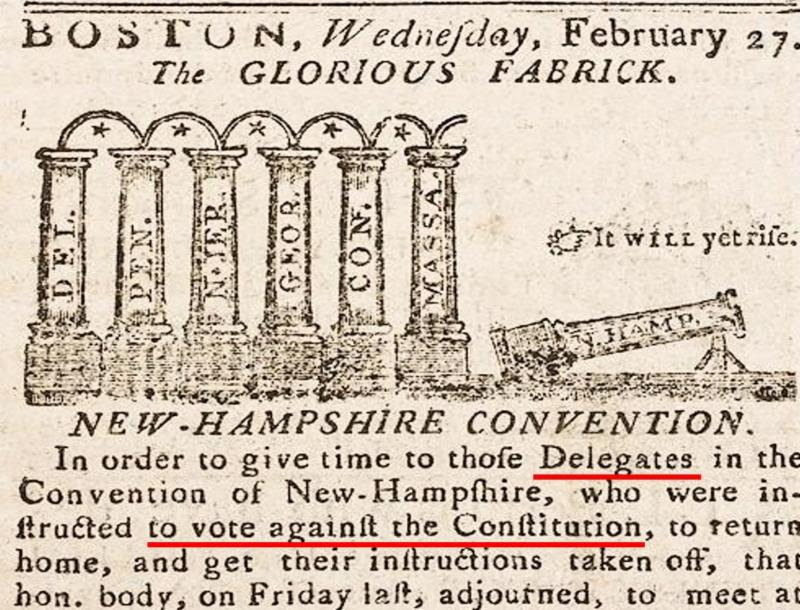
Many states had annual days of fasting.
Governor John Langdon decided to temporarily postpone the convention and schedule New Hampshire’s annual Fasting Day, a date fixed by the Governor, to be observed April 10, 1788:
“to be … kept as a day of fasting of humiliation and prayer.”

After the Day of Fasting, New Hampshire reconvened its ratifying convention on June 18, 1788.
After hearing Harvard President Rev. Samuel Langdon’s address “The Republic of the Israelites an example to the American States” the New Hampshire delegates voted to ratify the U.S. Constitution, June 21, 1788.

New Hampshire was the 9th State to ratify the U.S. Constitution. This fulfilled the necessary requirement of 2/3’s of the States, and thus the Constitution officially went into effect.

After ratifying the U.S. Constitution, the Delegates of New Hampshire thanked God:
“Acknowledging with grateful hearts the goodness of the Supreme Ruler of the Universe in affording the People of the United States in the Course of his Providence an Opportunity, deliberately & peaceably without fraud or surprise of entering into an explicit and solemn compact with each other
by assenting to & ratifying a new Constitution, in order to form a more perfect Union, establish justice, insure domestic tranquility, provide for the common defense, promote the general welfare and secure the Blessings of Liberty to themselves & their Posterity-

Do In the Name & behalf of the People of the State of New-Hampshire assent to & ratify the said Constitution for the United States of America …”
The Delegates of New Hampshire continued, recommending that the new Federal Government should be restricted:
“And as it is the Opinion of this Convention that certain amendments & alterations in the said Constitution would remove the fears & quiet the apprehensions of many of the good People of this State & more Effectually guard against an undue Administration of the Federal Government …
That all Powers not expressly & particularly Delegated by the aforesaid Constitution are reserved to the several States to be, by them Exercised …
That there shall be one Representative to every 30,000 persons …
Nor shall Congress in any Case make regulations contrary to a free and equal Representation …
That Congress do not lay direct Taxes …
That no standing Army shall be Kept up in time of Peace … nor shall Soldiers in Time of Peace be quartered upon private Houses without the consent-of the Owners …
Congress shall make no Laws touching Religion, or to infringe the rights of Conscience …
Congress shall never disarm any Citizen …”
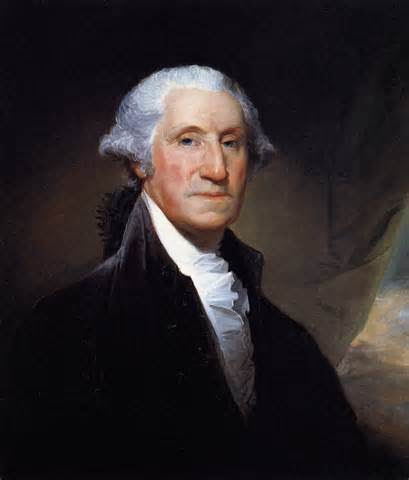
Governor John Langdon wrote to George Washington:
“I have the great pleasure of informing your Excellency that this State has this day adopted the Federal Constitution … thereby placing the Key Stone in the great arch.”

In 1788, John Langdon was elected New Hampshire’s first U.S. Senator where he traveled to the U.S. Capital in New York City.
The U.S. Senate elected him President of the Senate, where he counted the votes of the electoral college where George Washington was elected the first President.
Langdon wrote the letter informing George Washington that he had been elected.

On April 30, 1789, John Langdon administered the oath of office to the nation’s first Chief Executive, George Washington, and Vice-President John Adams.

Returning to New Hampshire, John Langdon was elected Governor, where he issued a Proclamation, October 10, 1805, acknowledging the nation’s victory over the Muslim Barbary Pirates of North Africa:
“It has been customary … to set apart a certain day … for … publicly recognizing their dependence upon Almighty God for protection,
and that they might express their gratitude to Him for all blessings and mercies received and implore a continuance of them;-
I therefore … appoint Thursday, the 28th day of November … as a day of public Thanksgiving and Prayer … in praising and adoring Almighty God, and in offering up our thanks to Him as the great author of every good and perfect gift …
For the termination of our contest with one of the African powers; the liberation of our fellow-citizens from bondage …”

Governor Langdon continued:
“But above all, for the inestimable blessings of the Gospel of Peace and Salvation, the means of grace and hopes of future glory, through the merits of a crucified Savior …
That He would bless the means used for the promulgation of His word, and make pure religion and morality more and more abound.”

In 1797, John Langdon helped save an escaped slave, Oney Judge, from being taken by slave-catchers.
Oney Judge learned to read and became a Christian.

Four years before the American Bible Society was founded, John Langdon founded the New Hampshire Bible Society in 1812, and served as its first President.
The Bible Society’s goal was to put a Bible in every New Hampshire home.

In retirement, John Langdon was visited in 1817 by President James Monroe, as the newspaper reported:
“While at Portsmouth, the President spent that part of the Sabbath which was not devoted to public divine service, with that eminent patriot and Christian, John Langdon.
His tarry … was probably longer than the time devoted to any individual in New England.”
John Langdon died September 18, 1819.
While Governor, John Langdon had issued a Proclamation, October 21, 1785:
“It therefore becomes our indispensable Duty, not only to acknowledge, in general with the rest of Mankind, our dependence on the Supreme Ruler of the Universe,
but as a People peculiarly favoured, to testify our Gratitude to the Author of all our Mercies, in the most solemn and public manner …
To celebrate the Praises of our divine Benefactor; to acknowledge our own Unworthiness, confess our manifold Transgressions, implore his Forgiveness,
and intreat the continuance of those Favours which he had been graciously pleaded to bestow upon us;
That he would … bless our Seminaries of Learning, and spread the Gospel of his Grace over all the Earth.”
—

American Minute posts brought to you by American Priorities 501(c)3.
American Minute is a registered trademark of William J. Federer. Permission granted to forward, reprint, or duplicate.
NJ City Agrees To Raise Christian Flag After Denying Permit: News Release from Liberty Counsel

Before the letter, parade organizers had consistently included a ceremonial raising of the Christian flag at city hall for their annual parade since 1979. However, in August 2025 the city unlawfully denied the permit citing violation of the Establishment Clause and that the decades-long practice of granting their permit was an “administrative error.” Now, the Jersey City officials have agreed to let organizers raise the Christian Flag on September 8, 2026, for their annual Children of Faith Parade.
In the letter, Liberty Counsel informed city officials about its unanimous 2022 victory in Shurtleff v. City of Boston, a case where Boston officials denied raising the Christian flag in an open forum. In that case, the U.S. Supreme Court ruled cities that open their flagpoles to the public cannot selectively exclude religious viewpoints when they allow other private groups to speak. Liberty Counsel noted that Jersey City’s flag program had previously permitted other ideological and religious flags, including for the “Jersey City LGBTQ+ Pride Festival;” the “Independence Day of Pakistan Flag Raising Ceremony” for the Muslim Council North America and Muslim Federation of New Jersey; and the “3rd Annual Palestine Flag Raising Ceremony,” among others.

In Shurtleff, the High Court ruled 9-0 that raising the Christian flag under Boston’s public flag-raising program did not amount to government speech or violate the Establishment Clause since the city had opened its flagpole to private speech and was not selecting or communicating the message. Rather the High Court ruled, denying the Christian flag amounted to unequal treatment and was unconstitutional viewpoint discrimination.
Since Jersey City’s flag program is almost identical to Boston’s, Liberty Counsel had requested Jersey City approve the flag-raising permit for the 2026 parade to avoid the city violating the First Amendment.
Liberty Counsel’s Founder and Chairman Mat Staver said, “We commend Jersey City officials for making the right decision to grant the Christian flag-raising permit for the Children of Faith Parade. Jersey City had stated that raising the Christian flag in their public forum would violate the Establishment Clause, but it does not. The opposite is true. Denying raising the Christian flag in a public forum is the actual First Amendment violation. The clear message from the U.S. Supreme Court is that government cannot favor one viewpoint and censor another in a public forum. Municipalities like Jersey City can legally permit both secular and religious commemorative emblems when they open their flagpoles to public expression.”
For media interviews, please email media@LC.org.
Happy Flag Day

From the White House:
BY THE PRESIDENT OF THE UNITED STATES OF AMERICA
A PROCLAMATION
On June 14, 1777, the delegates of the Second Continental Congress adopted a resolution declaring “that the flag of the United States be thirteen stripes, alternate red and white; that the union be thirteen stars, white in a blue field, representing a new Constellation.” In the 250th year of our glorious Republic, this Flag Day celebrates the American People, whose enduring spirit allows our beloved and timeless tricolor standard to fly as the greatest symbol of freedom, democracy, and sovereign strength the world has ever known.
At its inception, the Stars and Stripes symbolized America’s fundamental precepts of liberty, justice, and dependence on Almighty God. Our Nation’s official banner and the principles that propelled our Founding Fathers to boldly undertake the most consequential act of self-governance of all time have withstood the test of time. The flag is a physical representation of our storied past, shared sacrifice, common heritage, and divine destiny. From the frozen ground of Valley Forge to the blood-soaked field of Gettysburg; from the triumphant beaches of Normandy to the desolate face of the Moon; and from the granite steps of the Lincoln Memorial to the heart of every patriot who continues to define American Excellence to this day — wherever our beautiful flag flies, America’s greatness follows. After nearly two and a half centuries, through every tragedy and triumph, Old Glory remains the strongest beacon of sovereignty and hope the world has ever known, thanks to the devoted patriots of the past who made it so — and it is up to us to keep her flying proudly for generations to come.
Our beautiful flag is a global ensign of America’s indominable spirit, matchless power, and endless resolve to achieve a more perfect Union. This sacred symbol of the American people, carried by generations with incredible courage and unshakable faith in the promise of our Nation, deserves our deepest admiration, protection, and respect. Last year, I signed an Executive Order to preserve the dignity of our flag by enforcing accountability for acts of desecration tied to violence and lawlessness. We also authorized the revocation of visas, residency, and naturalization for foreign nationals who desecrate the banner under which millions of American patriots have fought and died. As President, I will always wield the full power of my office in defense of our flag’s sacred honor, and I will never rest in my commitment to ensure that the proudest emblem of liberty is forever treated with the reverence it has so dearly earned.
Next month, America will celebrate the most important milestone in our history — 250 glorious years of blessed Independence — and the Red, White, and Blue will preside over jubilant commemorations from sea to shining sea. It will billow atop flagpoles in sprawling cities and on neighborhood porches in small towns; it will fly over beaches, stadiums, parks, iconic landmarks, and military bases. Our flag will wave in the hands of children at parades and festivals and flap solemnly as a sentinel over hallowed cemeteries of the fallen. On Flag Day, during National Flag Week, and throughout the summer of this historic year, may our majestic flag soar as a triumphant symbol of all the American people have achieved and serve as a shining herald of the new Golden Age that lies before us.
To commemorate the adoption of our flag, the Congress, by joint resolution approved August 3, 1949, as amended (63 Stat. 492), designated June 14 of each year as “Flag Day” and requested that the President issue an annual proclamation calling for its observance and for the display of the flag of the United States on all Federal Government buildings. The Congress also requested, by joint resolution approved June 9, 1966, as amended (80 Stat. 194), that the President issue annually a proclamation designating the week in which June 14 occurs as “National Flag Week” and calling upon all citizens of the United States to display the flag during that week.
NOW, THEREFORE, I, DONALD J. TRUMP, President of the United States of America, do hereby proclaim June 14, 2026, as Flag Day and the week starting June 14, 2026, as National Flag Week. I direct the appropriate officials to display the flag on all Federal Government buildings during this week, and I urge all Americans to observe Flag Day and National Flag Week by displaying the flag. I also encourage the people of the United States to proudly observe with all due ceremony those days from Flag Day through Independence Day, set aside by the Congress (89 Stat. 211), as a time to honor America, to celebrate our heritage in public gatherings and activities, and to publicly recite the Pledge of Allegiance to the Flag of the United States of America.
IN WITNESS WHEREOF, I have hereunto set my hand this twelfth day of June, in the year of our Lord two thousand twenty-six, and of the Independence of the United States of America the two hundred and fiftieth.
DONALD J. TRUMP

Camp Constitution’s Annual Family Camp One Month Away. Spaces are Still Available
Camp Constitution 18th Annual Family Camp is one month away. It will be held at the Singing Hills Christian Camp https://www.singinghills.net/ Plainfield, NH. from Sunday July 12 to Friday July 17, 2026 We still have rooms available. We have to give Singing Hills a final headcount on July 3. So, if you are planning on attending, please let us know.
Returning instructors include Pastor David Whitney of the Institute on the Constitution, Catherine White of The Constitution Decoded, Alex Newman, author and host of the Sentinel Report, Kurt Hyde, retired U.S. Air Force Lt, Col, and Rev. Steve Craft, Camp Constitution’s chaplain.

Guest instructors include Julie Wilkinson who played in the movie “”UnPlanned: The Abby Johnson Story.” In addition to the classes, the camp will offer marksmanship courses, martial arts, hiking, basketball, volleyball, wiffleball, and optional field trip and swimming, chess, gaga and corn hole tournaments. Campers and staff end the day with an evening campfire.
Our theme: Celebrating our nation’s 250th Birthday
Camp Constitution’s annual camp is a family camp open to entire families, unaccompanied minors, and adults. The cost for the week which includes lodging, meals and class handouts is $300 for those 13 and over. $200. For campers 12 and under, and three and under with parents are free. A link to the camp registration: https://campconstitution.net/camp-registration/
Can’t attend but would like to help a worthy youngster or family attend camp? Please consider making a donation to Camp Constitution. Donations can be made via our PayPal account accessed from our website’s homepage https://campconstitution.net/ or by check payable to Camp Constitution and mailed to Camp Constitution C/O Hal Shurtleff 146 Powder Mill Rd. Alton, NH 03809.
For more information contact Hal Shurtleff (857) 498-1309 campconstitution1@gmail.com

The Weekly Sam: Christianity Versus Islam

Because we live in such a highly secularized society, we cannot believe that America could ever become
involved in a religious war in this day and age. Yet ferocious religious wars have been going on all over the
place: in Northern Ireland, in Israel, in the Balkans, in Sudan, in India, in Kashmir, and in Russia. But
history is a very harsh taskmaster and refuses to let us Americans escape into our secular fantasies and
liberal hot houses for long. Thus, it is vitally important for us to reconnect with the human race’s never
ending history of religious struggle. That a group of Islamic terrorists, trained in a remote war-torn, famine
ridden, hell-hole in Asia, could organize the kind of mind-boggling attack against America that took place on
September 11, 2001, means that America is not only not exempt from history, but has been dragged
kicking and screaming back into the middle of it.
Back in 1588, Christopher Marlowe, master of historical drama, wrote his famous Tamburlaine 2. In it there
is a fascinating scene in which the Christian King Sigismund of Hungary and Orcanes, the Muslim King of
Natolia, both former enemies, decide to establish peace between them in order to join forces to defeat
Tamberlaine the Great, the cruel, pagan conqueror of Asia.
Both men confirm their commitment with an oath. King Sigismund vows:
“By Him that made the world and sav’d my soul,
The Son of God and issue of a maid,
Sweet Jesus Christ, I solemnly protest
And vow to keep this peace inviolable!”
King Orcanes vows:
“By sacred Mohamet, the friend of God,
Whose holy Alcoran remains with us,
Whose Glorious body, when he left the world,
Clos’d in a coffin mounted up the air,
And hung on stately Mecca’s temple-roof,
I swear to keep this truce inviolable!”
But as the story goes, it was King Sigismund who later broke the truce and was defeated and killed by the
Muslims.
While the history of the struggle between Christians and Muslims for control of Europe was for a time
settled after the Muslims were expelled from Spain in 1492, and driven back from the gates of Vienna to
Asia and Africa, the Islamic enclaves that remained in the Balkans led to the recent wars in Bosnia and
Kosovo. The Serbs had considered themselves as the Christian bulwark against further Islamic incursions
in Europe, and therefore could not understand why they were being bombed by fellow Europeans and
Americans.
You had to know history to understand what Bosnia and Kosovo were all about and what bin Laden’s men
were doing in the Balkans. That conflict proved that the war between Christianity and Islam has never
ended. Over the ages, it simply took on different forms. The rise of European power put a lid on Islamic
ambitions and the Muslim world became the backwater of history until the discovery of oil in the twentieth
century. But in the nineteenth century, the Islamic Barbary states of North Africa could still make trouble for
the Infidel. They took possession of American and European commercial vessels, held their crews for
ransom, and enslaved other Christians. Our first war after independence was fought during the Jefferson
administration against the Muslim pirates and kidnappers of Tripolitania. It is known in the history books as
the Barbary War, in which U.S. Marines staged their first invasion of foreign soil. Hence, the Marine
anthem: “From the halls of Montezuma to the shores of Tripoli.”
In order to finally put an end to the piracy and barbarism coming out of North Africa, France decided to take
over Algeria. During the 1830s and 1840s, the French imposed their rule over the territory, encouraging
Europeans to settle there. The result was a flourishing French colony and an end to Barbary piracy. France
maintained order in North Africa until the end of World War II, when the anti-colonialist movement got
underway. Both liberals and communists joined in forcing the European powers to give up their colonies.
In Algeria, however, over a million Europeans had settled in the territory and the coastal departements
were considered an integral part of France. However, when Charles de Gaulle gained power at the height
of the Algerian uprising, he decided that France should quit Algeria because the Moslems could never
become true Frenchmen. And so France abandoned Algeria, and a million Europeans took to the boats.
Today, the invasion has been reversed. Five million Muslims, mostly Algerians, live in France. They make
up ten percent of the population and are part of the resurgent Islamic power in Europe. Christianity is now
so weak in France that one wonders if it is capable of resisting the assumption of Islamic power.
We have been told by our leaders and the media that we are not at war against the Islamic religion. We
are at war against terrorism. But what they all prefer not to recognize is that the spiritual power behind that
terrorism, the power that drives otherwise intelligent human beings to undertake suicidal missions against
the infidel is the religion of Islam. Of course, there are millions of Muslims who just want to lead normal
lives. Unfortunately, after September 11, 2001, nothing is “normal” anymore.
In an alarming article in the November issue of Commentary magazine, Daniel Pipes contends that
Islamist militants are serious about their plan to conquer America. He writes:
“The first missionaries for militant Islam, or Islamism, who arrived here from abroad in the
1920’s, unblushingly declared, “Our plan is, we are going to conquer America.”
The audacity of such statements hardly went unnoticed at the time, including by Christians who
cherished their own missionizing hopes. As a 1922 newspaper commentary put it:
“To the millions of American Christians who have so long looked eargerly
forward to the time the cross shall be supreme in every land and the people
of the whole world shall have become the followers of Christ, the plan to win
the continent to the path of the ‘infidel Turk’ will seem a thing unbelievable.
But there is no doubt about its being pressed with all the fanatical zeal for
which the Mohammedans are noted. Pipes writes further:
“As a teacher at an Islamic school in Jersey City, near New York, explains, the “short-term
goal is to introduce Islam. In the long term, we must save American society.” Step by step,
writes a Pakistan-born professor of economics, by offering “an alternative model” to
Americans, Muslims can transform what Ismail Al-Faruqi referred to as “the unfortunate
realities of North America” into something acceptable in God’s eyes.”
The irony in all of this is stunning. For years the Christian right has been trying to get Americans to live
godly lives, but with very limited success. The fact that 85% of American parents put their children in pagan
public schools is an indication of how strong our liberal secular culture is. It controls the curriculum in our
schools and universities. It controls most of the print media, the electronic media, and most of what comes
out of Hollywood. And American schools are now teaching American children all about Islam. While the
Bible has been eliminated from the classroom, apparently the Koran hasn’t. How else can you teach about
Islam?
Recently, the Reverend Franklin Graham, president of Samaritan’s Purse, a Christian relief agency, called
Islam “wicked and violent.” He said, “I don’t believe this is a wonderful, peaceful religion. When you read
the Koran and you read the verses from the Koran, it instructs the killing of the infidel, for those that are
non-Muslim.”
As the son of Billy Graham, Franklin is the designated successor to his father’s longtime evangelical
ministry. He delivered the benediction at Bush’s inauguration. But now he’s in trouble with the White
House, which sponsored a Ramadan dinner for 50 ambassadors from Islamic countries with a traditional
meal and prayer. Also, the Muslim chaplain of Georgetown University recently officiated at the opening
prayers of the House of Representatives on Capitol Hill.
The moral seems to be that if Islamist terrorists bomb the World Trade Center and the Pentagon and kill
5,000 Americans, other Islamists get invited to the White House for a special dinner prepared to their
specifications: no pork. Now that Americans are being invited to be kind to Muslims, where will all of this
lead?
Graham said, “It wasn’t Methodists flying into those buildings, it wasn’t Lutherans. It was an attack on this
country by people of the Islamic faith.” And that’s why the latter are now favored guests at the White
House! Of course, the President is doing this to keep the Islamic states in line while we war against the
terrorists which these states harbor.
But if we are being encouraged by our born-again President to be kind to our Muslim neighbors, shouldn’t
Christians see this as a missionary opportunity? Why not introduce Muslims to the loving grace of Jesus
Christ? One of the reasons why Americans find it difficult to become friendly with Muslims is because
sooner or later their rabid hatred of Israel will surface. Americans in general don’t like to hate anybody, and
they are uncomfortable with people who are haters.
Christianity preaches love. Islam preaches hate. That is why hatred of Israel fills the psyche of so many
Muslims. Abnormal, pathological hatred is not healthy. It requires constant energy to be sustained at the
level it exists among Muslims. And that is why life is so miserable in many Islamic countries. And that is
why Palestinian refugees have preferred to remain in refugee camps for 50 years rather than do something
constructive with their lives. They prefer to live with festering, enduring hatred, and teach it to their
children, rather than accept forgiveness and peace. No true Christian could ever waste his life that way.
Yet, the United Nations aid agency accepts these refugee camps as perfectly normal for the Arab Muslims.
After World War II, millions of displaced persons found new constructive lives in countries all over the
world. But in the Middle East, Palestinian hatred is used to torment the world about Israel.
It is to be hoped that one of the first things the new government of Afghanistan might do is recognize Israel
and establish diplomatic relations with the Jewish state. It would signal a dramatic change in the attitude of
Muslims toward Israel.
Indeed, let us be loving and concerned with the well being of our Muslim citizens, and let us convey to
them that Jesus will save them from their sickening hatred and grant them life renewed.

The Blumenfeld Archives http://blumenfeld.campconstitution.net/main.htm
American Minute with Bill Federer Nazi aggression led up to D-Day, June 6, 1944: Turning point in Europe, FDR “A Struggle to Preserve our Republic, our Religion and our Civilization”

|
|
|

|
|


|

|
|
|
|
|
|
|
|
|
|
|
|
|
|
|
|

|
|
|
|
|
|
|
|
|
|
|
|
|
|
|
|
|
|
|
|
|
|
|
|

|
|
|
|
|
|
|
|
|
|
|
|
|
|
|

|

|
The “Gay Manifesto” We Will Sodomize Your Sons

I first learned about this vile screed from my friend Warren Bradley, a retired Boston policeman back in 1988. He was a subscriber to Jerry Falwell’s Moral Majority newsletter, and it had reprinted this manifesto. I didn’t believe that it was true. I called the now defunct “Gay Community News” which was based in Boston and the man who answered confirmed that the paper did indeed publish it. He told me that the author was a “poet from Connecticut.” I asked him if printing such things was a way to gain supporters for the homosexual cause. He didn’t respond.
(First Published in Gay Community News, Feb. 15-21, 1987 and also put into the Congressional Record. Author – Michael Swift)
We shall sodomize your sons, emblems of your feeble masculinity, of your shallow dreams and vulgar lies. We shall seduce them in your schools, in your dormitories, in your gymnasiums, in your locker rooms, in your sports arenas, in your seminaries, in your youth groups, in your movie theater bathrooms, in your army bunkhouses, in your truck stops, in your all male clubs, in your houses of Congress, wherever men are with men together. Your sons shall become our minions and do our bidding. They will be recast in our image. They will come to crave and adore us.
Women, you cry for freedom. You say you are no longer satisfied with men; they make you unhappy. We, connoisseurs of the masculine face, the masculine physique, shall take your men from you then. We will amuse them; we will instruct them; we will embrace them when they weep. Women, you say you wish to live with each other instead of with men. Then go and be with each other. We shall give your men pleasures they have never known because we are foremost men too, and only one man knows how to truly please another man; only one man can understand the depth and feeling, the mind and body of another man.
All laws banning homosexual activity will be revoked. Instead, legislation shall be passed which engenders love between men.
All homosexuals must stand together as brothers; we must be united artistically, philosophically, socially, politically and financially. We will triumph only when we present a common face to the vicious heterosexual enemy.
If you dare to cry faggot, fairy, queer, at us, we will stab you in your cowardly hearts and defile your dead, puny bodies.
We shall write poems of the love between men; we shall stage plays in which man openly caresses man; we shall make films about the love between heroic men which will replace the cheap, superficial, sentimental, insipid, juvenile, heterosexual infatuations presently dominating your cinema screens. We shall sculpt statues of beautiful young men, of bold athletes which will be placed in your parks, your squares, your plazas. The museums of the world will be filled only with paintings of graceful, naked lads.
Our writers and artists will make love between men fashionable and de rigueur, and we will succeed because we are adept at setting styles. We will eliminate heterosexual liaisons through usage of the devices of wit and ridicule, devices which we are skilled in employing.

We will unmask the powerful homosexuals who masquerade as heterosexuals. You will be shocked and frightened when you find that your presidents and their sons, your industrialists, your senators, your mayors, your generals, your athletes, your film stars, your television personalities, your civic leaders, your priests are not the safe, familiar, bourgeois, heterosexual figures you assumed them to be. We are everywhere; we have infiltrated your ranks. Be careful when you speak of homosexuals because we are always among you; we may be sitting across the desk from you; we may be sleeping in the same bed with you.
There will be no compromises. We are not middle-class weaklings. Highly intelligent, we are the natural aristocrats of the human race, and steely-minded aristocrats never settle for less. Those who oppose us will be exiled.
We shall raise vast private armies, as Mishima did, to defeat you. We shall conquer the world because warriors inspired by and banded together by homosexual love and honor are invincible as were the ancient Greek soldiers.

The family unit-spawning ground of lies, betrayals, mediocrity, hypocrisy and violence–will be abolished. The family unit, which only dampens imagination and curbs free will, must be eliminated. Perfect boys will be conceived and grown in the genetic laboratory. They will be bonded together in communal setting, under the control and instruction of homosexual savants.
All churches who condemn us will be closed. Our only gods are handsome young men. We adhere to a cult of beauty, moral and esthetic. All that is ugly and vulgar and banal will be annihilated. Since we are alienated from middle-class heterosexual conventions, we are free to live our lives according to the dictates of the pure imagination. For us too much is not enough.


The exquisite society to emerge will be governed by an elite comprised of gay poets. One of the major requirements for a position of power in the new society of homoeroticism will be indulgence in the Greek passion. Any man contaminated with heterosexual lust will be automatically barred from a position of influence. All males who insist on remaining stupidly heterosexual will be tried in homosexual courts of justice and will become invisible men.
We shall rewrite history, history filled and debased with your heterosexual lies and distortions. We shall portray the homosexuality of the great leaders and thinkers who have shaped the world. We will demonstrate that homosexuality and intelligence and imagination are inextricably linked, and that homosexuality is a requirement for true nobility, true beauty in a man.

We shall be victorious because we are fueled with the ferocious bitterness of the oppressed who have been forced to play seemingly bit parts in your dumb, heterosexual shows throughout the ages. We too are capable of firing guns and manning the barricades of the ultimate revolution.
Tremble, hetero swine, when we appear before you without our masks.


