John Adams on Government: Christian Virtue Necessary for Liberty – American Minute with Bill Federer
& the Need for Christian Virtue – American Minute with Bill Federer The Wisdom of John Adams: on Liberty Tyranny

Download as PDF …





John Adams was born October 30, 1735. A Harvard graduate, he was admitted to the bar and in 1764, married Abigail Smith, the daughter of a Congregational minister.
In 1765, Britain enacted the Stamp Act, which would be equivalent to a modern-day Internet tax, online censorship or government surveillance of emails.
John Adams wrote:
“It seems very manifest from the Stamp Act itself, that a design is formed to strip us in a great measure of the means of knowledge, by loading the press, the colleges, and even an almanac and a newspaper, with restraints and duties.”
In resisting the Stamp Act, Adams wrote instructions to representatives from town of Braintree being sent to the Massachusetts General Court:
“The late acts of Parliament … divest us of our most essential rights and liberties … The Stamp Act … a very burdensome, and… unconstitutional tax, is to be laid upon us …
We are subjected to … penalties, to be prosecuted, sued for, and recovered, at the option of an informer, in a court of admiralty, without a jury …
Business … would be totally impossible … That Act … would drain the country of its cash, strip multitudes of all their property, and reduce them to absolute beggary …
No freeman should be subject to any tax to which he has not given his own consent.”
John Adams explained in A Dissertation on the Canon and Feudal Law, 1765, that it was Christian principles, brought to America by the Puritans, that resisted tyranny:
“The desire of dominion … when … restraints are taken off … becomes an encroaching, grasping, restless, and ungovernable power … contrived by the great for the gratification of this passion …
Originally formed … for the necessary defense … against … invasions … yet … tyranny, cruelty, and lust … was soon adopted by almost all the princes of Europe …
The people were held in ignorance … till God in his benign providence raised up the champions who began and conducted the Reformation.
From the time of the Reformation to the first settlement of America, knowledge gradually spread in Europe, but especially in England; and in proportion as that increased and spread among the people … tyranny … lost … strength.”
He continued:
“It was this great struggle that peopled America … by a sensible people … the Puritans …
This people had been so vexed and tortured by the powers of those days, for no other crime than their knowledge and their freedom of inquiry … they at last resolved to fly to the wilderness for refuge …
After their arrival here, they … formed their plan, both of ecclesiastical and civil government, in direct opposition to the canon and the feudal systems …
I always consider the settlement of America with reverence and wonder, as the opening of a grand scene and design in Providence for the illumination of the ignorant, and the emancipation of the slavish part of mankind all over the earth …”
Adams added:
“Tyranny in every form, shape, and appearance was their disdain …
They saw clearly, that popular powers must be placed as … a control, a balance, to the powers of the monarch … or else it would soon become the man of sin, the whore of Babylon, the mystery of iniquity, a great and detestable system of fraud, violence, and usurpation.
Their greatest concern seems to have been to establish a government of the church more consistent with the Scriptures, and a government of the state more agreeable to the dignity of human nature, than any they had seen in Europe …
To render the popular power in their new government as great and wise … as human nature and the Christian religion require it should be, they … had an utter contempt … of hereditary, indefeasible right … of passive obedience and nonresistance …
They thought all such slavish subordinations were … inconsistent with … that religious liberty with which Jesus had made them free …”
Adams explained further:“Original … government was … despotic … arbitrary, lawless power …
But knowledge diffused generally through the whole body of the people … their civil and religious principles …
For this purpose they laid very early the foundations of colleges, and … seminaries … They made it a crime for such a town to be destitute of a grammar schoolmaster …
Education of all ranks of people was made the care and expense of the public, in a manner that I believe has been unknown to any other people ancient or modern …
A native of America who cannot read and write is as rare … as a comet or an earthquake …
Liberty must at all hazards be supported. We have a right to it, derived from our Maker …”

Adams continued:
“Liberty cannot be preserved without a general knowledge among the people, who have a right … to knowledge, as their great Creator, who does nothing in vain, has given them understandings, and a desire to know …
Rulers are no more than … trustees for the people; and if the … trust is insidiously betrayed, or wantonly trifled away, the people have a right to revoke the authority … and to constitute abler and better … trustees …
The jaws of power are always opened to devour, and her arm is always stretched out, if possible, to destroy the freedom of thinking, speaking, and writing …
Be not intimidated, therefore, by any terrors, from publishing with the utmost freedom, whatever can be warranted by the laws of your country …
I hope in God the time is near at hand when they will be fully convinced of your understanding, integrity and courage …
Let us not suppose that all are become luxurious, effeminate, and unreasonable, on the other side the water, as many designing persons would insinuate.
Let us presume, what is in fact true, that the spirit of liberty is as ardent as ever among the body of the nation …
Let us dare to read, think, speak, and write.”

Adams stated in A Dissertation on the Canon and Feudal Law:
“Let us study … the great examples of Greece and Rome … the conduct of our own British ancestors, who have defended for us the inherent rights of mankind against foreign and domestic tyrants and usurpers, against arbitrary kings and cruel priests, in short, against the gates of earth and hell …
Let the pulpit resound with the doctrines and sentiments of religious liberty …
Let us hear the dignity of his nature, and the noble rank he holds among the works of God,
– that consenting to slavery is a sacrilegious breach of trust, as offensive in the sight of God as it is derogatory from our own honor or interest or happiness,
– and that God Almighty has promulgated from heaven, liberty, peace, and goodwill to man!”

When the Revolution started, John Adams recommended that George Washington be the Commander-in-Chief and that Thomas Jefferson pen the Declaration.

In Novanglus: A History of the Dispute with America, from its Origin, in 1754, to the Present Time, published February 6, 1775, John Adams wrote:
“It is the duty of the clergy to accommodate their discourses to the times, to preach against such sins as are most prevalent, and recommend such virtues as are most wanted …
If exorbitant ambition and venality are predominant, ought they not to warn their hearers against those vices?
If public spirit is much wanted, should they not inculcate this great virtue?
If the rights and duties of Christian magistrates and subjects are disputed, should they not explain them, show their nature, ends, limitations, and restrictions, how much soever it may move the gall of Massachusetts.”

John Adams authored the Massachusetts Constitution, 1780, described as the world’s oldest functioning written constitution, a model for the United States Constitution. It stated:
“The happiness of a people and the good order and preservation of civil government, essentially depend upon piety, religion and morality;
and as these cannot be generally diffused through a community, but by the institution of the Public worship of God …
the people of this commonwealth … authorize … the public worship of God, and for the support and maintenance of public Protestant teachers of piety, religion and morality …
And every denomination of Christians, demeaning themselves peaceably, and as good subjects of the commonwealth, shall be equally under the protection of the law …
The Governor shall be chosen annually; and no person shall be eligible to this office, unless … he shall declare himself to be of the Christian religion …
Any person chosen governor, lieutenant governor, counselor, senator or representative, and accepting the trust, shall … make … the following declaration, viz.-
“I, A. B., do declare, that I believe the Christian religion, and have a firm persuasion of its truth.”

John Adams was U.S. Minister to France, where, together with Benjamin Franklin, John Jay, and David Hartley, he signed the Treaty of Paris, September 3, 1783, officially ending the Revolutionary War:
“In the name of the Most Holy and Undivided Trinity.
It having pleased the Divine Providence to dispose the hearts of the most serene and most potent Prince George the Third, by the Grace of God, King of Great Britain, France, and Ireland, Defender of the Faith …
and of the United States of America, to forget all past misunderstandings and differences …
Done at Paris, this third day of September, in the year of our Lord one thousand seven hundred and eighty-three.”

While U.S. Minister to Britain, John Adams met with his former king, George the Third.

Adams helped ratify the U.S. Constitution by writing Defense of the Constitution of the Government of the United States, 1787-1788.

Initially, Presidential elections designated the President as the one who received the most votes, and the Vice-President was the one who received the second most votes.
John Adams was so popular that he was elected Vice-President twice, serving under George Washington.

When George Washington insisted on only serving two terms, John Adams was elected the 2nd U.S. President in 1796.
He established the Library of Congress and the Department of Navy.

His son, John Quincy Adams, became 6th President.

After Abigail Adams died in 1818, Adams wrote to Jefferson:
“I do not know how to prove physically, that we shall meet and know each other in a future state; nor does Revelation, as I can find, give us any positive assurance of such a felicity.
My reasons for believing it, as I do most undoubtedly, are that I cannot conceive such a Being could make such a species as the human, merely to live and die on this earth.
If I did not believe in a future state, I should believe in no God.
This Universe, this all would appear, with all of its swelling pomp, a boyish firework.
And if there be a future state, why should the Almighty dissolve forever all the tender ties which unite us so delightfully in this world, and forbid us to see each other in the next?”

In 1819, John Adams wrote to Jefferson:
“Have you ever found in history, one single example of a nation thoroughly corrupted that was afterwards restored to virtue? …
And without virtue, there can be no political liberty …
Will you tell me how to prevent luxury from producing effeminacy, intoxication, extravagance, vice and folly? …
No effort in favor of virtue is lost.”

In Paris, John Adams wrote in his diary, June 2, 1778:
“In vain are schools, academies, and universities instituted, if loose principles and licentious habits are impressed upon children in their earliest years …
The vices and examples of the parents cannot be concealed from the children.
How is it possible that children can have any just sense of the sacred obligations of Morality or Religion if, from their earliest infancy … their fathers (are) in as constant infidelity to their mothers?”
On June 21, 1776, John Adams wrote:
“Statesmen, my dear Sir, may plan and speculate for liberty, but it is Religion and Morality alone, which can establish the principles upon which freedom can securely stand.
The only foundation of a free Constitution is pure virtue,
and if this cannot be inspired into our people in a greater measure, than they have it now, they may change their rulers and the forms of government, but they will not obtain a lasting liberty.”
—
American Minute is a registered trademark of William J. Federer. Permission granted to forward, reprint, or duplicate.
The Weekly Sam: Colonial Education: Superior to Today’s Public Schools By Samuel Blumenfeld

When the Puritans arrived in the wilderness of New England, they set a high standard of
education for the colonists, and the rest of the English colonies followed suit so that
literacy was virtually universal. The need for biblical literacy was the driving force
behind education since it was religious freedom they sought in coming to the New World.
Their vision was of creating a truly Christian civilization in the wilderness.
With thoughts always of the future, the aim of the Puritan leadership was to establish and
sustain the religious foundations of the Commonwealth, which included the highly
democratic, Calvinistic form of church governance, Congregationalism. Thus, in
Massachusetts education was based more on a religious foundation than a secular one.
Because of the emphasis on education, Massachusetts gained a reputation for having the
best schools in the colonies.
The Puritans founded Harvard College as a Calvinist
institution in 1636. But the other colonies were not far behind. All of the Protestant sects,
most of which were Calvinist in theology, placed high value on learning the languages of
theology: Latin, Greek, and Hebrew, as well as the secular subjects that were taught at
Oxford and Cambridge and at the Law schools.
Colleges were also founded in Virginia (1693), Connecticut (1701), New Jersey (1746
and 1766), New York (1754), Pennsylvania (1755), Rhode Island (1764), and New
Hampshire (1770). All were private colleges, and there were usually private academies in
the towns to prepare students for higher education.
We can get a good picture of the various forms of education available during the colonial
period by surveying the education that formed the mindset of the 89 men who signed the
Declaration of Independence and the Constitution of the United States. According to
author Lawrence Cremin:
“Of the 56 signers of the Declaration, 22 were products of the provincial colleges, two
had attended the academy conducted by Francis Alison at New London, Pennsylvania,
and the others represented every conceivable combination of parental, church,
apprenticeship, school, tutorial, and self education, including some who studied abroad.
Of the 33 signers of the Constitution, who had not also signed the Declaration, 14 were
products of the provincial colleges, one was a product of the Newark Academy, and the
remainder spanned the same wide range of alternatives.”
The fact is that the men who founded the United States were educated under the freest
conditions possible, with colonial governments offering little more than moral
encouragement. George Washington was educated at home by his father and half-brother.
Benjamin Franklin was taught to read by his father and attended a private school for
writing and arithmetic. Thomas Jefferson studied Latin and Greek under a tutor. Of the
117 men who signed the Declaration of Independence, the Articles of Confederation, and
the Constitution, one out of three had had only a few months of formal schooling, and
only one in four had gone to college.
And that is probably why the Constitution made no mention of education. It was
considered a parental, religious, and private matter beyond the jurisdiction of
government. There were some statesmen, like Thomas Jefferson and John Adams who
advocated free, state-supported education on a modest scale to insure universal literacy.
But they were clearly in the minority. Thus, at the beginning of the American nation,
except for some town-supported common schools in New England, education was on a
completely laissez-faire, free-market basis.
Contrast the highly effective educational freedom and high literacy that existed then to
what we have in America today: completely centralized and regulated education by the
government-supported education establishment, plus compulsory school attendance laws,
plus highly unionized teachers with enormous political clout that keeps taxes as high as
possible.
And what are the American people getting for their money? The drugging of over four
million children by their educators to cure Attention Deficit Disorder, a steep decline in
literacy, and an anti-Christian philosophy of education. Indeed, what we have are
government schools that do not truly educate. If it were not for the growth of the
home-school movement and the restoration of educational freedom by this dedicated
remnant, this country would in time become a totalitarian society, controlled by
behavioral psychologists and corrupt politicians. In fact, with the election of socialist
Barack Obama, the nation has reached that brink where ending our Constitutional
Republic of limited powers and replacing it with atheistic Social Democracy with
unlimited powers is about to take place unless stopped by an alarmed and activated
American people.
That is why it is so important for Americans to know the history of education in this
country so that they can see our current trends in their proper foreboding context. Our
nation was founded by Christian men and women who believed in educational freedom
because it produced the young men and women capable of maintaining a free society.
Our freedom depends on our nation’s willingness to adhere to biblical morality and high
literacy. Because without them, we shall continue to founder in a sea of ignorance,
barbarism, and moral depravity.

The Blumenfeld Archives https://campconstitution.net/sam-blumenfeld-archive/
Christian Camp Freed From Colorado’s Dangerous Gender Policy

Good news from our friends at Liberty Counsel:
Camp IdRaHaJe, which derives its name from the song “I’d Rather Have Jesus,” challenged a policy from Colorado’s Department of Early Childhood that requires licensed camps to allow campers to use the bathrooms, bathing areas, and sleeping quarters of the opposite sex. The camp had requested a religious exemption, but state regulators denied it leaving the camp facing a potential shut it down as it stated it would not comply with the policy.
Rather than have the policy scrutinized in court, state officials agreed, as part of the settlement, not to enforce the policy against Camp IdRaHaJe. The state also clarified that “churches, synagogues, mosques, or any other place that is principally used for religious purposes” are also exempt from the requirements.

As a result of the settlement, approximately 2,400 to 3,000 kids will be able to attend the camp this summer in a safe, Christian environment.
Camp IdRaHaJe has hosted children since 1948 and has had a resident camp license since 1995. The camp’s doctrinal statement declares that “God has immutably created each person as either male or female in His image” and “the differentiation of the sexes, male and female, is part of the divine image in the human race.”
Camp IdRaHaJe hosts and serves children from ages six to 17 and offers off-site backpacking, camping trips and many other on-site activities. The camp hosts thousands of students each summer with the mission to “win souls to Jesus Christ through the spreading of the Gospel.” The camp is open to children of all backgrounds and beliefs.
Liberty Counsel Founder and Chairman Mat Staver stated, “Colorado’s gender policy is a violation of the camp’s Christian mission as well as a threat to child safety. Camp IdRaHaJe’s settlement is a victory for religious liberty in the state where religious organizations no longer have to choose between their sincerely held religious beliefs on human sexuality and their state licenses. The government also has no place forcing the false, corrosive gender ideology upon its citizens. Colorado needs to remove this policy altogether and protect children.”
Liberty Counsel provides broadcast quality TV interviews via Hi-Def Skype and LTN at no cost.
TAKE ACTION


The Weekly Sam: How to Dumb Down a Nation By Samuel L. Blumenfeld
It’s easy. Destroy its literacy, and you’ve dumbed it down. And once dumbed down, it
becomes the potential victim of any power that wants to dominate it.
If you look at the most illiterate nations on the planet, you find that they are ruled by
despots, their people live in abject poverty and have no hope for a better future. That
doesn’t mean that literate nations, like Germany, can’t produce monsters. But when they
do, we know that satanic influences are behind it.
America, from its beginning, was the most literate nation on earth, and the result was
positive in every respect. Why was it so literate? Because the people and their leaders
were governed by the precepts of the Bible, and biblical literacy was paramount in the
education of the country’s children.
But once we got a government schooling system, which was taken over by atheist
progressive educators, the God of the Bible was removed from the schools. It then
became possible to introduce a new socialist curriculum with teaching methods
calculated to reduce American literacy. The Bible was now relegated to an hour of study
in church on Sundays. And because it was no longer part of the curriculum, children no
longer considered it important to life.
A blatant, anti-biblical morality was introduced in the schools through such programs as
values clarification, sensitivity training, transcendental meditation, sex education, death
education, drug education, multiculturalism, psychotherapy, evolution, secular
humanism, and other such programs. Moral degeneration has been the inevitable result.
The result is that America has been greatly dumbed-down.
The Blumenfeld Archives: http://blumenfeld.campconstitution.net/main.htm
“Don’t Shoot Until You See the Whites of Their Eyes!” -June 1775, The Battle of Bunker Hill – American Minute with Bill Federer

Today marks the 250th anniversary of the Battle of Bunker Hill.

“Don’t Shoot Until You See the Whites of Their Eyes!” commanded Colonel William Prescott, repeating the order of General Israel Putnam, JUNE 17, 1775.
Colonel William Prescott’s men were in the center redoubt located on Breed’s Hill, adjacent Bunker Hill, guarding the north entrance to Boston Harbor.
Samuel Swett wrote in his History of Bunker Hill, that as the 2,300 British soldiers advanced:
“The American marksmen are with difficulty restrained from firing. Putnam rode through the line, and ordered that no one should fire till they arrived within eight rods …
Powder was scarce and must not be wasted. They should ‘not fire at the enemy till they saw the whites of their eyes …’
The same orders were reiterated by Prescott at the redoubt.”
Franklin Roosevelt proclaimed March 20, 1942:
“Our Army is a mighty arm of the tree of liberty.
It is a living part of the American tradition, a tradition that goes back to Israel Putnam, who left his plow in a New England furrow to take up a gun and fight at Bunker Hill.”
At the beginning of the battle, a stray musket ball from a British gun killed an American soldier, resulting in other soldiers running away.
To stop the confusion, Colonel William Prescott climbed on top of the the wall of the fortification, stood upright and walked back and forth, rallying his men.
When British General Thomas Gage saw Prescott through his telescope, he asked a local loyalist, Abijah Willard, who happened to be Prescott’s brother-in-law, if Prescott had enough courage to fight.
Willard replied:
“Prescott is an old soldier, he will fight as long as a drop of blood is in his veins.”
Another recorded Willard’s statement as:
“As to his men, I cannot answer for them, but Colonel Prescott will fight you to the gates of hell.”
Historian George Bancroft wrote that at the redoubt in the center of battle:
“No one appeared to have any command but Colonel Prescott … His bravery could never be enough acknowledged and applauded.”
British General Gage had no respect for the rag-tag Americans, resulting in him pridefully committing the serious mistake of ordering a direct assault.
British General William Howe had intended to unleash an artillery bombardment from field pieces on the Americans prior to the British advance, but providentially for the Americans, the British brought the wrong caliber ammunition.
They had six pounder cannons but nine pound shot.
As a result, British artillery was not able to soften the resistance.
General Howe ordered some 2,300 British soldiers to fix bayonets, and in their wool uniforms, charge in the hot sun up the hill covered with fences and uneven rows of uncut grass.
Twice the Americans repelled them, but the third time they ran out of gunpowder.
Over 1,000 British were killed or wounded in this first major action of the Revolutionary War.
There were nearly 500 American casualties, including the notable Dr. Joseph Warren.
Amos Farnsworth, a corporal in the Massachusetts Militia, made this entry in his diary immediately after the Battle of Bunker Hill, JUNE 17, 1775:
“We within the entrenchment … having fired away all ammunition and having no reinforcements…were overpowered by numbers and obliged to leave …
… I did not leave the entrenchment until the enemy got in. I then retreated ten or fifteen rods.
Then I received a wound in my right arm, the ball going through a little below my elbow, breaking the little shellbone.
Another ball struck my back, taking a piece of skin about as big as a penny.
But I got to Cambridge that night …
… Oh the goodness of God in preserving my life, although they fell on my right and on my left!
O may this act of deliverance of thine, O God, lead me never to distrust thee; but may I ever trust in thee and put confidence in no arm of flesh!”
The British then burned the nearby town of Charlestown.
Daniel Webster declared at the Bicentennial Celebration at Plymouth Rock, December 22, 1820:
“In New England the war of the Revolution commenced.
I address those who … saw the burning spires of Charlestown; who beheld the deeds of Prescott, and heard the voice of Putnam amidst the storm of war, and saw the generous Warren fall, the first distinguished victim in the cause of liberty.
It would be superfluous to say, that no portion of the country did more than the States of New England to bring the Revolutionary struggle to a successful issue.”
This same day as the Battle of Bunker Hill, 300 miles away in Philadelphia, the Continental Congress drafted George Washington’s commission as commander-in-chief, for which he refused a salary.
Washington wrote to his wife, Martha:
“Dearest … It has been determined in Congress, that the whole army raised for the defense of the American Cause shall be put under my care, and that it is necessary for me to proceed immediately to Boston to take … command …
I shall rely therefore, confidently, on that Providence which has heretofore preserved, and been bountiful to me.”
Washington ended:
“I … got Colonel Pendleton to Draft a Will … the Provision made for you, in case of my death, will, I hope, be agreeable.”
Yale President Ezra Stiles wrote May 8, 1783:
“Every patriot trembled till we had proved our armor, till it could be seen, whether … (we) could face the enemy with firmness.
They early gave us the decided proof of this, in the memorable Battle of Bunker Hill (June 17, 1775) …
This instantly convinced us, and for the first time convinced Britons themselves, that Americans both would and could fight with great effect.
Whereupon Congress put at the head of this spirited army, the only man, on whom the eyes of all Israel were placed (George Washington) …
This American JOSHUA was raised up by God, and divinely formed by a peculiar influence of the Sovereign of the Universe, for the great work of leading the armies … to liberty and independence.”
Less than a month after the Battle of Bunker Hill, the Continental Congress proclaimed a Day of Public Humiliation, Fasting and Prayer, as John Adams wrote to his wife, Abigail, July 12, 1775:
“We have appointed a Continental fast.
Millions will be upon their knees at once before their great Creator, imploring His forgiveness and blessing; His smiles on American Council and arms.”
Georgia’s Provincial Congress also passed a motion, July 5, 1775:
“That this Congress apply to his Excellency the Governor … requesting him to appoint a Day of Fasting and Prayer throughout this Province, on account of the disputes subsisting between America and the Parent State.”
Georgia’s Royal Governor James Wright replied July 7, 1775:
“Gentlemen: I have taken the…request made by … a Provincial Congress, and must premise, that I cannot consider that meeting as constitutional;
but as the request is expressed in such loyal and dutiful terms, and the ends proposed being such as every good man must most ardently wish for, I will certainly appoint a Day of Fasting and Prayer to be observed throughout this Province.”
Connecticut Governor Jonathan Trumbull wrote to General Washington, July 13, 1775:
“The Honorable Congress have proclaimed a Fast to be observed by the inhabitants of all the English Colonies on this continent, to stand before the Lord in one day, with public humiliation, fasting, and prayer,
to deplore our many sins, to offer up our joint supplications to God, for forgiveness, and for his merciful interposition for us in this day of unnatural darkness and distress.
They have, with one united voice, appointed you to the high station you possess. The Supreme Director of all events hath caused a wonderful union of hearts and counsels to subsist among us …
… Now therefore, be strong and very courageous.
May the God of the armies of Israel shower down the blessings of his Divine Providence on you, give you wisdom and fortitude, cover your head in the day of battle and danger, add success, convince our enemies of their mistaken measures,
and that all their attempts to deprive these Colonies of their inestimable constitutional rights and liberties are injurious and vain.”
On July 19, 1775, the Journals of the Continental Congress recorded:
“Agreed,
That the Congress meet here tomorrow morning, at half after 9 o’clock, in order to attend divine service at Mr. Duche’s Church; and that in the afternoon they meet here to go from this place and attend divine service at Doctor Allison’s church.”
On July 20, 1775, General Washington issued the order:
“The General orders this day to be religiously observed by the Forces under his Command, exactly in manner directed by the Continental Congress.
It is therefore strictly enjoined on all Officers and Soldiers to attend Divine Service;
And it is expected that all those who go to worship do take their Arms, Ammunition and Accoutrements, and are prepared for immediate action, if called upon.”
—
American Minute is a registered trademark of William J. Federer. Permission granted to forward, reprint, or duplicate.
Happy Father’s Day! “America needs heroes on the battlefield of everyday life”-U.S. Senate Chaplain Peter Marshall – American Minute with Bill Federer


U.S. Census Bureau, U.S. Department of Health & Human Services, Center for Disease Control, and other agencies report that children from fatherless homes are:
- Five times more likely to live in poverty;
- Nine times more likely to drop out of school;
- Twenty times more likely to go to in prison;
- Higher risk of drug and alcohol abuse;
- Increased incidents of internalized and externalized aggressive behavioral problems;
- Greater chance of runaways and homelessness;
- Twice as likely to commit suicide.
The first “Father’s Day” was conceived by Grace Golden Clayton. She was inspired by the first Mother’s Day observance in 1908.
She reminisced of her father, Methodist Reverend Fletcher Golden, who raised her and her siblings after their mother died.
Grace was also moved by the West Virginia Monongah Coal Mine explosion, December 6, 1907 – the worst mine disaster in the nation’s history.
In the town of 1,000 people, 360 men died in the mine, leaving families fatherless.
Grace arranged for a single special service at Central United Methodist Church on July 5, 1908, saying:
“It was partly the explosion that set me to think how important and loved most fathers are. All those lonely children and those heart-broken wives and mothers, made orphans and widows in a matter of a few minutes. Oh, how sad and frightening to have no father, no husband, to turn to at such an awful time.”
The person responsible for making Father’s Day an annual observance was Sonora Louise Smart Dodd.
Hearing a church sermon on the newly established Mother’s Day, Sonora wanted to honor her father, Civil War veteran William Jackson Smart, who had raised six children by himself after his wife died in childbirth.
The 28-year-old Sonora Louise Smart Dodd drew up a petition supported by the Young Men’s Christian Association and the ministers of Spokane, Washington, to celebrate Fathers’ Day on June 19, 1910.
Sonora , with the help of the Y.M.C.A, spread the celebration of Father’s Day on the third Sunday in June, to Oregon, then Chicago and then around the nation.

In 1916, Woodrow Wilson telegraphed a message to the Spokane Fathers’ Day service.
In 1924, President Calvin Coolidge signed a Father’s Day resolution:
“to establish more intimate relations between fathers and their children and to impress upon fathers the full measure of their obligations.”
Coolidge stated:
“My father had qualities that were greater than any I possess. He was a man of untiring industry and great tenacity of purpose …
He always stuck to the truth. It always seemed possible for him to form an unerring judgment of men and things. He would be classed as decidedly a man of character.
I have no doubt he is representative of a great mass of Americans who are known only to their neighbors; nevertheless, they are really great.”
Coolidge wrote to his father:
“I am sure I came to it (the presidency) largely by your bringing up and your example.”
In 1966, Lyndon Johnson issued the first Presidential Father’s Day Proclamation.
In 1972, President Nixon established Father’s Day as a permanent national observance, Proclamation 4127, stating:
“To have a father — to be a father — is to come very near the heart of life itself.
In fatherhood we know the elemental magic and joy of humanity.
In fatherhood we even sense the divine, as the Scriptural writers did who told of all good gifts corning “down from the Father of lights, with whom is no variableness, neither shadow of turning” (James 1:17)—symbolism so challenging to each man who would give his own son or daughter a life of light without shadow … “
Nixon added:
“Our identity in name and nature, our roots in home and family, our very standard of manhood—all this and more is the heritage our fathers share with us …
It has long been our national custom to observe each year one special Sunday in honor of America’s fathers; and from this year forward, by a joint resolution of the Congress approved April 24, 1972, that custom carries the weight of law …
Let each American make this Father’s Day an occasion for renewal of the love and gratitude we bear to our fathers, increasing and enduring through all the years.
Now, Therefore, I, Richard Nixon, President of the United States of America, do hereby request that June 18, 1972, be observed as Father’s Day.”
On May 20, 1981, in a Proclamation of Father’s Day, President Ronald Reagan stated:
“‘Train up a child in the way he should go: and when he is old, he will not depart from it,’ Solomon tells us. (Proverbs 22:6)
Clearly, the future is in the care of our parents. Such is the responsibility, promise, and hope of fatherhood. Such is the gift that our fathers give us.”
Dr. Ben Carson explained:
“The more solid the family … the more likely you are to be able to resist peer pressure …
Human beings are social creatures. We all want to belong, we all have that desire, and we will belong, one way or another …
If the family doesn’t provide that, the peers will, or a gang will, or you will find something to belong to.”
On Father’s Day, 1988, Ronald Reagan said:
“Children, vulnerable and dependent, desperately need security, and it has ever been a duty and a joy of fatherhood to offer it.
Being a father requires strength … and more than a little courage … to persevere, to fight discouragement, and to keep working for the family …”
Reagan ended:
“Let us … express our thanks and affection to our fathers, whether we can do so in person or in prayer.”
On December 6, 1904, President Theodore Roosevelt addressed Congress:
“No Christian and civilized community can afford to show a happy-go-lucky lack of concern for the youth of to-day;
for, if so, the community will have to pay a terrible penalty of financial burden and social degradation in the to-morrow …”
Roosevelt continued:
“The prime duty of the man is to work, to be the breadwinner; the prime duty of the woman is to be the mother, the housewife.
All questions of tariff and finance sink into utter insignificance when compared with the tremendous, the vital importance of trying to shape conditions so that these two duties of the man and of the woman can be fulfilled under reasonably favorable circumstances.”
Genesis 18:19 records one of the reasons God chose Abraham:
“For I know him (Abraham), that he will teach his children … (to) keep the way of the LORD, to do justice and judgment.”
Deuteronomy 4:9:
“Teach them to your children and grandchildren.”
Deuteronomy 6:7:
“And you shall teach them diligently to your children.
Williams Jennings Bryan gave over 600 public speeches during his Presidential campaigns, with his most famous being “The Prince of Peace,” which was printed in The New York Times, September 7, 1913:
“Christ promoted peace by giving us assurance that a line of communication can be established between the Father above and the child below.”
A warning from Greek philosopher Plato in his work Republic, 380 BC, was that democracy is in the process of collapsing when the younger generation disrespect their fathers:
“Can liberty have any limit? Certainly not … By degrees the anarchy finds a way into private houses …
The son is on a level with his father, he having no respect or reverence for either of his parents; and this is his freedom …
Citizens … chafe impatiently at the least touch of authority … they will have no one over them … Liberty overmasters democracy …
The excess of liberty, whether in states or individuals, seems only to pass into excess of slavery …
And so tyranny naturally arises out of democracy, and the most aggravated form of tyranny and slavery out of the most extreme form of liberty …”
Plato added:
“By heaven … the parent will discover what a monster he has been fostering in his bosom; and, when he wants to drive him out, he will find that he is weak and his son strong.
Why, you do not mean to say that the tyrant will use violence? What! beat his father if he opposes him?
Yes, he will, having first disarmed him … Then he is a parricide, and a cruel guardian of an aged parent; and this is real tyranny.”
George Orwell wrote in the book 1984 of what socialists do when they take over a country:
“Every record has been destroyed or falsified, every book rewritten, every picture has been repainted, every statue and street building has been renamed, every date has been altered.
And the process is continuing day by day and minute by minute. History has stopped.
Nothing exists except an endless present in which the Party is always right.”
U.S. Senate Peter Marshall commented on Marxist social deconstruction (20 Centuries of Great Preaching Vol. 12 Waco: Word, 1971 p. 11-19):
“The history of the world has always been the biography of her great men …
There was a time in these United States when youth was inspired by heroes … when a picture of Washington or Lincoln adorned every school room wall …
Along with the ponderous Family Bible on the Victorian table and the hymn books on the old-fashioned square piano, there looked down from the walls the likenesses of our national heroes …
Those were the days of great beliefs – belief in the authority of the Scriptures, belief that prayer was really answered, belief in marriage and the family as permanent institutions, belief in the integrity and worth of America’s great men.
These beliefs laid the groundwork for producing more great men, for many a boy figured, “If that man could do it, get an education, make his life count for something, then I can too …'”
Marshall continued:
“Then there dawned the day when the pictures of Washington and Lincoln did not fit in with our concept of modern décor … The old Family Bible looked embarrassingly out of place …
So the pictures and the Bible were often relegated to the Attic of Forgotten Things.
There went with them some of the most stabilizing influences of American life.
We had become a more sophisticated people, somewhat cynical of the cherished beliefs of our ancestors, rather blasé, frankly skeptical of old-fashioned sentimentalism.
Along with our higher education came a debunking contest. This debunking became a sort of national sport … It was smarter to revile than to revere … more fashionable to depreciate than to appreciate.
In our classrooms at all levels of education, no longer did we laud great men – those who had struggled and achieved. Instead, we merely took their dimensions and ferreted out their faults.
We decided that it was silly to say God sent them for a special task … They were merely … products of their environments …
The Constitution, that hitherto cherished charter of American liberties, was drawn up by men who never spoke on a telephone or flew in a plan, therefore, we should change the Constitution to suit modern ways.”
Marshall’s concerns were echoed by others.
Thomas Sowell, a Senior Fellow at the Hoover Institution at Stanford University, stated:
“Ours may become the first civilization destroyed, not by the power of our enemies, but by the ignorance of our teachers and the dangerous nonsense they are teaching our children. In an age of artificial intelligence, they are creating artificial stupidity.”
In writing for The Federalist, June 12, 2020, Katy Faust and Stacy Manning reported:
“NAACP president Kweisi Mfume, when asked if white racism or the absence of fathers posed a greater threat to black Americans, replied without hesitation, ‘The absence of black fathers.'”
Senate Chaplain Marshall added that sons and daughters need courageous fathers to defend them against predatory agendas:
“We failed to realize that when we were denying the existence of great men, we were also denying the desirability of great men.
So now, many of our children have grown up without the guiding star … holding in their hands only a bunch of … question marks, with no keys with which to open the doors of knowledge and life.
The young no longer had any particular ambition to become heroes.
Their ambition now was to make as much money as possible, as quickly as possible, in whatever way was most convenient …
Thus, our debunking is … a sign of decaying foundations of character to the individual and in the national life …
We who are Christians, believe that God gives the world a few great men to lead the rest of us closer to Him, that to depreciate or to deny their greatness is to deny one of God’s revelations of Himself to mankind.
The heroes the Christian cherishes … were (or are) human .. They have their weakness … Their faults are well-known to their friends, better known to themselves. But the point is that with God and His guidance, they can provide the moral leadership that our nation so sorely needs.
America needs heroes on the battlefield of everyday life … in our homes, in our schools, on college campuses, in offices and factories, who can lead us towards a return to idealism. For time is running out for us …”
U.S. Senate Chaplain Peter Marshall concluded:
“The call today is for Christian heroes and heroines … who are willing to speak a good word for Jesus Christ … who are willing to live by the undiluted values of Christian morality in the pagan atmosphere of our society surrounded by lewdness, pornography, and profanity.
This may be a higher bravery than that of any battlefield: to face ridicule, sarcasm, sneering disdain for what one believes to be right.
To fight for goodness and right … fighting the battle first in our own hearts and souls … seeking God’s help to overcome our particular temptations for the sake of peace .. for the sake of America … for our own sake … for God’s sake.”
In 1942, General MacArthur was named Father of the Year. He stated:
“By profession I am a soldier and take pride in that fact. But I am prouder — infinitely prouder — to be a father.
A soldier destroys in order to build; the father only builds, never destroys. The one has the potentiality of death; the other embodies creation and life.
And while the hordes of death are mighty, the battalions of life are mightier still.
It is my hope that my son, when I am gone, will remember me not from the battle but in the home repeating with him our simple daily prayer, ‘Our Father Who Art in Heaven.'”
MacArthur composed “A Father’s Prayer”:
“Build me a son, O Lord, who will be strong enough to know when he is weak, brave enough to face himself when he is afraid, one who will be proud and unbending in honest defeat, and humble and gentle in victory.
Build me a son whose wishes will not take the place of deeds; a son who will know Thee — and that to know himself is the foundation stone of knowledge.
Lead him, I pray, not in the path of ease and comfort, but under the stress and spur of difficulties and challenge. Here let him learn to stand up in the storm; here let him learn compassion for those who fail …
Build me a son whose heart will be clear, whose goal will be high; a son who will master himself before he seeks to master other men; one who will reach into the future, yet never forget the past.
And after all these things are his, add, I pray, enough of sense of humor, so that he may always be serious, yet never take himself too seriously.
Give him humility, so that he may always remember the simplicity of true greatness, the open mind of true wisdom, and the meekness of true strength.
Then, I, his father, will dare to whisper, ‘I have not lived in vain.'”
President Reagan ended his Father’s Day message:
“With God’s grace, fathers find the patience to teach, the fortitude to provide, the compassion to comfort, and the mercy to forgive.
All of this is to say that they find the strength to love their wives and children selflessly.”
—
American Minute is a registered trademark of William J. Federer. Permission granted to forward, reprint, or duplicate.
FLAG DAY “I pledge allegiance to the Flag and to the Republic …” – A Republic is where the citizens are co-kings! – American Minute with Bill Federer

Listen (text to speech)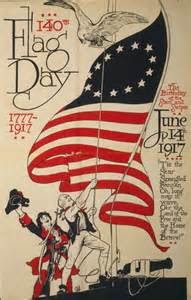 Download as PDF …
Thirteen Stars and Thirteen Stripes.
It was on JUNE 14, 1777, that the Second Continental Congress selected the FLAG of the United States.
Our founders were in the midst of fighting an eight year long war to come out from under the dominion of the most powerful globalist king in world history.
In 1885, the first version of the Pledge of Allegiance was first written by Union Army Captain George Thatcher Balch, a veteran of the Civil War.
Balch became auditor of the New York City Board of Education where he authored Methods of Teaching Patriotism in the Public Schools, 1890.
He is largely responsible for flag poles being placed in front of public schools.
Balch ‘s Pledge, called a “salute to the flag,” was:
“I give my heart and my hand to my country—one country, one language, one flag.”
Balch’s Pledge was revised in 1892, the 36-year-old Baptist minister Francis Bellamy, who was ordained in the Baptist Church of Little Falls, New York.
Bellamy was a member of the staff of The Youth’s Companion, which published the Pledge of Allegiance on September 8, 1892, in Boston, Massachusetts.
The magazine recommended the Pledge be part of school programs celebrating the first “Columbus Day,” together with prayers, patriotic speeches, the singing of “My Country, ‘Tis of Thee”, also known as “America,” written in 1831 by Samuel Francis Smith, and the reading of President Benjamin Harrison’s proclamation July 21, 1892:
“Let THE NATIONAL FLAG float over every schoolhouse in the country and the exercises be such as shall impress upon our youth the patriotic duties of American citizenship …
Let there be expressions of gratitude to Divine Providence.”
Public-school children first recited the Pledge at the National School Celebration dedicating the Chicago World’s Fair, October 12, 1892, for the 400th anniversary of Columbus’ discovery of America.
In 1916, President Woodrow Wilson designated JUNE 14 as “NATIONAL FLAG DAY.”
“I … call your attention to the approach of the anniversary of the day upon which THE FLAG OF THE UNITED STATES was adopted by the Congress as the emblem of the Union …
I therefore … request that throughout the nation … the FOURTEENTH DAY of JUNE be observed as FLAG DAY with special patriotic exercises …
to give significant expressions to our thoughtful love of America, our comprehension of the great mission of liberty and justice … for an America which no man can corrupt, no influence draw away from its ideals, no force divide against itself …
Done at the City of Washington … in the year of Our Lord one thousand nine hundred and sixteen.”
In 1954, the Knights of Columbus led a campaign to add “One Nation Under God” to the Pledge, resulting in Congress passing Public Law 396.
President Dwight Eisenhower signed it into law on Flag Day, June 14, 1954:
“Section 7. The following is designated as the Pledge of Allegiance to THE FLAG:
‘I pledge allegiance to the flag of the United States of America and to the Republic for which it stands, one Nation under God, indivisible, with liberty and justice for all.’
Such pledge should be rendered by standing with the right hand over the heart.
However, civilians will always show full respect to the flag when the pledge is given by merely standing at attention, men removing the headdress. Persons in uniform shall render the military salute.”
President Eisenhower then stood on the steps of the U.S. Capitol Building and recited the revised Pledge of Allegiance for the first time.
The words “under God” were taken from Abraham Lincoln’s Gettysburg Address, November 19, 1863:
“… that this Nation, under God, shall have a new birth of freedom.”
In 1979, a publication approved by and printed under authority of Congress titled “The Capitol-A Pictorial History of the Capitol and of the Congress” (Washington, D.C.: U.S. Government Printing Office, 1979), p. 24, commented regarding the Pledge:
“This Pledge attests what has been true about America from the beginning. Faith in the transcendent, sovereign God was in the public philosophy – the American consensus. America’s story opened with the first words of the Bible, In the beginning God …
We are truthfully one nation under God ‘and our institutions presuppose a Divine Being,’ wrote Justice William O. Douglas in 1966 …
Only a nation founded on theistic presupposition would adopt a first amendment to ensure the free exercise of all religions or of none.
The government would be neutral among the many denominations and no one church would become the state church.
But America and its institutions of government could not be neutral about God.”
Speaking of the Flag, President Calvin Coolidge stated May 31, 1926:
“Our condition today is not merely that of one people UNDER ONE FLAG, but of a thoroughly united people who have seen bitterness and enmity which once threatened to sever them pass away, and a spirit of kindness and good will reign over them all.”
Coolidge stated May 25, 1924, at the Confederate Memorial, Arlington National Cemetery, Virginia:
“It is the maintenance of our American ideals, BENEATH A COMMON FLAG, under the blessings of Almighty God … We know that Providence would have it so.”
President Franklin D. Roosevelt stated November 13, 1935:
“OUR FLAG for a century and a half has been the symbol of the principles of liberty of conscience, of religious freedom and equality before the law; and these concepts are deeply ingrained in our national character.”
During World War Two, President Franklin D. Roosevelt stated on FLAG DAY, June 14, 1942:
“The belief in man, created free, in the image of God – is the crucial difference between ourselves and the enemies we face today …
… We ask the German people, still dominated by their Nazi whip-masters, whether they would rather have the mechanized hell of Hitler’s ‘New’ Order or – in place of that, freedom of speech and religion …
We ask the Japanese people, trampled by their savage lords of slaughter, whether they would rather continue slavery and blood or – in place of them, freedom of speech and religion …
We know that man, born to freedom in the image of God, will not forever suffer the oppressors’ sword …”
Roosevelt continued:
“I am going to close by reading you a prayer …
‘God of the free, we pledge our hearts and lives today to the cause of all free mankind.
Grant us victory over the tyrants who would enslave all free men and Nations …
Grant us patience with the deluded and pity for the betrayed …
Grant us … valor that shall cleanse the world of oppression and the old base doctrine that the strong must eat the weak because they are strong.'”
After the Revolution, on June 14, 1783, General George Washington sent a “Circular Letter” to the thirteen Governors of the newly independent states. He stated:
“I am now preparing to resign …
Before I carry this resolution into effect, I think it a duty … to make this my last official communication, to congratulate you on the glorious events which Heaven has been pleased to produce in our favor …
The Citizens of America are from this period to be considered as the actors of a most conspicuous theater, which seems to be particularly designed by Providence for the display of human greatness and felicity …
Heaven has crowned all its other blessing, by giving a fairer opportunity for political happiness, than any other nation has ever been favored with …”
Washington continued with a warning:
“According to the system of policy the states shall adopt at this moment, they will stand or fall;
and by their confirmation or lapse, it is yet to be decided, whether the Revolution must ultimately be considered as a blessing or a curse …
not to the present age alone, for with our fate will the destiny of unborn millions be involved.”
Washington’s concern for “unborn millions” was indicative of the founders, who sacrificed prosperity for posterity.
Today, some are willing to sacrifice their posterity for prosperity, yoking future generations with ungodliness and unpayable debt.
John Adams wrote, April 26, 1777:
“Posterity! You will never know how much it cost the present generation to preserve your freedom! I hope you will make a good use of it.
If you do not, I shall repent in Heaven that I ever took half the pains to preserve it.”
Washington concluded with an admonition to follow the example of “the Divine Author of our blessed religion”:
“I now make it my earnest prayer that God would have you, and the state over which you preside, in His holy protection;
that He would incline the hearts of the citizens … to entertain a brotherly affection and love for one another … and particularly for their brethren who have served in the field;
and finally, that He would most graciously be pleased to dispose us all to do justice, to love mercy,
and to demean ourselves with that charity, humility, and pacific temper of mind, which were the characteristics of the Divine Author of our blessed religion, and without an humble imitation of whose example in these things, we can never hope to be a happy nation.”
Yale President Ezra Stiles spoke of the American flag, May 8, 1783, describing how this nation is different from others which dominate their people through concentrated power:
“That symbol of union, THE AMERICAN FLAG with it increasing stripes and stars, may have an equally combining efficacy for ages …
The senatorial constitution and consulate of the Roman Empire lasted from Tarquin — last Roman king, 509 B.C. — to Caesar — Roman dictator, 49 B.C. — …
The Assyrian endured without mutation through a tract of one thousand three hundred years from Semiramis — legendary ancient Babylonian queen — to Sardanapalus — alleged last Assyrian ruler, 627 B.C. — …
Nor was the policy of Egypt overthrown for a longer period from the days of Metzraim — upper and lower Nile kingdoms, c.3,300 B.C. —
till the time of Cambyses — Persian conqueror of Egypt, 525 B.C. — and Amasis — last great Egpytian ruler, 526 B.C. — …
The Medo-Persian — 550-330 B.C. — and Alexandrine Empires — 356-323 B.C. –, and that of Timur — 1370-1405 A.D. –, who once reigned from Smyrna to the Indus, were … of short and transitory duration …
Pragmatic sanction … secured the imperial succession in the House of Austria for ages — Habsburgs, 1020-1780 — …
Whatever mutations may arise in the United States, perhaps hereditary monarchy and a standing army will be the last.”
Ben Franklin warned June 2, 1787:
“There is scarce a king in a hundred who would not, if he could, follow the example of Pharaoh – get first all the people’s money, then all their lands, and then make them and their children servants forever …
There is a natural inclination in mankind to kingly government … I am apprehensive … that the government of the states may, in future times, end in a monarchy.”
Yale President Ezra Stiles continued:
“This great American revolution, this recent political phenomenon … will be … contemplated by all nations …
Navigation will carry THE AMERICAN FLAG around the globe itself; and display the thirteen stripes and new constellation at Bengal and Canton, on the Indus and Ganges, on the Whang-ho and the Yang-tse-kiang; and with commerce will import the wisdom and literature of the east …
That prophecy of Daniel is now literally fulfilling – there shall be a universal traveling to and fro, and knowledge shall be increased.
This knowledge will be brought home and treasured up in America: and being here digested and carried to the highest perfection, may re-blaze back from America to Europe, Asia and Africa, and illumine the world with truth and liberty …”
Ezra Stiles added:
“John Adams … observes — in letter from Amsterdam, April 28, 1782 — …
‘But the great designs of Providence must be accomplished … The progress of society will be accelerated by centuries by this revolution …
American ideas of toleration and religious liberty … will become the fashionable system of Europe very soon. Light spreads from the Dayspring in the west — Luke 1:78 — ; and may it shine more and more until the perfect day — Proverbs 4:18 — …'”
Stiles concluded:
“The United States will embosom all the religious sects or denominations in Christendom …
The Presbyterian,
the Church of England …
the Unitas Fratrum … Moravian bishops …
Ancient Bohemian churches …
the Baptists,
the Friends — Quakers –,
the Lutherans,
the Romanists …
the Dutch,
and Gallic,
and German reformed or Calvinistic churches …
There is a Greek church brought from Smyrna …
There are Wesyans, Mennonites … all … who will give the religious complexion to America …
Episcopal … Greek and Armenian patriarchates …
With a most generous benevolence … of a friendly cohabitation of all sects in America, proving that men may be good members of civil society, and yet differ in religion …
Little would civilians have thought ages ago, that the world should ever look to America for models of government.”
President James Buchanan stated March 4, 1857:
“We ought to cultivate peace, commerce, and friendship with all nations … in a spirit of Christian benevolence toward our fellow-men …
The people, under the protection of THE AMERICAN FLAG, have enjoyed civil and religious liberty.”
In 1865, President Abraham Lincoln commented to State Senator James Scovel of New Jersey:
“If God gives me four years more to rule this country, I believe it will become what it ought to be – what its Divine Author intended it to be – no longer one vast plantation for breeding human beings for the purpose of lust and bondage.
But it will become a new Valley of Jehoshaphat — Joel 3:2, 12 –, where all the nations of the earth will assemble together UNDER ONE FLAG, worshiping a common God, and they will celebrate the resurrection of human freedom.”
When Lincoln died, President Andrew Johnson stated April 25, 1865:
“In order to mitigate that grief on earth which can only be assuaged by communion with the Father in heaven …
I … appoint … the 25th day of May next, to be observed, wherever in the United States THE FLAG OF THE COUNTRY may be respected, as a day of humiliation and mourning, and I recommend … citizens … assemble in their respective places of worship, there to unite in solemn service to Almighty God.”
President Rutherford B. Hayes noted in his diary that during the Civil War:
“Archbishop John Baptist Purcell strung THE AMERICAN FLAG, in the crisis of our fate, from the top of the Cathedral in Cincinnati April 16, 1861! The spire was beautiful before, but the Catholic prelate made it radiant with hope and glory for our country!”
When Rutherford B. Hayes died, President Benjamin Harrison described him, January 18, 1893:
“He was a patriotic citizen, a lover of THE FLAG and of our free institutions, an industrious and conscientious civil officer, a soldier of dauntless courage, a loyal comrade and friend, a sympathetic and helpful neighbor, and the honored head of a happy Christian home.”
President Andrew Johnson stated while serving as a Senator from Tennessee (The Life and Public Services of Andrew Johnson-State Papers, Speeches and Addresses, by John Savage, NY: Derby & Miller, 1866, p. 247, appendix p. 87, January 31, 1862):
“Let us look forward to the time when we can take THE FLAG OF OUR COUNTRY and nail it below the Cross, and there let it wave as it waved in the olden times, and let us gather around it and inscribe for our motto: ‘Liberty and Union, one and inseparable, now and forever,’ and exclaim, ‘Christ first, our country next!'”
In dedicating the Oregon Trail, President Warren G. Harding stated July 3, 1923:
“Never in the history of the world has there been a finer example of civilization following Christianity.
The missionaries led under the banner of the Cross, and the settlers moved close behind under the STAR-SPANGLED SYMBOL OF THE NATION.”
On January 10, 1963, Democrat Congressman Albert Sydney Herlong Jr., of Florida, read into the Congressional Record the 45 communist goals for America, which included:
“… 12. Do away with all loyalty oaths …
17. Get control of the schools. Use them as transmission belts for socialism and current Communist propaganda. Soften the curriculum. Get control of teachers’ associations. Put the party line in textbooks.
18. Gain control of all student newspapers.
19. Use student riots to foment public protests against programs or organizations which are under Communist attack …
25. Break down cultural standards of morality by promoting pornography and obscenity in books, magazines, motion pictures, radio, and TV …
27. Infiltrate the churches and replace revealed religion with “social” religion. Discredit the Bible …
28. Eliminate prayer or any phase of religious expression in the schools on the ground that it violates the principle of “separation of church and state.”
29. Discredit the American Constitution by calling it inadequate, old-fashioned …
30. Discredit the American Founding Fathers. Present them as selfish aristocrats who had no concern for the ‘common man.’
31. Belittle all forms of American culture and discourage the teaching of American history on the ground that it was only a minor part of the ‘big picture’ …
42. Create the impression that violence and insurrection are legitimate aspects of the American tradition; that students and special-interest groups should rise up and use ‘united force’ to solve economic, political or social problems.”
Socialist Howard Zinn wrote A People’s History of the United States, 1980, in order to debunk America’s heritage.
An exposé revealing Zinn’s manipulation of the facts was written by Mary Garbar, Debunking Howard Zinn: Exposing the Fake History That Turned a Generation against America, 2019.
The Founding Fathers, for all their human failings, gave a present to future Americans, namely, each citizen gets to determine their own destiny, in a sense, be the king of their own life, and then all citizens, together, are the king of the country.
The pledge is “to the Flag and to the Republic for which it stands.”
A “republic” is where the people are king, ruling the country through their public servants called representatives.
Kings have subjects, who are subjected to the king’s will.
Republics have citizens. The word “citizen” is Greek for co-ruler, co-sovereign, co-king.
When a person pledges allegiance to the Flag, they are pledging allegiance to us being in charge of ourselves. They are saying that we, the people, are the king, not some power-usurping globalist totalitarian deep state dictator.
When someone protests the flag, they are effectively saying:
“I don’t want to be the king anymore, I protest this system where I participate in ruling myself, I would rather relinquish authority over my life to deep-state government bureaucrats.”
Whether they fully realize it or not, those who dishonor the flag are effectively rejecting:
- equality before the law,
- freedom of speech,
- freedom of conscience,
- freedom of religion, and
- inalienable rights from the Creator.
“Kneeling” is the universal sign of surrender.
Old Testament believers, such as Daniel, or Shadrach, Meshach, and Abednego, would rather be thrown into the lion’s den or into the fiery furnace than kneel to something other than God.
Early Christian believers would rather be martyred in the Roman Colosseum than kneel to something other than God.
At the Dodger versus Giants baseball game, July 23, 2020, Giants pitcher Sam Coonrod was to only player not to kneel.
When asked why, Coonrod stated: “I’m a Christian, so I just believe that I can’t kneel before anything besides God.”
The Christian Post reported, August 3, 2020:
“Orlando Magic forward Jonathan Isaac was the lone player to stand during the national anthem …
He cited the Gospel later when asked to explain his reasoning.
‘I don’t think that kneeling … for me, personally, is the answer … For me, black lives are supported through the Gospel, all lives are supported through the Gospel. My life has been supported by the Gospel …
Everyone is made in the image of God and we all share in His glory …'”
Isaac continued:
“We all make mistakes but I think the Gospel of Jesus Christ is that there’s grace for us and that Jesus came and died for our sins, and that we all will come to an understanding of that and that God wants to have a relationship with us.”
The 6’11” NBA Player Jonathan Isaac concluded:
“We all fall short of God’s glory, and at the end of the day, whoever will humble themselves and seek God and repent their sins, then we could see our mistakes and people’s mistakes and people’s evil in a different light,
and that it would help bring us closer together and get past skin color, get past anything that’s on the surface that doesn’t really deal with the hearts of men and women.”
One of the first Gospel songs that nearly all children in America were taught, was:
“Jesus loves the little children;
All the children of the world;
Red, and yellow, black, and white;
They are precious in His sight;
Jesus loves the little children of the world.”
On CNN Tonight with Don Lemon, February 1, 2019, singer Gladys Knight-the Empress of Soul, explained why she was going to sing the National Anthem, the Star-Spangled Banner, at Super Bowl 53:
“As far as this is concerned, I grew up with the national anthem … We used to sing it in school before school started.
We used to say prayers in school before school started, and we just don’t have that anymore and I’m just — I’m just hoping that it will be about our country and how we treat each other and being the great country that we are.”
On the Great Seal of the United States is the Latin phrase E Pluribus Unum, which means “Out of many, one.”
Though there are many sources for this phrase, one is that of Roman statesman Cicero, who, in De Officiis, described basic family and social bonds as the origin of society:
“When each person loves the other as much as himself, it makes one out of many — unum fiat ex Pluribus– .”
Further back, this concept was written in Leviticus 19:17-18:
“You shall not hate your brother in your heart, but you shall reason frankly with your neighbor, lest you incur sin because of him. You shall not take vengeance or bear a grudge against the sons of your own people, but you shall love your neighbor as yourself: I am the Lord.”
The opposite of this is the Latin phrase divide et impera, meaning “divide and rule” or “divide and conquer.”
This division concept was utilize throughout history, such as:
Sun Tzu’s The Art of War, Philip the Second of Macedon, Alexander the Great, Julius Caesar’s Gallic Wars, Niccolò Machiavelli, British in India, Napoleon in Europe, and others.
On a biological level, an autoimmune disease is a disease where the body attacks itself.
On a “body politic” level, this is happening in America, a type of cultural autoimmune disease, where citizens are taught to attack their own country.
Eleanor Roosevelt is credited with saying:
“Pit race against race, religion against religion, prejudice against prejudice. Divide and conquer! We must not let that happen here.”
Alexander Solzhenitsyn, who spent eleven years in socialist gulag labor camps, warned in a speech titled “Godlessness: the First Step to the Gulag,” May 10, 1983:
“Western societies are losing more and more of their religious essence as they thoughtlessly yield up their younger generation to atheism …
Atheist teachers in the West are bringing up a younger generation in a spirit of hatred of their own society.”
Attorney Chris Banescu, a regular contributor to OrthodoxyToday.org, wrote July 18, 2011:
“As a survivor of the Communist Holocaust I am horrified to witness how my beloved America, my adopted country, is gradually being transformed into a secularist and atheistic utopia, where communist ideals are glorified and promoted, while …
God has been progressively erased from our public and educational institutions …
Those of us who have experienced and witnesses first-hand the atrocities and terror of communism understand fully why such evil takes root, how it grows and deceives, and the kind of hell it will ultimately unleash …
Godlessness is always the first step towards tyranny and oppression!”
Emphasizing America’s dedication to God, President Eisenhower stated on Flag Day, June 14, 1954:
“From this day forward, the millions of our school children will daily proclaim in every city and town, every village and rural school house, the dedication of our nation and our people to the Almighty.
… To anyone who truly loves America, nothing could be more inspiring than … this re-dedication of our youth, on each school morning, to our country’s true meaning …
… In this way we are reaffirming the transcendence of religious faith in America’s heritage and future; in this way we shall constantly strengthen those spiritual weapons which forever will be our country’s most powerful resource, in peace or in war.”
—
American Minute is a registered trademark of William J. Federer. Permission granted to forward, reprint, or duplicate.
What On Earth Is Going On In Maine?
(This is from Liberty Counsel http://www.lc.org
Under Gov. Janet Mills, Maine has become one of the most anti-Christian states in the nation. In fact, Liberty Counsel has sued this particular governor more than any other governor in the Union! And the only state we have sued more often in our 36-year history is California.
But even CA Gov. Gavin Newsom learned the hard way, during the COVID shutdowns, that Liberty Counsel will not allow anti-God governments to discriminate against Christians. But the State of Maine has somehow missed the message.
The anti-God political machine running the Pine Tree State seems bent on eradicating Christianity from the state.
ONE church appears to be “ground zero” for Maine’s anti-Christian attacks — Calvary Chapel.
Liberty Counsel is fighting back.
Maine has a rich religious history. Catholic missionaries arrived in the state in 1604. The first Christian mass in all of New England was held on Maine’s Swan Island in 1611.
During the colonial years, the Puritans, followed by the Congregationalists, dominated Maine. The colony even required towns to fund a Congregational church and minister. Methodists, Baptists, and Freewill Baptists arrived in the 18th century, and Jews soon followed at the end of the 19th century.
But fast-forward to the 21st century and Maine is tied with Vermont for being “the least religious state” in the nation.
Since being targeted by Gov. Mills’ unconstitutional COVID lockdowns on churches, Calvary Chapel of Bangor has birthed six churches spanning the sparsely populated state. Pastor Ken Graves and Calvary Chapel are working to change Maine’s spiritual landscape by sharing the gospel and transforming broken people. But an anti-God governor and a league of similarly minded bureaucrats is doing their darndest to try to stop the revival happening in Maine.
During the COVID shutdowns, ME Gov. Janet Mills threatened to throw the participants in Calvary Chapel Bangor’s drug rehabilitation program in prison if they read the Bible and prayed together during Mills’ unlawful church shutdowns. Mills ordered that the group could meet, so long as they DID NOT read the Bible or pray.
Liberty Counsel took Mills and Maine to court, and Mills and her crew had to end her outrageous restrictions on churches and places of worship.
In 2022, Maine lost again, this time at the U.S. Supreme Court when the state allowed vouchers for any schools — except Christian schools. The High Court ruled Maine’s law unconstitutional.
Then, a Maine state family court judge banned a member of Calvary Chapel from taking her own daughter to church. The judge cited the opinion of a Marxist California professor in declaring that churches are “cults.”
Liberty Counsel has taken up this case on appeal, and continues to fight for this born-again Christian mother and her daughter’s right to attend the church of their choice.
Now, the University of Maine System is refusing to sell an excess university property to the highest bidder solely because the winning bidder is a Christian church. That church is Calvary Chapel Belfast.
Liberty Counsel is taking Maine back to court again…and we intend to win.
Don’t let anti-God governors and bureaucrats silence the gospel! Support our legal fund today!
I don’t know what Gov. Mills and the anti-God political machine running Maine have against Calvary Chapel’s network of churches, which extend from the cold shores of Portland through the Highlands and right to the St. Crois Valley, which borders Canada. Maybe it’s because Calvary Chapel is saving so many souls, bringing lost people back into Christ’s flock.
What I do know is that discrimination against Christians and churches is against the law.
Liberty Counsel will not stop fighting until the State of Maine stops attacking Christians and their churches.
For over 35 years, Liberty Counsel has been defending life, religious freedom, and the natural family. We’ve won 37 cases before the U.S. Supreme Court and thousands of others before state courts and the U.S. Courts of Appeal.
We NEVER charge for our work because most people — and churches — could not afford to defend themselves against anti-Christian governors and governments. Our clients rely on YOU, the faithful Liberty Counsel supporter, to ensure liberty remains free.
A generous supporter has established a special Challenge Grant to support our work. But that grant only kicks in when you do. Every donation made to our legal fund today will be DOUBLED in impact. Even recurring monthly donations will be doubled for the duration of the grant! Please, help us defend the faith with your generous gift today.
Mat Staver
Founder and Chairman
Liberty Counsel
TAKE ACTION
Even a small recurring monthly donation would be incredibly helpful in defending life, religious liberty, and the natural family, AND that recurring donation will be DOUBLED in impact for the duration of the Challenge Grant!
Sources:
“Catholic Sites in Maine.” Roman Catholic Diocese of Portland. Accessed March 3, 2025. Portlanddiocese.org/catholic-sites-maine.
Hatlen, Burton, Joshua M. Smith, Peter Lodge, and Michael Hermann. “A Sampler from the New Historical Atlas of Maine: Religion in Maine.” Maine Policy Review 11.1 (2002): 48 -57, Digitalcommons.library.umaine.edu/mpr/vol11/iss1/11.
“Least Religious States 2023.” Wisevoter. Accessed March 3, 2025. Wisevoter.com/state-rankings/least-religious-states.
Judd, Richard. “Religion on Maine’s Frontier.” Maine History Online. Accessed March 3, 2025. Mainememory.net/sitebuilder/site/825/page/1235/display.
“The History of Our Presbyterate.” Roman Catholic Diocese of Portland. Accessed March 3, 2025. Portlanddiocese.org/vocations/history-our-presbyterate.
D-Day, June 6, 1944 & Nazi aggression that led up to it; “A Struggle to Preserve our Republic, our Religion & our Civilization” – American Minute with Bill Federer
1944? FDR “A Struggle to Preserve our Republic June 6 our Religion & our Civilization” What led up to D-Day

After World War I, Germany’s economy suffered from depression and a devaluation of their currency.
On January 30, 1933, Adolph Hitler was elected Chancellor of Germany by promising hope and universal healthcare.
Less than a month later, on February 27, 1933, a crisis occurred — the Rheichstag, Germany’s Capitol Building, was suspiciously set on fire, with evidence pointing to Hitler’s supporters.
Hitler, though, blamed the attack on his political opponents and used the power of the state to falsely accused and arrest them.
Hitler used the panic of the “crisis” as an opportunity to suspend citizens’ rights and systematically undermine Germany’s Weimar Republic.
He had radical homosexual activist Ernst Röhm and his feared Brownshirts, called “Sturmabteilung” (storm troopers), to storm into the meetings of his political opponents, disrupting and shouting down speakers.
Brownshirts organized protests and street riots, similar to modern day BLM/Antifa-style protests, smashing windows, blocking traffic, setting fires, vandalizing, and even beating to death innocent bystanders to spread fear and panic.
Nazis implemented boycotts of Jewish businesses.
The riots destabilized the country and led to the overthrow old political leaders.
On Kristallnacht (Night of Broken Glass), they broke windows, looted and set on fire over 7,500 Jewish stores and 200 synagogues.
Once securely in power, Hitler had his SS and Gestapo secret police kill the Brownshirts in the Night of the Long Knives, thus eliminating competition and giving the public impression that he was cracking down on lawbreakers.
Nazis had old military leaders falsely accused and forced to retire.
Some were imprisoned and even shot without a trial.
He pushed a type of critical race theory, whereby all other races were taught that they were inferior to the Aryan race.
Hitler then confiscated weapons from law-abiding citizens.
An SA Oberführer warned of an ordinance by the provisional Bavarian Minister of the Interior:
“The deadline set … for the surrender of weapons will expire on March 31, 1933. I therefore request the immediate surrender of all arms …
Whoever does not belong to one of these named units (SA, SS, and Stahlhelm) and … keeps his weapon without authorization or even hides it, must be viewed as an enemy of the national government and will be held responsible without hesitation and with the utmost severity.”
Heinrich Himmler, head of Nazi S.S. (“Schutzstaffel”-Protection Squadron), announced:
“Germans who wish to use firearms should join the S.S. or the S.A. Ordinary citizens don’t need guns, as their having guns doesn’t serve the State.”
In 1938, when a suspected homosexual youth shot a Nazi diplomat in Paris, it was used as an excuse to confiscate all firearms from Jews.
German newspapers printed, November 10, 1938:
“Jews Forbidden to Possess Weapons by Order of SS Reichsführer Himmler, Munich …
‘Persons who, according to the Nürnberg law, are regarded as Jews, are forbidden to possess any weapon. Violators will be condemned to a concentration camp and imprisoned for a period of up to 20 years.'”
The New York Times, November 9, 1938, reported:
“The Berlin Police … announced that … the entire Jewish population of Berlin had been ‘disarmed’ with the confiscation of 2,569 hand weapons, 1,702 firearms and 20,000 rounds of ammunition.
Any Jews still found in possession of weapons without valid licenses are threatened with the severest punishment.”
Of the Waffengesetz (Nazi Weapons Law), March 18, 1938, Hitler stated at a dinner talk, April 11, 1942 (Hitler’s Table Talk 1941-44: His Private Conversations, 2nd Edition, 1973, p. 425-6, translated by Norman Cameron and R. H. Stevens):
“The most foolish mistake we could possibly make would be to allow the subject races to possess arms.
History shows that all conquerors who have allowed their subject races to carry arms have prepared their own downfall by so doing …
So let’s not have any native militia or native police. German troops alone will bear the sole responsibility for the maintenance of law and order.”
Hitler’s Minister of Propaganda, Joseph Goebbels, pioneered the use of fake news to sway public opinion so that the entire nation accepted the lies of the deep-state:
“If you tell a lie big enough and keep repeating it, people will eventually come to believe it …
The truth is the greatest enemy of the state.”
In socialist countries, a person’s life is only of worth if it benefits the state:
“No life still valuable to the state will be wantonly destroyed.” (German Penal Code, October 10, 1933)
Those not promoting the deep-state narrative were driven from their jobs, publicly ridiculed, and eventually removed from society and sent to labor and concentration camps.
Anti-socialist John Basil Barnhill stated in a debate with Henry M. Tichenor, 1914 (National Rip Saw Publishing Co., St. Louis, MO):
“Where the people fear the government you have tyranny. Where the government fears the people you have liberty.”
This is similar to Robert F. Kennedy, Jr., who warned at Hillsdale College, April 11, 2023:
“1. Any power that government takes from the people, it will never return voluntarily;
2. Every power that government takes, it will ultimately abuse to the maximum extent possible;
3. Nobody ever complied their way out of totalitarianism. The only thing we can do is resist.”
2. Every power that government takes, it will ultimately abuse to the maximum extent possible;
3. Nobody ever complied their way out of totalitarianism. The only thing we can do is resist.”
National Socialist Workers Party operated over 1,200 concentration camps where millions of Jews, Poles, Gypsies, handicapped, and others were experimented upon, tortured, or were killed in gas chambers.
German churches were silent, as they had for centuries taught pietism – a version of separation of church and state where Christians were instructed to only focus on their own personal spiritual life and withdraw from involvement in worldly politics.
As a result, the church stood by silent as the National Socialist Workers Party usurped power, leaving the work of stopping Hitler to done by the sacrifice of millions of courageous Allied soldiers.
By the time a few courageous Germany church leaders spoke out, such as Dietrich Bonhoeffer, it was too late — the government had grown so powerful it simply arrested and executed them.
Hitler’s National Socialist Workers’ Party used diplomatic intimidation, deception, and Blitzkrieg “lightning war” attacks to take control of:
- Austria,
- The Sudeten Region,
- Bohemia,
- Moravia,
- Poland,
- Denmark,
- Norway,
- Luxembourg,
- Belgium,
- Holland,
- France,
- Monaco,
- Greece,
- The Channel Island (UK),
- Czechoslovakia,
- Baltic states,
- Serbia,
- Italy,
- Hungary,
- Romania,
- Bulgaria,
- Slovakia,
- Finland,
- Croatia, and more.
Other Axis Powers were also aggressively expanding:
- Italy had invaded Ethiopia in 1935, and
- the Empire of Japan had invaded China in 1937.
The United States entered World War II on December 7, 1941, when Pearl Harbor was bombed by Imperial Japan, a Tripartite Pact partner with Nazi Germany and Italy’s Benito Mussolini.
The turning point in the Pacific War was the Battle of Midway, June 4, 1942.
The turning point in Europe was D-Day, JUNE 6, 1944.
Over 160,000 troops from America, Britain, Canada, free France, Poland, and other nations landed along a 50-mile stretch of the Normandy coast of France.
In his D-Day Orders, JUNE 6, 1944, Supreme Allied Commander General Dwight Eisenhower sent nearly 100,000 Allied troops marching across Europe to defeat Hitler’s National Socialist Workers Party:
“You are about to embark upon the Great Crusade … The eyes of the world are upon you.
… The hopes and prayers of liberty loving people everywhere march with you …
You will bring about … the elimination of Nazi tyranny over the oppressed peoples of Europe …
… Your task will not be an easy one. Your enemy is well trained, well equipped and battle hardened, he will fight savagely …
And let us all beseech the blessings of Almighty God upon this great and noble undertaking.”
It was the largest seaborne invasion force in world history, supported by 13,000 aircraft, 5,000 ships with 195,700 navy personnel.
Prior to the invasion, Allies attempted to mislead the Nazis as to where the attack would take place.
The invasion was supposed to take place June 5, but the weather was so bad aircraft could not fly. General Eisenhower gave the risky order to delay the attack 24 hours to allow the weather and tide to improve.
The night before, Allied aircraft launched an enormous air assault on Nazi defenses, batteries, and bridges.
Then paratroopers were sent in behind enemy lines to cut off their supplies.
President Ronald Reagan stated at the 40th Anniversary of D-Day:
“Something else helped the men of D-day: their rockhard belief that Providence would have a great hand in the events that would unfold here; that God was an ally in this great cause.
And so, the night before the invasion, when Colonel Wolverton asked his parachute troops to kneel with him in prayer he told them:
‘Do not bow your heads, but look up so you can see God and ask His blessing in what we’re about to do.’
Also that night, General Matthew Ridgway on his cot, listening in the darkness for the promise God made to Joshua: ‘I will not fail thee nor forsake thee.'”
Then elite Army Rangers went in to scale the cliffs and take out Nazi machine gun positions.
President Reagan stated:
“40 years ago at this moment, the air was dense with smoke and the cries of men, and the air was filled with the crack of rifle fire and the roar of cannon.
At dawn, on the morning of the 6th of June, 1944, 225 Rangers jumped off the British landing craft and ran to the bottom of these cliffs.
Their mission was one of the most difficult and daring of the invasion: to climb these sheer and desolate cliffs and take out the enemy guns.
The Allies had been told that some of the mightiest of these guns were here and they would be trained on the beaches to stop the Allied advance.
… The Rangers looked up and saw the enemy soldiers — the edge of the cliffs shooting down at them with machineguns and throwing grenades.
And the American Rangers began to climb.
They shot rope ladders over the face of these cliffs and began to pull themselves up. When one Ranger fell, another would take his place.
When one rope was cut, a Ranger would grab another and begin his climb again. They climbed, shot back, and held their footing.
… Soon, one by one, the Rangers pulled themselves over the top, and in seizing the firm land at the top of these cliffs, they began to seize back the continent of Europe. Two hundred and twenty-five came here.
After 2 days of fighting, only 90 could still bear arms.”
At 6:30am, Allied forces began landing.
Troops ran across the heavily fortified beaches of:
- Utah Beach
- Pointe du Hoc
- Omaha Beach
- Gold Beach
- Juno Beach
- Sword Beach
Ocean water ran red with the blood of almost 9,000 killed or wounded.
In the next two and a half months, over two million soldiers arrived on the shores.
Paris was liberated on August 25, 1944, and the Nazi war machine was pushed back over the Seine River
It was a major turning point in World War II.
Reagan continued:
“The men of Normandy had faith that what they were doing was right, faith that they fought for all humanity, faith that a just God would grant them mercy on this beachhead or on the next.
It was the deep knowledge — and pray God we have not lost it — that there is a profound, moral difference between the use of force for liberation and the use of force for conquest.”
Shortly after D-Day, on July 20, 1944, a courageous German resistance movement was formed which attempted to assassinate Hitler, but he survived.
Hitler retaliated by killing over 7,000 Germans.
President Franklin Roosevelt stated JUNE 6, 1944:
“My fellow Americans: Last night, when I spoke with you about the fall of Rome, I knew at that moment that troops of the United States and our allies were crossing the Channel in another and greater operation …
I ask you to join with me in prayer:
Almighty God, Our sons, pride of our Nation, this day have set upon a mighty endeavor, a struggle to preserve our republic, our religion, and our civilization …
Give strength to their arms, stoutness to their hearts, steadfastness in their faith. They will need Thy blessings. Their road will be long and hard.
For the enemy is strong. He may hurl back our forces … We know that by Thy grace, and by the righteousness of our cause, our sons will triumph …
Some will never return. Embrace these, Father, and receive them, Thy heroic servants, into Thy kingdom …”
Of those who “never returned” was Orval Wilford “Billy” Epperson, the uncle of the writer of this article.
He was a 2nd Lieutenant in the U.S. Army Air Corp, (525th Bomber Squadron, 379th Bomber Group, Heavy, A.P.O. 550 (#0-768946), Recipient of the Purple Heart.)
Oval W. “Billy” Epperson was killed during Operation Overlord one month after D-Day.
His B-17 Flying Fortress, nicknamed “Pansy Yokum,” was shot down on July 9, 1944, about 8 ½ miles northwest of Le Havre (over the English Channel.)
His name is on the monument near Omaha Beach, at the Cimitière Amèrican de Normandie (in Colleville-sur-Mer, France) at the Killed in Action Wall (“Tablet of the Missing”).

FDR concluded his D-Day Prayer:
“Help us, Almighty God, to rededicate ourselves in renewed faith in Thee in this hour of great sacrifice …
I ask that our people devote themselves in a continuance of prayer. As we rise to each new day, and again when each day is spent, let words of prayer be on our lips, invoking Thy help to our efforts.
Give us strength … and, O Lord, give us Faith. Give us Faith in Thee … With Thy blessing, we shall prevail over the unholy forces of our enemy …
And a peace that will let all of men live in freedom, reaping the just rewards of their honest toil. Thy will be done, Almighty God. Amen.”
FDR’s D-Day Prayer has been added to the World War II Memorial in Washington, D.C., thanks to the tireless efforts of Chris Long of the Ohio Christian Alliance who initiated The D-Day Landing Prayer Act (S 1044).
A bipartisan bill was introduced in the House by Ohio Congressman Bill Johnson, introduced in the Senate by Ohio Senator Rob Portman, and signed into law in 2014.
The website for this historic project is: www.ddayprayerproject.org
President Donald Trump read a portion of Franklin Roosevelt’s D-Day Prayer at the 75th anniversary memorial event held in Portsmouth, England, with England’s Queen Elizabeth II, Prime Minister Theresa May, French President Emmanuel Macron, and other world leaders.
FDR stated in his D-Day Prayer that the war was “a struggle to preserve our republic, our religion, and our civilization.”
A Democrat, President Roosevelt shared his Christian nationalist sentiments during a Fireside Chat, April 28, 1942:
“THIS GREAT WAR effort must be carried through … It shall not be imperiled by the handful of noisy traitors — betrayers of America, betrayers of Christianity itself.”
FDR stated at Madison Square Garden, NY, October 28, 1940:
“WE GUARD AGAINST the forces of anti-Christian aggression, which may attack us from without, and the forces of ignorance and fear which may corrupt us from within.”
FDR stated in Brooklyn, New York, November 1, 1940:
“THOSE FORCES HATE democracy and Christianity as two phases of the same civilization. They oppose democracy because it is Christian. They oppose Christianity because it preaches democracy.”
FDR stated in a Labor Day Address, September 1, 1941:
“PRESERVATION OF THESE rights is vitally important now, not only to us who enjoy them, but to the whole future of Christian civilization.”
As Franklin Roosevelt was an outspoken defender the nation as well as Christian civilization, one wonders if the modern mainstream media would label him a “Christian nationalist.”
FDR addressed Congress, March 1, 1945:
“I SAW SEVASTOPOL and Yalta! And I know that there is not room enough on earth for both German militarism and Christian decency.”
Eleven months after D-Day, the war in Europe ended with an Allied victory on May 8, 1945.
FDR stated May 27, 1941:
“THE WHOLE WORLD is divided between … pagan brutality and the Christian ideal. We choose human freedom which is the Christian ideal.”
—
American Minute is a registered trademark of William J. Federer. Permission granted to forward, reprint, or duplicate.
The Weekly Sam: The NEA Trojan Horse in American Education

The following is from a description of Sam’s book on Amazon:
When Sam Blumenfeld was finishing his 1984 book on the NEA his manuscript was refused by all publishers. Reason: They all believed he and they would be dragged into court frivolously by the NEA Union to prevent him form getting his extensive research in the book out into the public. In other words, publishers were being intimidated by the powerful Teacher’s Union. Finally, he found a brave small group who formed a new publishing company and risked everything to get his blockbuster revelations into print. Fortunately, the NEA was more busy at that time dealing with newly elected Ronald Reagan and his administration to bother squashing Sam’s publisher. The rest is history: the book sold tens of thousands of copies and was in print for many years. It was, and still is, the seminal book on the professional group which ultimately dropped all pretenses of being devoted only to the kids and their education. As recently as 2009 the NEA’s top attorney, Bob Channin [July 9, 2009, NEA Representative Assembly, San Diego] in a speech to his members, stated in effect that the interests of the members came ahead of the interest of the kids.
“Although this book was first published in 1984, everything in it is as relevant today as when it was first published. If anything, the NEA has simply moved even further to the left than it was back them. It has simply adopted all of the politically correct trends of the far left. The history behind all of this has not changed. Thus, the NEA’s influence in American education as a force of the left is still a fact that parents of children in the public schools must deal with.” — Samuel L. Blumenfeld – Preface to 2011 Edition
Here is a link to a free PDF version of the book:
http://blumenfeld.campconstitution.net/Books/NEA-Trojan%20Horse%20In%20American%20Education.pdf
