A Trip to Camp Constitution–Happenings on the Way to Heaven by Kathryn van der Pol

Happenings on the Way to Heaven
Copyrighted by Kathryn van der Pol
July 23, 2023
#38
Last week I told you that Sybren and I were headed to New Hampshire. By the time you read this, we’re settled back in Washington, mowing our meadows, weeding the gardens, and readjusting to Texas’s habanero heat.
We drove through seventeen states: Arkansas, Kentucky, Ohio, Pennsylvania, New York, Vermont, New Hampshire, Maryland, West Virginia, Virginia, North Carolina, South Carolina, Georgia, Alabama, Mississippi, Louisiana, and, of course, Texas, driving a “great circle” of over 4,000 miles. It’s good to be home.
The primary purpose of our trip was to attend Camp Constitution in New Hampshire. It was funny to hear the campers complain about it being “hot” when it was only 85 degrees. It also rained a good bit. How I wished I could have bottled up the rain clouds and delivered them to Washington.
Hal Shurtleff is the founder of Camp Constitution. He started it 15 years ago for families, most with children, to learn about the founding fathers, current events, the Declaration of Independence the U.S. Constitution and Bill of Rights.
Shurtleff is a Constitutional celebrity in his own right. Last year he won a Supreme Court decision 9-0, involving the free exercise and establishment clause of the First Amendment.
In 2017, his camp took a field trip to Boston’s City Hall for a celebration. The City Hall had three flag poles: one for the U.S. flag, one for the Massachusetts flag, and one for citizens to use. Shurtleff had brought a Christian flag which has a white background with a cross in the corner. The clerk at City Hall would not allow him to raise the Christian flag, saying it violated separation of Church and State. So, Shurtleff sued and in January 2022, the U.S. Supreme Court voted unanimously to uphold his and Camp Constitution’s unalienable right to exercise their freedom of religion. The court stated there was no evidence that the state was establishing a religion by allowing the raising of the Christian flag, but by forbidding Hal to raise the flag, the city denied his right to exercise his freedom of religion.
I first learned of Camp Constitution years ago watching an online presentation by a Harvard professor who mentioned it in his talk. Curious, I looked at it and thought it was a great idea. Imagine bringing families together for five to camp out in the beautiful outdoors, hear talks on history and current events by talented speakers, go to campfires, play games, and come home relaxed, invigorated, wiser and a better citizen.
The camp is designed for children ages five to infinity. There is one program for 5-to 11-year-olds and another for everybody else. So, moms and dads have time to learn, too.
From what I’ve experienced since Sybren and I moved to Washington, there is momentum to strengthen leadership in all areas of government, business, education, and our churches. One of the great blessings of living here is the community’s widespread appreciation of traditional Judeo-Christian values. Yet, in the past couple of years, we’ve seen efforts to undermine those values, too.
Earlier, I wrote about the Education Pillar that the Texas Leadership Summit held in Brenham. At that event, nationally recognized journalist, Alex Newman, was one of the speakers. He mentioned to me that he was part of Camp Constitution, so this brought back all my earlier research, and my imagination raced into high gear.
That prompted me to think, could we do Camp Constitution here? Is there interest in a program that involves parents, grandparents, and children all learning together? Can we start Camp Constitution in Washington County or close by?
Most of us who have common sense and lived long enough realize that the only long-term solution to turn around the country is education. The only way to resist the secular, atheistic, socialist, communist agendas of our enemies is to practice our faith publicly. Live it out in the public square. Do the things that encourage and strengthen families. Do the things that give people hope for a better life. Do the things that encourage civil discourse and respect for differences. Do the things that promote citizen participation in all branches of government.
When I emailed Hal and asked him if we could expand Camp Constitution to Texas, he said, “Yes! Absolutely, but why don’t you come up here and see it?” So, we did.
The rest is history.
We took classes titled, “The Declaration of Independence,” “Philosophical Worldview of the Constitution,” “Communist China and the New World Order, “The American View of Law and Government,” “Global Societal Crises of the 17th Century: The Sun-Earth Connection.”
Interspersed with these talks, two pastors gave sermons, and we prayed for our country on our knees.
The little children had classes on the first amendment. They made root beer and tie-dyed t-shirts. They created an Independence parade. They sang patriotic songs and memorized the Preamble to the Constitution.
All the children went swimming, hiking, and played tournament games. Each morning began with a flag ceremony and Reveille and ended with a flag ceremony and Taps, played by one of the older boys on his trumpet. Every night adults and children participated in campfire, guitar playing, singing old ballads, performing skits, and telling jokes. It was fun seeing people be joyful, playful, and respectful.
Sybren and I made wonderful new friends and had great conversations. It was exciting to experience America, still the land of the free and the home of the brave.
Questions or comments? Write Kathryn@TexasHeritage.net

This article was originally published in the Brenham Banner Press Washington County Texas. Mrs. van der Pol is Sunday columnist for their paper and writes about matters of faith and history. (Editor)
The Weekly Sam; The New Education Reform: Will It Work? from John Dewey to Marc Tucker in One Hundred Years By Samuel L. Blumenfeld

You cannot really understand the nature and scope of the present education reform
program coming out of Washington unless you understand that it is the culmination of
plans initiated by the progressives about a hundred years ago. In other words, what
we have today emanating from the U.S. Department of Education and the education
establishment in general is the same master plan mapped out by John Dewey and his
colleagues at the turn of the century to change America’s social order. True, there
have been twists and turns, arguments and debates among the educational elite, but
all in all the basic plan of the progressives remains intact.
Who were the progressives? They were a new breed of educator, members of the
Protestant academic elite who no longer believed in the religion of their fathers. They
rejected Biblical religion as myth and legend and put their faith in science, evolution,
and psychology. Science explained the nature of the material world, evolution
explained the origin of living matter — our original soma emerged from the primoradial
ooze and through a remarkable series of accidents ended up with us — and
psychology provided the means to study human nature scientifically and to control
human behavior. What more could an educator possibly want?
Now the progressives were also socialists. Why? Because they had to deal with the
problem of evil and they refused to accept the Biblical view. The Bible tells us that man
is a fallen creature, having disobeyed God by eating of the tree of the knowledge of
good and evil, and that as a result, man is the cause of his own misery. In other words,
the origin of evil is man’s heart, not the environment or the ozone layer or the stock
market. John Calvin characterized fallen man as being innately depraved. Catholics, of
course, call it original sin.
What Calvin meant is that when man departs from God he is capable of any depravity
he can think of. But the Bible provides a happy solution for all of this. Which means
that man can still have a happy, productive and long life provided that he live in
accordance with God’s law. Indeed, his sins can be forgiven, he can be saved and
have eternal life after death if he accepts Jesus Christ as his Savior. In other words,
the Bible presents us with the problem of man’s sinful nature, but also provides the
solution.
However, the progressives rejected all of that as myth and legend. But they still had to
deal with the problem of evil. What caused it? Since they believed that there was no
God, there could be no such thing as sin — which is an offense against God. So where
did evil come from? They decided that it came from ignorance, poverty, and social
injustice. And what caused social injustice? Why it was this terrible capitalist system
of ours, this dog-eat-dog world of economic competition, private property, and
individualism which created selfish people. The solution: socialism, which would
replace individualism with collectivism, get rid of private property or at the very least
bring private property under the control of government, and finally get rid of religion
with its ridiculous notion of sin that so terribly undermined man’s self-esteem.
The question then became how do you change America from a capitalist system to a
socialist one? The answer was simple: change the curriculum in the education
system so that it would produce little socialists instead of little individualists. The
progressives realized that adult Americans were not about to give up their
individualism or private property or free enterprises or religion. And so they realized
that they would have to educate children in such a manner that they as adults would
usher in the new socialist utopia through democrattic means.
And so, beginning in about 1898 the progressives began their messianic crusade to
reform American education in order to bring about socialism. The reason why I call the
progressive movement a messianic crusade is because of the spiritual aspects of the
crusade. You see, the reason why the crusaders had to bring about socialism is
because that was the only way they could prove that they were right and the Bible was
wrong. They were convinced that once we had socialism, it would be seen that man
was not a fallen creature but was instead imbued with overwhelming benevolence and
good will.
These progressives all came from good Christian homes, and they all knew the Bible.
If the Bible was right and they were wrong, they knew where they’d be going. And so
they were driven by a strong messianic motive to prove their rightness. Incidentally,
the progressives for the most part did not get their vision of socialism from Karl Marx,
but from an American by the name of Edward Bellamy who wrote a book entitled
Looking Backward, published in 1888. In that book Bellamy projected the fantasy of a
socialist America in the year 2000. If you want to know what that vision was like, read
the book.
One can say that this crusade began in earnest in 1898 because that was the year in
which John Dewey wrote his influential essay, “The Primary-Education Fetich,” in
which he singled out high literacy as the great obstacle to socialism because it tended
to produce individuals who could stand on their own two feet and think for themselves.
(Unstated, but clearly known by the progressives was the fact that high literacy was
also a prerequisite for Biblical literacy.) What we needed in the primary grades,
Dewey argued, was less emphasis on literacy and more emphasiS on socialization. In
effect, what he was saying was that the masses had to be dumbed down in order to
make it easy for the ruling elite to impose socialism. And he outlined a strategy
whereby all of this could be done with the public hardly noticing. He wrote:
Change must come gradually. To force it unduly would ccmpromise its final success by favoring a violent
reaction.
That’s an interesting statement. If the reforms he proposed were so great, why would
they provoke a violent reaction? Obviously, Dewey and his colleagues knew that their
reforms would go against the grain of American tradition. Dewey goes on:
What is needed in the first place is, that there should be a full and frank statement of conviction with regard
to the matter from physiologists and psychologists and from those school administrators who are
conscious of the evils of the present regime.
So there you already see in 1898 what the role of the psychologists would be. They
were to use scientific arguments to discredit the traditional curriculum. On the crucial
matter of primary reading instruction, the first psychologist to answer Dewey’s call was
Edmund Huey, whose book, The Psychology and Pedagogy of Reading, published in
1908, became the bible of the look-say, whole-word advocates. They used Huey’s
book to provide a pseudo-scientific justification for getting rid of alphabetic phonics
and instituting whole-word instruction in its place. Dewey continues:
There are already in existence a considerable number of educational “experiment stations,” which
represent the outposts of educational progress. If these schools can be adequately supported for a
number of years they will perform a great vicarious service. After such schools have worked out carefully
and definitely the subject-matter of a new curriculum,–finding the right place for language studies and
placing them in their right perspective,–the problem of the more general educational reform will be
immensely simplified and facilitated.
And so, what Dewey was saying to his progressive colleagues was that they needed
to try all of their new ideas in private experimental schools to see what kind of results
they would get before implementing them wholesale throughout the public school
system.
Incidentally, one of the experimental schools that was used for this purpose was the
Lincoln School at Teachers College of Columbia University, New York. John D.
Rockefeller Jr. gave the school $3 million in 1917 and put four of his five sons in that
school. Alvin Moscow, in his book The Rockefeller Inheritance, writes:
Unlike private schools of its time, Lincoln was co-educational and non-segregated. The Rockefeller boys
mixed with children from all walkS of life …. Boys studied sewing and cooking with the girls, and the girls
took shop courses with the boys. Reading, writing and arithmetic were introduced only when a child was
ready and eager to leam. He was expected to pick up these fundamentals out of natural curiosity and
desire to learn …. Nelson never did learn to spell or master his numbers … Laurence … encountered
trouble with his three R’s. However, he did make Princeton, where, in his freshman year, facing written
examinations for the first time, he almost flunked out. Winthrop had the most trouble. He floundered in
the freedom and lack of discipline at Lincoln and in the tenth grade was transferred to the Loomis School,
a more formal prep boarding school … in Connecticut. … Unprepared for the higher scholastic standards
at Loomis, at the first marking period, where D was the lowest passing mark, Winthrop earned two E’s and
three F’s. But he liked Loomis and was saved there by his high marks for effort.
David, the youngest son was the only one that did well at the Lincoln School. He had no trouble with the three R’s and eventually went to Harvard, He then went on to become
a leader of the internationalist movement leading to world government. Nelson, who
was severely dyslexic, hired Henry Kissinger to do his reading and thinking for him.
And Winthrop went on to become Governor of Arkansas. In any case, by the 1920’s, it
was already known by the progressives that their kind of education had great
academic drawbacks, and they had the Rockefeller boys to prove it. But that didn’t
faze them because that’s what they actually wanted.
Now the reason why I have gone back to the origins of the progressive education
movement is because it is important to know the false premise on which the movement
was founded, the premise that evil is caused by ignorance, poverty, and social
injustice. Twentieth Century history has proven beyond any doubt the falsehood of
that premise. Let me give you proof. One of the most evil men of the century was Dr.
Mengele, the Nazi doctor at the Auschwitz death camp who performed horrible
medical experiments on live human beings. Was he ignorant? No, he had the best
education Germany could provide. Was he the victim of poverty? No, he was born in
a wealthy family with a silver spoon in his mouth. Was he the victim of social injustice?
To the contrary, he was a member of Germany’s privileged elite. So where did his evil
impulses come from? From his innate sinful nature. He put his faith not in God but in
Satanic Adolf Hitler, who gave him the freedom to be as evil as his heart desired.
So we know that the premise of our education reform movement is false. But there is
also a second false premise on which the education reform movement is built, and that
is the belief that public educators have the moral right, indeed the moral duty, to
change the values and beliefs of the children in their charge without the knowledge or
consent of their parents. That was very clearly spelled out in Prof. Benjamin Bloom’s
famous Taxonomy of Educational Objectives published in 1958 in which he wrote:
By educational objeclives, we mean explicil formulations of the ways in which students are expected to be
changed by the educative process. That is, the ways in which they will change in their thinking, their
feelings, and their actions ..
The evidence points out convincingly to Ihe fact that age is a factor operating against attempts to effect a
complete or thorough-going reorganization of attitudes and values.
The evidence collected thus far suggests that a single hour of classroom activity under certain conditions
may bring about a major reorganization in cognitive as well as affective behaviors. We are of the opinion
that this will prove to be a most fruitful area of research in connection with the affective domain.
Thus, when American educators speak of subjecting children to a thorough-going
reorganization of their attitudes and values what they really mean is getting children to
shed their Biblical values in favor of humanist values, to shed their belief in absolute
moral values in favor of moral relativism and situational ethics.
America was founded by people who believed that God was sovereign over our nation
and that His law prevailed over the laws of man. Indeed, the U.S Constitution is a
perfect example of man’s law being completely compatible with God’s law. However,
once you reject God, then God’s sovereignty and law is replaced by State sovereignty
and law. T he State, then, becomes God, and the public educators can claim that they
now represent the public good and have the moral duty to train children to serve the
secular state whose compelling interests override all other interests.
By the way, it is not at all difficult to trace the history of this reform movement from its
very beginning to the present, for the reformers have kept very good records of their
progress in the annual yearbooks of The National Society for the Study of Education.
The first yearbook was published in 1901. If you study the names of the society’s
officers, you will find among them the best known advocates of humanism and
socialism, including Harold Rugg, William H. Kilpatrick, Ernest Horn, George S.
Counts, John Goodlad, Ralph Tyler, Benjamin Bloom, and many others.
What is impressive about the reform movement is its meticulous attention to detail, its
continuity, and the way the baton has been passed from one generation to the next so
that there is no change in ideology or ultimate goal. What you find out in studying
these yearbooks are the names and associations of the individuals who have been
working behind the scenes to effect these reforms over many decades. One of the
most prominent among them is a professor by the name of Ralph W. Tyler who spent
70 of his 92 years engaged in the ongoing process of education reform. He died in
1994. An article paying tribute to Tyler in Phi Delta Kappan of June 1994 states:
An activist — with a profound belief that demonstration and example are more powerful than ideas that are
merely scripted — he harnessed his theorems to social engineering and participated in an astonishing
number of watershed events: his monumental Eight-Year Study, his founding role in the National
Academy of Education. his creation and 14-year directorship of the Center for Advanced Study in the
Behavioral Sciences at Stanford University. his part in the formulation of the Association for the Evaluation
of Educational Achievement, his attainments as university examiner and dean of social sciences at the
University of Chicago, and his service as consultant to five U.S. preSidents. In Tyler’s calculus, social
fragmentation was a challenge education could meet only through collective accomplishments.
That last sentence sums up a very important concept held by the progressives, that
reform must be organized in a collective manner so that it is carried out uniformly
throughout the entire nation, in all the schools. If reform were left to the localities, it
would be fragmented, and fragmentation, although healthy for freedom and local
control, would be bad for those who want to reshape the nation according to their own
social vision. The article continues:
Intermixed with these achievements, moreover, were his famous rationale on curriculum development.
translated into five languages; his advisory work with the Spencer Foundation; his labors on the Armed
Forces Testing Program; his tenure as president of Systems Development Foundation; his 15 years as
chairman of the National Commission on Resources for youth.
You can see what one dedicated reformer can do to advance the progressive agenda.
The article continues:
increasingly energized by an abiding concern for comity, rectitude, and the public weal, and he sought to
serve education — whether in a formal lecture or in an informal conversation — in disparate ways ..
A minister’s son, Tyler saw bettering the common good as a calling. Over the years, I think, he was
A typical week might include a Monday morning meeting in New York with the Ford Foundation, a banquet
speech that evening in Chicago, and then the “redeye” to San Francisco. Tuesday might be spent at the
center in Palo Alto. followed by dinner on the evening flight to Denver. Wednesday might begin with
national assessment meetings, continue with a lunchtime talk to Colorado school superintendents. and
end with another dinner flight back to Chicago — in order to spend Wednesday evening with the Spencer
Foundation Board. By catching the 10:00 p.m. flight to Washington, he could sleep at the Cosmos Club.
breakfast with the NEA president. and attend the Tri-Lateral commission meetings on Thursday …. He kept this
up week after week.
When you understand the kind of obsessive drive these men have to carry out their
humanist agenda, you then realize why they couldn’t care less about the clamor of
parents who want to get back to basics. Who do these parents think they are? The
article continues:
One of the less frequently recognized human virtues is that of unfettering talents in others. Here, too,
Tyler made a monumental contribution …. He aided and abetted the careers of Robert Havighurst,
Herbert Thelen, David and Frank Riesman, Benjamin Bloom, Lee Cronback, Philip Jackson, David
Krathwohl , Allison Davis, Jacob Getzewls, Nathan Gage, Edgar Friedenburg, Hilda Taba, Thomas James,
Louis Raths, Ernest Boyer, John Goodlad, and a host of others.
These are just some of the faceless educators responsible for giving us the education
system we have today.
I’m sure that each one of them helped by Tyler would be able to tell a similar story of
dedication to education reform. All of them, I suppose, think that they are doing good.
Yet, we look at the state of public education today with all of its problems and failings
and I doubt that any of these reformers feel responsible for any of this. They don’t
even take responsibility for the reading problems caused by the look-say method. In
fact, they use the failings of public education as the pretext for generating more
reforms. They also talk a lot about democracy and freedom, and yet their reforms are
inevitably leading us to a more socially controlled, politically correct SOCiety. In other
words, they are masters of what Orwell called “doublespeak,”
These men lead a kind of schizoid existence. They live in the ivory tower of the
graduate school, financed by government and private grants, totally insulated from
parental pressure, writing books, reports and dissertations for one another, attending
professional meetings all over the country and the world, not at all concerned that what
they are doing makes no sense to the average citizen and certainly no sense to the
. parents who put their children in public schools.
And because there is this deafness on the part of this educational establishment,
parents are now opting out of the system and putting their children in private schools
or homeschooling them. Ninety-six years of committees and yearbooks from the
National Society for the Study of Education are totally irrelevant to parents who are
truly concerned about the education of their children
Nevertheless, these reformers are now so powerful that, with the assistance of the
White House, they can get the Congress to pass laws mandating lhese reforms. For
example, in 1994, with the help of Pres. Clinton, the US. Congress passed Goals
2000, the School-to-Work Opportunities Act, and the Improving America’s Schools Act.
Goals 2000 is raw social engineering, intended to restructure all of American society
and not just the schools. The School-to-Work Opportunities Act establishes a formal
partnership between the U.S. Departments of Educatron and Labor. The grant money
for this education-labor linkup is tied to compliance with requirements outlined in
Goals 2000. It also mandates transforming public education into a glorified voc-ed
system, more in line with a planned economy than a free economy. The Improving
America’s Schools Act is a reauthorization of the Elementary and Secondary
Education Act of 1965 through which the Johnson administration opened the
floodgates of the U.S. Treasury to the educators. Since then, the educators have been
able to extract more and more money from the taxpayers by asserting that money will
solve our education problems, while the simple truth is that the more money the
educators get, the worse education becomes.
If you think that the Republican victories in November 1994 have changed anything,
I’m terrible sorry to disappoint you. In September 1995, the U.S. House of
Representatives passed the Consolidated and Reformed Education, Employment, and
Rehabilitation Systems Act, more simply known as the Careers Act (H. R. 1617), by a
vote of 345 to 79. In October, the Senate passed its version of the bill, the Workforce
Development Act of 1995 (S. 143) by a vote of 95 to 2. Both bills would federalize
public education and bring it under the kind of centralized control that has been the
dream of the reformers.
Fortunately, a small group of conservative activists who had read both bills got to their
Congressmen in time and were able to temporarily stop their progress in committee.
During the last few months the bills have undergone revision, but we are not sure what
the Republican Congress will finally give us. One thing we do know is that instead of
working to get the Federal government out of the education business, the Congress
will no doubt get it more deeply in.
What will be enacted is a Human Resources Development System, authored by one of
the latest crop of messianic reformers, Marc Tucker, chairman of the National Center
for Education and the Economy, an offshoot of the Carnegie Foundation. Tucker is the
Ralph Tyler of today, close friend of Bill and Hillary, coordinating the imposition of a
Soviet style education system on America with the help of Congress, a dozen
Republican governors, and some of America’s largest corporations. Mr. Tucker
describes his vision of American education as “a seamless web of opportunities to
develop one’s skills that literally extends from cradle to grave and is the same system
for everyone–young and old, poor and rich. worker and full-time student.” When he
says it’s a system for everyone, he means it, for his vision of America is socialist
egalitarianism.
It’s easy to trace the growing power of the education reformers from John Dewey to
Marc Tucker. Dewey had no access to the White House nor did he need one. What he
did need was access to the big foundations and their money to finance the early
experiments. But Tucker understands that for the reform program to be imposed
universally on American education requires more money than all of the foundations
can muster. Therefore, he needs the mandates of the federal government because
that’s where the billions are.
In a famous letter Tucker wrote to Hillary Clinton in November 1992, he described in
detail his concept of what the newly elected president could do to promote education
reform. He wrote:
The object is to create a single comprehensive system for professional and technical education that meets
the requirements of everyone from high school students to skilled dislocated workers, from the hard core
unemployed to employed adults who want to improve their prospects. Creating such a system means
sweeping aside countless programs, building new ones, combining funding authorities, changing deeply
embedded institutional structures, and so on. The question is how to get from where we are to where we
want to be. Trying to ram it down everyone’s throat would engender overwhelming opposition.
Now where did we hear that before? Wasn’t it Professor Dewey who said in 1898 that
“change must come gradually” because “to force it would compromise its final success
by favoring a violent reaction?” Mr. Tucker continues:
Our idea is to draft legislation that would offer an opportunity for those states–and selected large cities-
that are excited about this set of ideas to come forward and join with each other and with the federal
government in an alliance to do the necessary design work and actually deliver the needed services on a
fast track. The legislation would require the executive branch fo establish a competititive grant program for
those states and cities and to engage a group of organizations to offer technical assistance to the
expanding set of states and cities engaged in designing and implementing the new system.
Radical changes in attitudes, values and beliefs are requried to move any combination of these agendas ..
. . At the narrowest level, the agenda cannot be moved unless there is agreement among the governors,
the President and the Congress.
And so, what is required to implement the new education reform is a radical change in
attitudes, values and beliefs, just what Prof. Benjamin Bloom and Ralph Tyler
recommended beck in the ’50s. With Tucker’s program, we shall also get a massive intrusion of government into our
private lives through the federal computer data-gathering system developed by the
National Center for Education Statistics. The system will gather detailed personal data
on every student and teacher in America. To standardize data collecting, the U.S.
Department of Education has published handbooks for local use. The first handbook
was published in 1964, a second in 1974, and the latest version in 1994 bearing the
title Student Data Handbook for Early Childhood, Elementary and Secondary
Education (NCES 94-303). It runs to about 300 pages. A similar handbook has been
prepared for staff.
What kind of information will they be gathering? Under identification, apart from name
and address they will want to know your driver’s license number, health record
number, Medicaid number, school-assigned number, Selective Service number, Social
Security number, College Board/ACT number, local education agency number, state
education agency number, U.S. Dept. of Education number, etc.
Under religious background the government will want to know if you are: Amish,
Assembly of God, Baptist, Buddhist, Calvinist, Catholic, Eastern Orthodox, Episcopal,
Friends, Greek Orthodox, Hindu, Islamic, Jehovah’s Witnesses, Jewish, Latter Day
Saints, Lutheran, Mennonite, Methodist, Pentecostal, Presbyterian, Other Christian
denomination, Seventh Day Adventist, Tao, None, Other.
What business is it of the federal government to collect data about your religious
affiliation? What about the separation of church and state? What about the right to
privacy? What use are they going to make of this information?
In the category of assessments, students will apparently be required to take a whole
battery of tests that will reveal just about everything there is to know about you. These
tests include an Achievement test, Advanced Placement Test, Aptitude Test, Attitudinal
Test, which the handbook describes as “An assessment to measure the mental and
emotional set of patterns of likes and dislikes or opinions held by a student or a group
of students. This is often used in relation to considerations such as controversial
issues or personal adjustments.”
What business is it of the federal government to collect data on your attitudes? Who
will have access to this information, and for what reason? There is also a Personality
Test, a Psychological Test, a Portfolio Assessment, and a dozen other tests. All of
these tests will have been devised by the nation’s leading behavioral psychologists
whose theoretical goal is the control of human behavior. In fact, what we have in this
data-gathering system is an instrument for total social control in the making.
The handbook also calls for extensive medical information on each individual. For
example, concerning the individual’s oral health, the government will want to know:
Number of Teeth, Number of Permanent Teeth Lost, Number of Teeth Decayed,
Number of Teeth Restored, Occlusion Condition, with subcategories Normal
Occlusion, Mild malocclusion, Moderate malocclusion, Severe malocclusion; Gingival
Condition, with subcategories Normal, Mild deviation, Moderate deviation, Severe
deviation; Oral Soft Tissue Condition with subcategories Normal, Mild deviation,
Moderate deviation, Severe deviation; Dental Prosthetics, and Orthodontic
Appliances.
Anyone reading your dossier will get a very graphic picture of what’s in your mouth!
Why should the government, or anyone else beside your dentist, know if you have
false teeth, or a bad bite, or once wore braces?
Incidentally, in the new education system, every student will have an Individual Health
Plan. In other words, Hillary Clinton will get her socialized medicine plan in through
the back door of compulsory public education. Also, there will be a small army of
health nurses, social workers, psychologists, and counselors to help any student who
has a problem. By the way, the counselor is described as, “A staff member responsible
for gUiding individuals, families, groups and communities by assisting them in
problem-solving, decision-making, discovering meaning, and articulating goals related
to personal, educational, and career development.”
Do we really need a paid government employee to “discover meaning” for us? Have
Americans become that helpless?
By the way, the only information the public school wanted to know about me back in
1931 when I entered kindergarten was my name, address, date of birth and my
parents names and address. That was it, and it was all written down by hand on a
card. In those days the idea of limited government still had meaning.
But we and the reformers have come a long way since them. The federal government
and the state departments of education are imposing School-to-Work all over the
United States. The reform movement marches on and the idea of limited government
has gone the way of the gold standard. The government will now plan your life for you,
from cradle to grave, and most Americans, ignorant of history, will probably accept the
new social order.
Meanwhile, only the homeschoolers seem to know what to do. As for the future of
America, it’s a big question mark. Will we finally get the socialism that Dewey and his
associates longed for? If the data-gathering system doesn’t convince you that our
government is up to no good, nothing else will. But it certainly should convince
concerned parents that they’d better get their kids out of this Human Resources
Development System before it reduces them to helpless dependents who can’t make
a decision without the friendly assistance of a government official. What do you call
such a government? Socialist, fascist, communist, totalitarian? Your lesson for today
is to think up a fitting label. Thank you.
Camp Constitution’s 15th Annual Family Camp Report

Camp Constitution’s 15th annual family camp which took place at the Singing Hills Christian Camp in Plainfield, NH ended Friday. “We had another full house with attendees coming as far as Texas, Florida and Michigan”, said Hal Shurtleff, the camp’s co-founder and director.

Camp instructors included Professor Willie Soon, one of the world’s top atmospheric scientists, who attended with his family, Pastor David Whitney of the Institute on the Constitution, Rev. Steve Craft who serves at the camp chaplain, Mrs. Catherine White of the Constitution Decoded, and, also attending with his family, Alex Newman, author of several books, who did live shows of his program The Sentinel Report which airs on Frank Speech https://frankspeech.com/shows/sentinel-report-tv-show-alex-newman
Vince Ellison, author of the book 25 Lies: Exposing the Democrats’ Most Dangerous, Seductive, Damnable and Destructive Lies and How to Refute Them and producer of the documentary Will You Go to Hel For Me. conducted a class via Zoom, and campers were given the opportunity to vet a U.S. Presidential candidate when Vivek Ramaswamy paid a visit to the camp on Thursday. Videos of the classes and activities were taped by Mr. Mert Melfa and uploaded to both the camp’s Rumble and YouTube channels: https://rumble.com/v31ctai-communist-china-model-for-the-new-world-order-with-alex-newman-at-camp-cons.html


A full day at Camp Constitution starts with optional run or swim, flag rasing and morning devotional with a rendition of Reville by veteran camper Franklin Soon.


After a hearty breakfast, the camp conducts three 45-miniute classes with 15-minute breaks in between.


During the first class, Head Counselor Chris Kalis conducts room inspection where both cleanliness, and a Patriotic theme will give those in the room points towards the room inspection contest where the occupants of the winning room get treated to free pizza on Thursday after campfire.


Our junior campers -ages 5-12- also attend classes taught by Mrs. Edith Craft, Mrs. Kathy Mickel who also serves as our nurse and Mrs. Roberta Stewart.


After lunch, campers and staff engage in numerous recreational opportunities including swimming, basketball, volleyball, and marksmanship:


After dinner, two more classes are held followed by evening campfire. led by Mrs. Paulie Heath, a Christian recording artist. Campfire ends with a Bible reading, prayer and the playing of Taps. Campers pick up a copy of the daily camp newspaper edited by Mr. Mark Affeck before heading back to their rooms for the night.

On Wednesday afternoon, some campers and staffers took advantage of an optional field trip to Fort Number 4 in nearby Charlestown, NH:


On Thursday evening the camp held its closing ceremony where the Super Camper and Super Staffer awards are presented. Mrs. Roberta Stewart was awarded the Super Staffer award, and campers Marley Newman and Elizabeth Krutov were awarded the Super Camper awards which includes a free tuition for next year’s camp. Runners up were Franklin Soon and Collette Chu.
Thanks to all of you who, with your support, time, and prayers, helped make this unique camp program possible.

Next year’s camp will run from Sunday July 14 to Friday July 19 and held at Singing Hills. And, we will be holding our 2nd Annual Weekend Family Retreat at Camp Sentinel Tuftonboro, NH Friday September 29 to Sunday October 1. A link to the application: https://campconstitution.net/wp-content/uploads/2023/06/Weekend-Camp-Application-and-Release-2023.pdf

The Weekly Sam: How Insane Is America? By Samuel L. Blumenfeld
(This article was written in 2011.)
Michael Savage asserts that liberalism is a form of insanity, and I agree with him.
Considering the reaction of liberals to the attempted assassination of Congresswoman
Gabrielle Giffords, it is obvious that liberals are out of touch with reality and prefer to
live in a fantasy world of their own making. They devoutly wish that conservatives were
violent and murderous and that the Tea Party was run by a group of Nazis. But alas
conservatives and Tea Partiers are just ordinary patriotic citizens who believe in a
Constitutional Republic and that, in a free society, the ballot box is the way to change
things.

But what is insanity? My college dictionary defines insane as “mentally deranged,
crazy; utterly senseless.” Insanity is defined as “extravagant folly,” with synonyms like:
“dementia, lunacy, mania, frenzy, madness,” and many more. Which means that there are
insane people both inside and outside insane asylums. But, I would define insanity as
lacking logic, rationality, and common sense, the inability to put two and two together.
From that point of view, liberalism is indeed a form of insanity.
Let’s look at the liberal policies of our government that, from any viewpoint, can be
considered insane. For example, the liberal Congress and our ultra-liberal president
enacted a highly complex, 2000-page National Healthcare Bill, which few of the
legislators actually read. Indeed, it was Speaker Pelosi who said that the Bill had to be
passed so that we could see what was in it. That’s crazy. How many citizens have
access to this 2000-page monster? Is it being freely distributed to each household like
the Income Tax forms? Obviously, 99 percent of Americans will never know what‘s in
that law. Ms. Pelosi also characterized the Tea Party Movement as Astroturf. Another
sign of an unbalanced mind.
Then our government promoted a policy of forcing banks to provide mortgages to poor
people who would be unable to make their monthly payments. The liberals’ rationale?
Poor people should be able to own homes. Sounds nice, but it’s insane. And the nation
is suffering its consequences.
Another act of insanity was committed when the liberal lame-duck Congress voted to
scrap the Don’t Ask, Don’t Tell policy and permit homosexuals to serve openly in the
military. Why would anyone want to join the military and advertise something as
private as one’s sexual preference? Why? To openly solicit sexual propositions? Is
that now legal? And will openly gay enlistees be required to take tests, just like other
enlistees, to see if they are HIV positive or have a sexually transmitted disease? And
will gay enlistees complain that these tests are discriminatory? When you pass insane
laws you get more problems than you can logically deal with.
Our new airport security policies are also a form of blatant insanity. The new policy
assumes that an 80-year-old Jewish male, a 60-year-old Catholic nun, a 45-year-old
businessman on his way to a conference, a 20-year-old college student on Spring Break,
and a 10-year-old Little Leaguer are all potentially suicidal and are boarding their planes
in order to blow them up in service to Islamic Jihad. That’s totally insane.
We know who the potential terrorists are: young male Muslims with one-way tickets and
no luggage. So why must every air traveler in America be subjected to a search for a
bomb in his or her underwear? And why do we now need thousands of airport security
employees to spot the few actual suicidal terrorists who want to blow up planes?
Any junior psychologist or intelligent layman should be able to pick out a suicidal
terrorist from among a group of passengers boarding a plane. I think I could do it. The
average air traveler does not spend big money to commit suicide on a plane. Yet the
government actually believes that anyone who buys an airline ticket and shows up at an
airport is a potential suicidal maniac serving Allah.
Another foolish idea was the creation of the Federal Reserve System by a group of
secretive New York bankers on the premise that it would prevent bank failures,
depressions, recessions, and inflation. Yet, under the Fed we had the longest and
deepest depression in American history, we’ve had inflation to the point where a hotdog
that cost five cents in 1938 now costs $2.50 in lots of sports venues. We’ve also had
many more bank failures than before the Fed was created. Yet the idea of doing away
with the Fed is unthinkable, as if there were no banks or currency before the Fed was
invented.
Another massive form of insanity is our public education system that is dumbing down
the nation and costing billions of dollars. Everyone in Congress ought to be required to
read Charlotte Iserbyt’s well-documented indictment of the U.S. Department of
Education, The Deliberate Dumbing Down of America, as well as John Taylor Gatto’s
masterpiece of historical research, The Underground History of American Education. If
this nation does not bring sanity back to the education of its youth, it will have a very
gloomy future.
Indeed, public education has become a criminal enterprise. First the schools actually
create dyslexia and thereby deform the brains of our children by using the sight method
to teach reading. Brain scientists have shown through brain scans what a child’s brain
looks like when he or she is dyslexic. Our schools no longer teach cursive writing, which
actually helps a child learn to read. They let our kids hold pens with as many fingers as
they want so that their handwriting resembles chicken scratches. As for spelling, kids
are encouraged to spell any way they want. It’s called “creative spelling.”
Our educators have also become drug pushers by forcing millions of children to take such
mood-altering drugs as Ritalin and Adderall to relieve the symptoms of ADD or ADHD,
both created by the frustration of reading failure. Some kids have dropped dead or
committed suicide because of the long-term effects of these drugs.
Then our schools destroy the religious beliefs of the children by evicting God from the
school house. As a result the kids become humanists, atheists or nihilists. The
educators then contribute to the delinquency of minors by teaching pornographic sex ed
which encourages sexual experimentation, promiscuity, and risky alternate life-styles. They also contribute to teenage suicide by teaching death ed–a depressing, scary subject.
And yet, we keep financing this insane horror show as if there were no better way to
educate our children. In fact, homeschoolers have found a better way: education at home
by parents at no cost to the taxpayer.
Then we have an insane government energy policy which bans drilling for oil in Alaska
even though gas prices continue to rise and our dependence on foreign oil increases. We
pour money into windmills and solar panels which cannot be used to drive cars. And we
pour billions into making Ethanol so that ranchers have to pay higher prices for corn, thus
increasing the cost of food in the supermarket. None of this makes sense.
We also have hundreds of laws and regulations restricting property owners on how they
can use their own property. We have an insane system of taxation that requires every
individual to either be an accountant or hire a professional accountant to figure out the
rules of the system. Attempts to simplify the system have been met by political inertia.
The American people are now so totally mesmerized by their government’s insane
liberalism that they now consider the abnormal to be normal and the normal to be
abnormal. They can no longer distinguish between right and wrong, good and evil, or
the beautiful and the ugly. Religious belief is considered hokey, and cynical nihilism is
the mindset of the intellectual elite.
Yes, we do have some islands of sanity in America: the homeschool movement, a few
good conservative colleges and think tanks, some patriotic commentators on television, a
handful of rational news publications, and a small group of sane economists like Thomas
Sowell who are willing to provide us with cogent analysis of our present situation. And
not much else. It takes a lot of courage and moral honesty to remain sane in America.
A sort of bleak way to start 2011. Can the Tea Party Movement begin to set things
right? We hope so.

This article came from the Sam Blumenfeld Archive. For free (donations accepted) and unlimited access to this resource visit http://blumenfeld.campconstitution.net/main.htm
Happy Father’s Day! “America needs heroes on the battlefield of everyday life”-U.S. Senate Chaplain Peter Marshall – American Minute with Bill Federer
Father’s Day! “America needs heroes on the battlefield of everyday life” -U.S. Senate Chaplain Peter Marshall


U.S. Census Bureau, U.S. Department of Health & Human Services, Center for Disease Control, and other agencies report that children from fatherless homes are:
- Five times more likely to live in poverty;
- Nine times more likely to drop out of school;
- Twenty times more likely to go to in prison;
- Higher risk of drug and alcohol abuse;
- Increased incidents of internalized and externalized aggressive behavioral problems;
- Greater chance of runaways and homelessness;
- Twice as likely to commit suicide.
In an effort to recognize the importance of a father in the home, the several “Father’s Day” services were celebrated.
One was organized by Grace Golden Clayton, who on July 5, 1908, arranged a church service to honor all fathers, in memory of her father who was a Methodist minister in West Virginia.
Another event was celebrated June 19, 1910, in Spokane, Washington.
Sonora Louise Smart Dodd heard a church sermon on the newly established Mother’s Day and wanted to honor her father, Civil War veteran William Jackson Smart, who had raised six children by himself after his wife died in childbirth.
Sonora Louise Smart Dodd drew up a petition supported by the Young Men’s Christian Association and the ministers of Spokane to celebrate Fathers’ Day.

In 1916, Woodrow Wilson spoke at a Spokane Fathers’ Day service.
On December 6, 1904, President Theodore Roosevelt addressed Congress:
“No Christian and civilized community can afford to show a happy-go-lucky lack of concern for the youth of to-day;
for, if so, the community will have to pay a terrible penalty of financial burden and social degradation in the to-morrow …”
Roosevelt continued:
“The prime duty of the man is to work, to be the breadwinner; the prime duty of the woman is to be the mother, the housewife.
All questions of tariff and finance sink into utter insignificance when compared with the tremendous, the vital importance of trying to shape conditions so that these two duties of the man and of the woman can be fulfilled under reasonably favorable circumstances.”
In 1972, President Nixon established Father’s Day as a permanent national observance (Proclamation 4127), stating:
“To have a father — to be a father — is to come very near the heart of life itself.
In fatherhood we know the elemental magic and joy of humanity.
In fatherhood we even sense the divine, as the Scriptural writers did who told of all good gifts corning “down from the Father of lights, with whom is no variableness, neither shadow of turning” (James 1:17)—symbolism so challenging to each man who would give his own son or daughter a life of light without shadow … “
Nixon added:
“Our identity in name and nature, our roots in home and family, our very standard of manhood—all this and more is the heritage our fathers share with us …
It has long been our national custom to observe each year one special Sunday in honor of America’s fathers; and from this year forward, by a joint resolution of the Congress approved April 24, 1972, that custom carries the weight of law …
Let each American make this Father’s Day an occasion for renewal of the love and gratitude we bear to our fathers, increasing and enduring through all the years.
Now, Therefore, I, Richard Nixon, President of the United States of America, do hereby request that June 18, 1972, be observed as Father’s Day.”
On May 20, 1981, in a Proclamation of Father’s Day, President Ronald Reagan stated:
“‘Train up a child in the way he should go: and when he is old, he will not depart from it,’ Solomon tells us. (Proverbs 22:6)
Clearly, the future is in the care of our parents. Such is the responsibility, promise, and hope of fatherhood. Such is the gift that our fathers give us.”
Dr. Ben Carson explained:
“The more solid the family … the more likely you are to be able to resist peer pressure …
Human beings are social creatures. We all want to belong, we all have that desire, and we will belong, one way or another …
If the family doesn’t provide that, the peers will, or a gang will, or you will find something to belong to.”
On Father’s Day, 1988, Ronald Reagan said:
“Children, vulnerable and dependent, desperately need security, and it has ever been a duty and a joy of fatherhood to offer it.
Being a father requires strength … and more than a little courage … to persevere, to fight discouragement, and to keep working for the family …”
Reagan ended:
“Let us … express our thanks and affection to our fathers, whether we can do so in person or in prayer.”
Genesis 18:19 records one of the reasons God chose Abraham:
“For I know him (Abraham), that he will teach his children … (to) keep the way of the LORD, to do justice and judgment.”
Deuteronomy 4:9:
“Teach them to your children and grandchildren.”
Deuteronomy 6:7:
“And you shall teach them diligently to your children.”
Williams Jennings Bryan gave over 600 public speeches during his Presidential campaigns, with his most famous being “The Prince of Peace,” which was printed in The New York Times, September 7, 1913:
“Christ promoted peace by giving us assurance that a line of communication can be established between the Father above and the child below.”
A warning from Greek philosopher Plato in his work Republic, 380 BC, was that democracy is in the process of collapsing when the younger generation disrespect their fathers:
“Can liberty have any limit? Certainly not … By degrees the anarchy finds a way into private houses …
The son is on a level with his father, he having no respect or reverence for either of his parents; and this is his freedom …
Citizens … chafe impatiently at the least touch of authority … they will have no one over them … Liberty overmasters democracy …
The excess of liberty, whether in states or individuals, seems only to pass into excess of slavery …
And so tyranny naturally arises out of democracy, and the most aggravated form of tyranny and slavery out of the most extreme form of liberty …”
Plato added:
“By heaven … the parent will discover what a monster he has been fostering in his bosom; and, when he wants to drive him out, he will find that he is weak and his son strong.
Why, you do not mean to say that the tyrant will use violence? What! beat his father if he opposes him?
Yes, he will, having first disarmed him … Then he is a parricide, and a cruel guardian of an aged parent; and this is real tyranny.”
George Orwell wrote in the book 1984 of what socialists do when they take over a country:
“Every record has been destroyed or falsified, every book rewritten, every picture has been repainted, every statue and street building has been renamed, every date has been altered.
And the process is continuing day by day and minute by minute. History has stopped.
Nothing exists except an endless present in which the Party is always right.”
U.S. Senate Peter Marshall commented on Marxist social deconstruction (20 Centuries of Great Preaching Vol. 12 Waco: Word, 1971 p. 11-19):
“The history of the world has always been the biography of her great men …
There was a time in these United States when youth was inspired by (heroes) … when a picture of Washington or Lincoln adorned every school room wall …
Along with the ponderous Family Bible on the Victorian table and the hymn books on the old-fashioned square piano, there looked down from the walls the likenesses of our national heroes …
Those were the days of great beliefs – belief in the authority of the Scriptures, belief that prayer was really answered, belief in marriage and the family as permanent institutions, belief in the integrity and worth of America’s great men.
These beliefs laid the groundwork for producing more great men, for many a boy figured, “If that man could do it, get an education, make his life count for something, then I can too …'”
Marshall continued:
“Then there dawned the day when the pictures of Washington and Lincoln did not fit in with our concept of modern décor … The old Family Bible looked embarrassingly out of place … So the pictures and the Bible were often relegated to the Attic of Forgotten Things.
There went with them some of the most stabilizing influences of American life.
We had become a more sophisticated people, somewhat cynical of the cherished beliefs of our ancestors, rather blasé, frankly skeptical of old-fashioned sentimentalism.
Along with our higher education came a debunking contest. This debunking became a sort of national sport … It was smarter to revile than to revere … more fashionable to depreciate than to appreciate.
In our classrooms at all levels of education, no longer did we laud great men – those who had struggled and achieved. Instead, we merely took their dimensions and ferreted out their faults.
We decided that it was silly to say God sent them for a special task … They were merely … products of their environments …
The Constitution, that hitherto cherished charter of American liberties, was drawn up by men who never spoke on a telephone or flew in a plan, therefore, we should change the Constitution to suit modern ways.”
Marshall’s concerns were echoed by others.
Thomas Sowell, a Senior Fellow at the Hoover Institution at Stanford University, stated:
“Ours may become the first civilization destroyed, not by the power of our enemies, but by the ignorance of our teachers and the dangerous nonsense they are teaching our children. In an age of artificial intelligence, they are creating artificial stupidity.”
In writing for The Federalist, June 12, 2020, Katy Faust and Stacy Manning reported:
“NAACP president Kweisi Mfume, when asked if white racism or the absence of fathers posed a greater threat to black Americans, replied without hesitation, ‘The absence of black fathers.'”
Senate Chaplain Marshall added that sons and daughters need courageous fathers to defend them against predatory agendas:
“We failed to realize that when we were denying the existence of great men, we were also denying the desirability of great men.
So now, many of our children have grown up without the guiding star … holding in their hands only a bunch of … question marks, with no keys with which to open the doors of knowledge and life.
The young no longer had any particular ambition to become heroes.
Their ambition now was to make as much money as possible, as quickly as possible, in whatever way was most convenient …
Thus, our debunking is … a sign of decaying foundations of character to the individual and in the national life …
We who are Christians, believe that God gives the world a few great men to lead the rest of us closer to Him, that to depreciate or to deny their greatness is to deny one of God’s revelations of Himself to mankind.
The heroes the Christian cherishes … were (or are) human .. They have their weakness … Their faults are well-known to their friends, better known to themselves. But the point is that with God and His guidance, they can provide the moral leadership that our nation so sorely needs.
America needs heroes on the battlefield of everyday life … in our homes, in our schools, on college campuses, in offices and factories, who can lead us towards a return to idealism. For time is running out for us …”
U.S. Senate Chaplain Peter Marshall concluded:
“The call today is for Christian heroes and heroines … who are willing to speak a good word for Jesus Christ … who are willing to live by the undiluted values of Christian morality in the pagan atmosphere of our society surrounded by lewdness, pornography, and profanity.
This may be a higher bravery than that of any battlefield: to face ridicule, sarcasm, sneering disdain for what one believes to be right.
To fight for goodness and right … fighting the battle first in our own hearts and souls … seeking God’s help to overcome our particular temptations for the sake of peace .. for the sake of America … for our own sake … for God’s sake.”
In 1942, General MacArthur was named Father of the Year. He stated:
“By profession I am a soldier and take pride in that fact. But I am prouder — infinitely prouder — to be a father.
A soldier destroys in order to build; the father only builds, never destroys. The one has the potentiality of death; the other embodies creation and life.
And while the hordes of death are mighty, the battalions of life are mightier still.
It is my hope that my son, when I am gone, will remember me not from the battle but in the home repeating with him our simple daily prayer, ‘Our Father Who Art in Heaven.'”
MacArthur composed “A Father’s Prayer”:
“Build me a son, O Lord, who will be strong enough to know when he is weak, brave enough to face himself when he is afraid, one who will be proud and unbending in honest defeat, and humble and gentle in victory.
Build me a son whose wishes will not take the place of deeds; a son who will know Thee — and that to know himself is the foundation stone of knowledge.
Lead him, I pray, not in the path of ease and comfort, but under the stress and spur of difficulties and challenge. Here let him learn to stand up in the storm; here let him learn compassion for those who fail …
Build me a son whose heart will be clear, whose goal will be high; a son who will master himself before he seeks to master other men; one who will reach into the future, yet never forget the past.
And after all these things are his, add, I pray, enough of sense of humor, so that he may always be serious, yet never take himself too seriously.
Give him humility, so that he may always remember the simplicity of true greatness, the open mind of true wisdom, and the meekness of true strength.
Then, I, his father, will dare to whisper, ‘I have not lived in vain.'”
President Reagan ended his Father’s Day message:
“With God’s grace, fathers find the patience to teach, the fortitude to provide, the compassion to comfort, and the mercy to forgive.
All of this is to say that they find the strength to love their wives and children selflessly.”
—
American Minute is a registered trademark of William J. Federer. Permission granted to forward, reprint, or duplicate.
Happy Father’s Day for Camp Constitution.
Bunker Hill Day Remembered

Remarks by the late Pastor Garrett Lear, the Patriot Pastor at the 245th Anniversary of the Battle of Bunker Hill , June 17, 2020
BUNKER HILL 2020
The Battle Cry No other king but King Jesus!
Isaiah 33:22
We are here today in the midst of a prevailing chaos to celebrate a decisive loss of life and property. The 245th Anniversary of the Battle of Bunker Hill.
WE should be here, we must be here, we want to be here. Here we stand as our ancestors did so long ago. Our stand is more ceremonial than actual. No blood and treasure will be expended today as it was then.
1200 colonial troops under the command of seasoned soldier and leader William Prescott in a stealth move occupied Bunker and Breed’s Hills.
Belligerents as they were called (some of us here today might be called that) came from CT, MA, NH, RI under command of Prescott, Putnam , Warren, Stark faced off against Howe, Gage, Pigot, Abercrombie Clinton, Graves, Pitcairn. 2400 against 3000.
The battle was tactical though somewhat a Pyrrhic victory for the British. It certainly proved that because of the American Colonial Patriot courage, Yankee ingenuity and mettle… inexperienced militia could stand up to regular troops in battle. What an important message to send to King George by special delivery post!
Our losses: 115 Killed 305 wounded 30 captured (20 POWS died) Totaling 450.
Their losses:19 officers killed 62 officers wounded 207 soldiers killed 766 soldiers wounded total 1,054. That sent the British high command an important message that all tyrants need to hear… we will not submit to lawless deeds or have our native natural God Given rights violated.
I had at least 4 ancestors here perhaps more than that, who I am attempting to verify.
At this present time in our beloved country, when skin color is being rioted over so to speak… there were some 150 African Americans and some 27 American Indians on the Patriot side. Free African Americans Barzillai Lew, Salem Poor, and Peter Salem for example.
The one of the last and longest living survivors was Ralph Farnham. He Lived long enough to tell about the battle, keeping it fresh in people’s minds as we are here to do today. We will not forget. Will we?
“Do not fire until you see the whites of their eyes”… we may not be sure who said it first, but we know that when they ran out of powder and shot, they threw rocks rather than surrender the hill!
That is Hutzpah, that is Huzzah, that is Hallelujah. Let us pray.

The Patriot Pastor’s website: http://thepatriotpastor.com/
FLAG DAY “I pledge allegiance to the Flag and to the Republic …” – A Republic is where the citizens are co-kings! – American Minute with Bill Federer

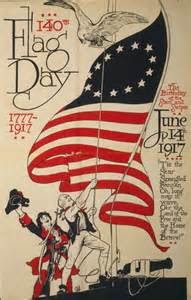
Thirteen Stars and Thirteen Stripes.
It was on JUNE 14, 1777, that the Second Continental Congress selected the FLAG of the United States.
Our founders were in the midst of fighting an eight-year long war to come out from under the dominion of the most powerful globalist king in world history.
After the Revolution, on JUNE 14, 1783, General George Washington sent a “Circular Letter” to the thirteen Governors of the newly independent states. He stated:“I am now preparing to resign …
Before I carry this resolution into effect, I think it a duty … to make this my last official communication, to congratulate you on the glorious events which Heaven has been pleased to produce in our favor …
The Citizens of America are from this period to be considered as the actors of a most conspicuous theater, which seems to be particularly designed by Providence for the display of human greatness and felicity …
Heaven has crowned all its other blessing, by giving a fairer opportunity for political happiness, than any other nation has ever been favored with …”
Washington continued with a warning:
“According to the system of policy the states shall adopt at this moment, they will stand or fall;
and by their confirmation or lapse, it is yet to be decided, whether the Revolution must ultimately be considered as a blessing or a curse …
not to the present age alone, for with our fate will the destiny of unborn millions be involved.”
Washington’s concern for “unborn millions” was indicative of the founders, who sacrificed prosperity for posterity.
This contrasted with later politicians who sacrifice posterity for prosperity, yoking future generations with unpayable debt and lawlessness.
John Adams wrote, April 26, 1777:
“Posterity! You will never know how much it cost the present generation to preserve your freedom! I hope you will make a good use of it.
If you do not, I shall repent in Heaven that I ever took half the pains to preserve it.”
Washington concluded with an admonition to follow the example of “the Divine Author of our blessed religion”:
“I now make it my earnest prayer that God would have you, and the state over which you preside, in His holy protection;
that He would incline the hearts of the citizens … to entertain a brotherly affection and love for one another … and particularly for their brethren who have served in the field;
and finally, that He would most graciously be pleased to dispose us all to do justice, to love mercy,
and to demean ourselves with that charity, humility, and pacific temper of mind, which were the characteristics of the Divine Author of our blessed religion, and without an humble imitation of whose example in these things, we can never hope to be a happy nation.”
In 1916, President Woodrow Wilson designated JUNE 14 as “NATIONAL FLAG DAY.”
“I … call your attention to the approach of the anniversary of the day upon which THE FLAG OF THE UNITED STATES was adopted by the Congress as the emblem of the Union …
I therefore … request that throughout the nation … the FOURTEENTH DAY of JUNE be observed as FLAG DAY with special patriotic exercises …
to give significant expressions to our thoughtful love of America, our comprehension of the great mission of liberty and justice … for an America which no man can corrupt, no influence draw away from its ideals, no force divide against itself …
Done at the City of Washington … in the year of Our Lord one thousand nine hundred and sixteen.”
Speaking of the Flag, President Calvin Coolidge stated May 31, 1926:
“Our condition today is not merely that of one people UNDER ONE FLAG, but of a thoroughly united people who have seen bitterness and enmity which once threatened to sever them pass away, and a spirit of kindness and good will reign over them all.”
President Calvin Coolidge stated May 25, 1924, at the Confederate Memorial, Arlington National Cemetery, Virginia:
“It is the maintenance of our American ideals, BENEATH A COMMON FLAG, under the blessings of Almighty God … We know that Providence would have it so.”
President Franklin D. Roosevelt stated November 13, 1935:
“OUR FLAG for a century and a half has been the symbol of the principles of liberty of conscience, of religious freedom and equality before the law; and these concepts are deeply ingrained in our national character.”
During World War II, President Franklin D. Roosevelt stated on FLAG DAY, JUNE 14, 1942:
“The belief in man, created free, in the image of God – is the crucial difference between ourselves and the enemies we face today …
… We ask the German people, still dominated by their Nazi whip-masters, whether they would rather have the mechanized hell of Hitler’s ‘New’ Order or – in place of that, freedom of speech and religion …
We ask the Japanese people, trampled by their savage lords of slaughter, whether they would rather continue slavery and blood or – in place of them, freedom of speech and religion …
We know that man, born to freedom in the image of God, will not forever suffer the oppressors’ sword …”
Roosevelt continued:
“I am going to close by reading you a prayer …
‘God of the free, we pledge our hearts and lives today to the cause of all free mankind.
Grant us victory over the tyrants who would enslave all free men and Nations …
Grant us patience with the deluded and pity for the betrayed …
Grant us … valor that shall cleanse the world of oppression and the old base doctrine that the strong must eat the weak because they are strong.'”
Mentioning the Flag, Yale President Ezra Stiles explained, May 8, 1783, that America is different from most of the other countries in world history, where people were dominated by power concentrated into the hands of deep state government leaders:
“That symbol of union, THE AMERICAN FLAG with it increasing stripes and stars, may have an equally combining efficacy for ages …
The senatorial constitution and consulate of the Roman Empire lasted from Tarquin — last Roman king, 509 BC — to Caesar — Roman dictator, 49 BC — …
The Assyrian endured without mutation through a tract of one thousand three hundred years from Semiramis — legendary ancient Babylonian queen — to Sardanapalus — alleged last Assyrian ruler, 627 BC — …
… Nor was the policy of Egypt overthrown for a longer period from the days of Metzraim — upper and lower Nile kingdoms, c.3,300 BC —
till the time of Cambyses — Persian conqueror of Egypt, 525 BC — and Amasis — last great Egpytian ruler, 526 BC — …
The Medo-Persian — 550-330 BC — and Alexandrine Empires — 356-323 BC –, and that of Timur — 1370-1405 AD –, who once reigned from Smyrna to the Indus, were … of short and transitory duration …
… Pragmatic sanction … secured the imperial succession in the House of Austria for ages — Habsburgs, 1020-1780 — …
Whatever mutations may arise in the United States, perhaps hereditary monarchy and a standing army will be the last.”
Ben Franklin warned June 2, 1787:
“There is scarce a king in a hundred who would not, if he could, follow the example of Pharaoh – get first all the people’s money, then all their lands, and then make them and their children servants forever …
There is a natural inclination in mankind to kingly government … I am apprehensive … that the government of the states may, in future times, end in a monarchy.”
Yale President Ezra Stiles continued:
“This great American revolution, this recent political phenomenon … will be … contemplated by all nations …
Navigation will carry THE AMERICAN FLAG around the globe itself; and display the thirteen stripes and new constellation at Bengal and Canton, on the Indus and Ganges, on the Whang-ho and the Yang-tse-kiang; and with commerce will import the wisdom and literature of the east …
That prophecy of Daniel is now literally fulfilling – there shall be a universal traveling to and fro, and knowledge shall be increased.
This knowledge will be brought home and treasured up in America: and being here digested and carried to the highest perfection, may re-blaze back from America to Europe, Asia and Africa, and illumine the world with truth and liberty …”
Ezra Stiles added:
“John Adams … observes — in letter from Amsterdam, April 28, 1782 — …
‘But the great designs of Providence must be accomplished …
The progress of society will be accelerated by centuries by this revolution …
American ideas of toleration and religious liberty … will become the fashionable system of Europe very soon. Light spreads from the Dayspring in the west — Luke 1:78 — ; and may it shine more and more until the perfect day — Proverbs 4:18 — …'”
Stiles concluded:
“The United States will embosom all the religious sects or denominations in Christendom …
The Presbyterian,
the Church of England …
the Unitas Fratrum … Moravian bishops …
Ancient Bohemian churches …
the Baptists,
the Friends — Quakers –,
the Lutherans,
the Romanists …
the Dutch,
and Gallic,
and German reformed or Calvinistic churches …
There is a Greek church brought from Smyrna …
There are Wesyans, Mennonites … all … who will give the religious complexion to America …
Episcopal … Greek and Armenian patriarchates …
With a most generous benevolence … of a friendly cohabitation of all sects in America, proving that men may be good members of civil society, and yet differ in religion …
Little would civilians have thought ages ago, that the world should ever look to America for models of government.”
President James Buchanan stated March 4, 1857:
“We ought to cultivate peace, commerce, and friendship with all nations … in a spirit of Christian benevolence toward our fellow-men …
The people, under the protection of THE AMERICAN FLAG, have enjoyed civil and religious liberty.”
In 1865, President Abraham Lincoln commented to State Senator James Scovel of New Jersey:
“If God gives me four years more to rule this country, I believe it will become what it ought to be – what its Divine Author intended it to be – no longer one vast plantation for breeding human beings for the purpose of lust and bondage.
But it will become a new Valley of Jehoshaphat — Joel 3:2, 12 –, where all the nations of the earth will assemble together UNDER ONE FLAG, worshiping a common God, and they will celebrate the resurrection of human freedom.”
When Lincoln died, President Andrew Johnson stated April 25, 1865:
“In order to mitigate that grief on earth which can only be assuaged by communion with the Father in heaven …
I … appoint … the 25th day of May next, to be observed, wherever in the United States THE FLAG OF THE COUNTRY may be respected, as a day of humiliation and mourning, and I recommend … citizens … assemble in their respective places of worship, there to unite in solemn service to Almighty God.”
President Rutherford B. Hayes noted in his diary that during the Civil War:
“Archbishop John Baptist Purcell strung THE AMERICAN FLAG, in the crisis of our fate, from the top of the Cathedral in Cincinnati April 16, 1861! The spire was beautiful before, but the Catholic prelate made it radiant with hope and glory for our country!”
When Rutherford B. Hayes died, President Benjamin Harrison described him, January 18, 1893:
“He was a patriotic citizen, a lover of THE FLAG and of our free institutions, an industrious and conscientious civil officer, a soldier of dauntless courage, a loyal comrade and friend, a sympathetic and helpful neighbor, and the honored head of a happy Christian home.”
President Andrew Johnson stated while serving as a Senator from Tennessee (The Life and Public Services of Andrew Johnson-State Papers, Speeches and Addresses, by John Savage, NY: Derby & Miller, 1866, p. 247, appendix p. 87, Jan. 31, 1862):
“Let us look forward to the time when we can take THE FLAG OF OUR COUNTRY and nail it below the Cross, and there let it wave as it waved in the olden times, and let us gather around it and inscribe for our motto: ‘Liberty and Union, one and inseparable, now and forever,’ and exclaim, ‘Christ first, our country next!'”
In dedicating the Oregon Trail, President Warren G. Harding stated July 3, 1923:
“Never in the history of the world has there been a finer example of civilization following Christianity.
The missionaries led under the banner of the Cross, and the settlers moved close behind under the STAR-SPANGLED SYMBOL OF THE NATION.”
President Benjamin Harrison stated July 21, 1892
“Let THE NATIONAL FLAG float over every schoolhouse in the country and the exercises be such as shall impress upon our youth the patriotic duties of American citizenship … Let there be expressions of gratitude to Divine Providence.”
On FLAG DAY, JUNE 14, 1954, President Dwight Eisenhower signed Public Law 396 adding the phrase “One Nation Under God” to the Pledge of Allegiance:
“Section 7. The following is designated as the Pledge of Allegiance to THE FLAG: ‘I pledge allegiance to the flag of the United States of America and to the Republic for which it stands, one Nation under God, indivisible, with liberty and justice for all.’
Such pledge should be rendered by standing with the right hand over the heart. However, civilians will always show full respect to the flag when the pledge is given by merely standing at attention, men removing the headdress. Persons in uniform shall render the military salute.”
President Eisenhower stood on the steps of the Capitol Building and recited the revised Pledge of Allegiance for the first time.
The Pledge of Allegiance was first written in 1892 by a Baptist minister from Boston named Francis Bellamy, who was ordained in the Baptist Church of Little Falls, New York.
Francis Bellamy was a member of the staff of The Youth’s Companion, which first published the Pledge on September 8, 1892, in Boston, Massachusetts.
Public-school children first recited it during the National School Celebration on the 400th anniversary of Columbus’ discovery of America, October 12, 1892, at the dedication of the 1892 Chicago World’s Fair.
The words “under God” were taken from Abraham Lincoln’s Gettysburg Address:
“… that this Nation, under God, shall have a new birth of freedom.”
In 1979, a publication approved by and printed under authority of Congress titled “The Capitol-A Pictorial History of the Capitol and of the Congress” (Washington, D.C.: U.S. Government Printing Office, 1979), p. 24, commented regarding the Pledge:
“This Pledge attests what has been true about America from the beginning. Faith in the transcendent, sovereign God was in the public philosophy – the American consensus. America’s story opened with the first words of the Bible, In the beginning God …
… We are truthfully one nation under God ‘and our institutions presuppose a Divine Being,’ wrote Justice William O. Douglas in 1966 …
Only a nation founded on theistic presupposition would adopt a first amendment to ensure the free exercise of all religions or of none.
The government would be neutral among the many denominations and no one church would become the state church.
But America and its institutions of government could not be neutral about God.”
On January 10, 1963, Democrat Congressman Albert Sydney Herlong Jr., of Florida, read into the Congressional Record the 45 communist goals for America, which included:
“… 12. Do away with all loyalty oaths …
17. Get control of the schools. Use them as transmission belts for socialism and current Communist propaganda. Soften the curriculum. Get control of teachers’ associations. Put the party line in textbooks.
18. Gain control of all student newspapers.
19. Use student riots to foment public protests against programs or organizations which are under Communist attack …
25. Break down cultural standards of morality by promoting pornography and obscenity in books, magazines, motion pictures, radio, and TV …
27. Infiltrate the churches and replace revealed religion with “social” religion. Discredit the Bible …
28. Eliminate prayer or any phase of religious expression in the schools on the ground that it violates the principle of “separation of church and state.”
29. Discredit the American Constitution by calling it inadequate, old-fashioned …
30. Discredit the American Founding Fathers. Present them as selfish aristocrats who had no concern for the ‘common man.’
31. Belittle all forms of American culture and discourage the teaching of American history on the ground that it was only a minor part of the ‘big picture’ …
42. Create the impression that violence and insurrection are legitimate aspects of the American tradition; that students and special-interest groups should rise up and use ‘united force’ to solve economic, political or social problems.”
The Founding Fathers, for all their human failings, gave a present to future Americans, namely, each citizen gets to determine their own destiny, in a sense, be the king of their own life, and then all citizens, together, are the king of the country.
The pledge is “to the Flag and to the Republic for which it stands.”
A “republic” is where the people are king, ruling the country through their public servants called representatives.
Kings have subjects, who are subjected to the king’s will.
Republics have citizens. The word “citizen” is Greek for co-ruler, co-sovereign, co-king.
When a person pledges allegiance to the Flag, they are pledging allegiance to us being in charge of ourselves. They are saying that we, the people, are the king, not some power-usurping totalitarian deep state dictator.
When someone protests the flag, they are effectively saying:
“I don’t want to be the king anymore, I protest this system where I participate in ruling myself, I would rather relinquish authority over my life to deep-state government bureaucrats.”
Whether they fully realize it or not, those who dishonor the flag are effectively rejecting:
- equality before the law,
- freedom of speech,
- freedom of conscience,
- freedom of religion, and
- inalienable rights from the Creator.
“Kneeling” is the universal sign of surrender.
Old Testament believers, such as Daniel, or Shadrach, Meshach, and Abednego, would rather be thrown into the lion’s den or into the fiery furnace than kneel to something other than God.
Early Christian believers would rather be martyred in the Roman Colosseum than kneel to something other than God.
At the Dodger versus Giants baseball game, July 23, 2020, Giants pitcher Sam Coonrod was to only player not to kneel.
When asked why, Coonrod stated: “I’m a Christian, so I just believe that I can’t kneel before anything besides God.”
The Christian Post reported, August 3, 2020:
“Orlando Magic forward Jonathan Isaac was the lone player to stand during the national anthem …
He cited the Gospel later when asked to explain his reasoning.
‘I don’t think that kneeling … for me, personally, is the answer … For me, black lives are supported through the Gospel, all lives are supported through the Gospel. My life has been supported by the Gospel …
Everyone is made in the image of God and we all share in His glory …'”
Isaac continued:
“We all make mistakes but I think the Gospel of Jesus Christ is that there’s grace for us and that Jesus came and died for our sins, and that we all will come to an understanding of that and that God wants to have a relationship with us.”
The 6’11” NBA Player Jonathan Isaac concluded:
“We all fall short of God’s glory, and at the end of the day, whoever will humble themselves and seek God and repent their sins, then we could see our mistakes and people’s mistakes and people’s evil in a different light,
and that it would help bring us closer together and get past skin color, get past anything that’s on the surface that doesn’t really deal with the hearts of men and women.”
One of the first Gospel songs that nearly all children in America were taught, was:
“Jesus loves the little children,
All the children of the world.
Red, and yellow, black, and white,
They are precious in His sight
Jesus loves the little children of the world.”
On CNN Tonight with Don Lemon, February 1, 2019, singer Gladys Knight-the Empress of Soul, explained why she was going to sing the National Anthem, the Star-Spangled Banner, at Super Bowl 53:
“As far as this is concerned, I grew up with the national anthem … We used to sing it in school before school started.
We used to say prayers in school before school started, and we just don’t have that anymore and I’m just — I’m just hoping that it will be about our country and how we treat each other and being the great country that we are.”
On the Great Seal of the United States is the Latin phrase E Pluribus Unum, which means “Out of many, one.”
Though there are many sources for this phrase, one is that of Roman statesman Cicero, who, in De Officiis, described basic family and social bonds as the origin of society:
“When each person loves the other as much as himself, it makes one out of many — unum fiat ex Pluribus– .”
Further back, this concept was written in Leviticus 19:17-18:
“You shall not hate your brother in your heart, but you shall reason frankly with your neighbor, lest you incur sin because of him. You shall not take vengeance or bear a grudge against the sons of your own people, but you shall love your neighbor as yourself: I am the Lord.”
The opposite of this is the Latin phrase divide et impera, meaning “divide and rule” or “divide and conquer.”
This concept was utilize throughout history, such as: Sun Tzu’s The Art of War, Philip II of Macedon, Alexander the Great, Julius Caesar’s Gallic Wars, Niccolò Machiavelli, British in India, Napoleon in Europe, and others.
On a biological level, an autoimmune disease is a disease where the body attacks itself.
On a “body politic” level, this is happening in America, a type of cultural autoimmune disease, where citizens are taught to attack their own country.
Eleanor Roosevelt is credited with saying:
“Pit race against race, religion against religion, prejudice against prejudice. Divide and conquer! We must not let that happen here.”
Alexander Solzhenitsyn, who spent eleven years in socialist gulag labor camps, warned in a speech titled “Godlessness: the First Step to the Gulag,” May 10, 1983:
“Western societies are losing more and more of their religious essence as they thoughtlessly yield up their younger generation to atheism …
Atheist teachers in the West are bringing up a younger generation in a spirit of hatred of their own society.”
Attorney Chris Banescu, a regular contributor to OrthodoxyToday.org, wrote July 18, 2011:
“As a survivor of the Communist Holocaust I am horrified to witness how my beloved America, my adopted country, is gradually being transformed into a secularist and atheistic utopia, where communist ideals are glorified and promoted, while …
God has been progressively erased from our public and educational institutions …
Those of us who have experienced and witnesses first-hand the atrocities and terror of communism understand fully why such evil takes root, how it grows and deceives, and the kind of hell it will ultimately unleash …
Godlessness is always the first step towards tyranny and oppression!”
Emphasizing America’s dedication to God, President Eisenhower stated on Flag Day, June 14, 1954:
“From this day forward, the millions of our school children will daily proclaim in every city and town, every village and rural school house, the dedication of our nation and our people to the Almighty.
… To anyone who truly loves America, nothing could be more inspiring than … this re-dedication of our youth, on each school morning, to our country’s true meaning …
… In this way we are reaffirming the transcendence of religious faith in America’s heritage and future; in this way we shall constantly strengthen those spiritual weapons which forever will be our country’s most powerful resource, in peace or in war.”
—
Download as PDF …
American Minute is a registered trademark of William J. Federer. Reposted with permission
—
Image Credits: Public Domain; Description: 140th U.S. Flag Day poster 1777-1917; The birthday of the stars and stripes, June 14th, 1917, ‘Tis the Star Spangled Banner, oh, long may it wave, o’er the land of the free and the home of the brave!” Library of Congress description: “Poster showing a man raising the American flag, with a minuteman cheering and an eagle flying above”; Date: 1917; Source: US-LibraryOfCongress-BookLogo.svg ; United States Library of Congress’s Prints and Photographs division under the digital ID cph.3g06262 ; https://commons.wikimedia.org/wiki/File:US_Flag_Day_poster_1917.jpg
Governments Should Heed Christian Flag Case by Liberty Counsel

In Wethersfield, Connecticut, the city council voted 5-4 in December 2022 to limit what flags could be flown on government property. Mayor Michael Rell, who had previously supported raising the “rainbow pride flag,” voted this time not to allow it because he believed the ruling in Shurtleff could open the town to lawsuits if they tried to be the “ultimate decision-making body” for who can or cannot fly flags.

“When we allow any one group to fly their flag it sends a message to the public,” said Rell. “It puts us in a position where as a council we would have to sit there and pick one group over the other…It’s not a position the council should be in. The council’s role is to make policy. We should not be making divisive political decisions that could set the town up for a lawsuit.”
In neighboring Massachusetts, city councils across the state have debated whether they could, or should, speak for their communities at large through flag raising. Towns like Dighton, Reading and Williamstown have all voted to do the “safe thing” to allow only traditional flags and not allow flag requests at all to prevent “divisiveness.”
“We decided to stay in our lane and reserve ourselves to town governance issues,” said Andrew Hogeland, who sits on the Williamstown Select Board and serves as president of the Massachusetts Select Board Association. “It’s a matter of how much do you want to be the entity that declares what the values of the municipality are. In our view, we thought our citizens are pretty good at doing that themselves.”
Across the country in Redlands, California. city councilmembers voted 3-2 in May 2023 to uphold the city’s longstanding policy of not flying any non-official flag.
Redlands Mayor Eddie Tejeda stated, “It is my opinion that if we adopt changes to our flag policy, that we do so at our own risk…In this case, it will demonstrate favor of one group over others.”
Other states where municipalities are keeping their flagpoles to traditional flags include Ohio and New York, as well as several school districts in Utah and Wisconsin.
In Shurtleff v. City of Boston, the U.S Supreme Court unanimously declared that the City of Boston violated the Constitution by censoring a private flag in a public forum open to “all applicants” merely because the application referred to it as a “Christian flag.” The High Court stated because the government admitted it censored the Christian flag because it was referred to as a Christian flag on the application, the censorship was viewpoint discrimination, and therefore the government was not taking part in establishing a religion by flying the flag.
The Supreme Court’s decision in Shurtleff focused in part on “government speech” and “ownership of expression.” The ruling stated that when the government opens a forum for expression to the public (such as a flagpole), then the First Amendment prevents viewpoint discrimination.
Some government officials have not learned the lesson from the Shurtleff case, and failure to heed its commands can be very costly, as it was for the City of Boston, which had to pay over $2.1 million in attorney’s fees and costs. For instance, the governor of Wisconsin ordered the “pride flag” flown over the state’s capitol June 1, 2023. In the city of Dallas, Texas, the city council passed a resolution May 31, 2023, to fly the flag at town hall during June and at city-owned properties around the city. In San Francisco, California, police officers raised the “pride flag” at city-owned flagpoles, some of them wearing rainbow-colored hats and patches as part of their uniforms.
These cities are on notice that they could wind up like the City of Boston.
Liberty Counsel’s Founder and Chairman Mat Staver said, “This 9-0 decision from the Supreme Court involving the Christian flag continues to influence many elected officials around the nation. The clear message from the Supreme Court is that government cannot favor one viewpoint and censor another. To avoid litigation and an unfavorable ruling like the City of Boston received, governments should stick with government flags. If they veer away from government flags, be warned that viewpoint censorship can be a costly mistake.”
For more information on Shurtleff v. City of Boston, visit www.LC.org/flag.
Liberty Counsel advances religious liberty, the sanctity of human life, and the family through litigation and education. We depend on your support, which enables us to represent people at no cost. Click here to GIVE NOW.
D-Day, June 6, 1944 & the Nazi aggression that led up to it; FDR “A Struggle to Preserve our Republic, our Religion & our Civilization” – American Minute with Bill Federer


After World War I, Germany’s economy suffered from depression and a devaluation of their currency.
On January 30, 1933, Adolph Hitler was elected Chancellor of Germany by promising hope and universal healthcare.
Less than a month later, on February 27, 1933, a crisis occurred — the Reichstag, Germany’s Capitol Building, was suspiciously set on fire, with evidence pointing to Hitler’s supporters.
Hitler, though, blamed the attack on his political opponents and used the power of the state to falsely accuse and arrest them
Hitler used the panic of the “crisis” as an opportunity to suspend citizens’ rights and systematically undermine Germany’s Weimar Republic.
He had radical homosexual activist Ernst Röhm and his feared Brownshirts, called “Sturmabteilung” (storm troopers), to storm into the meetings of his political opponents, disrupting and shouting down speakers.
Brownshirts organized protests and street riots, similar to modern day BLM/Antifa-style protests, smashing windows, blocking traffic, setting fires, vandalizing, and even beating to death innocent bystanders to spread fear and panic.
Nazis implemented boycotts of Jewish businesses.The riots destabilized the country and led to the overthrow old political leaders.
On Kristallnacht (Night of Broken Glass), they broke windows, looted and set on fire over 7,500 Jewish stores and 200 synagogues.
Once securely in power, Hitler had his SS and Gestapo secret police kill the Brownshirts in the Night of the Long Knives, thus eliminating competition and giving the public impression that he was cracking down on lawbreakers.
Nazis had old military leaders falsely accused and forced to retire.
Some were imprisoned and even shot without a trial.
He pushed a type of critical race theory, whereby all other races were taught that they were inferior to the Aryan race.
Hitler then confiscated weapons from law-abiding citizens.
An SA Oberführer warned of an ordinance by the provisional Bavarian Minister of the Interior:
“The deadline set … for the surrender of weapons will expire on March 31, 1933. I therefore request the immediate surrender of all arms …
Whoever does not belong to one of these named units (SA, SS, and Stahlhelm) and … keeps his weapon without authorization or even hides it, must be viewed as an enemy of the national government and will be held responsible without hesitation and with the utmost severity.”
Heinrich Himmler, head of Nazi S.S. (“Schutzstaffel”-Protection Squadron), announced:
“Germans who wish to use firearms should join the S.S. or the S.A. Ordinary citizens don’t need guns, as their having guns doesn’t serve the State.”
In 1938, when a suspected homosexual youth shot a Nazi diplomat in Paris, it was used as an excuse to confiscate all firearms from Jews.
German newspapers printed, November 10, 1938:
“Jews Forbidden to Possess Weapons by Order of SS Reichsführer Himmler, Munich …
‘Persons who, according to the Nürnberg law, are regarded as Jews, are forbidden to possess any weapon. Violators will be condemned to a concentration camp and imprisoned for a period of up to 20 years.'”
The New York Times, November 9, 1938, reported:
“The Berlin Police … announced that … the entire Jewish population of Berlin had been ‘disarmed’ with the confiscation of 2,569 hand weapons, 1,702 firearms and 20,000 rounds of ammunition.
Any Jews still found in possession of weapons without valid licenses are threatened with the severest punishment.”
Of the Waffengesetz (Nazi Weapons Law), March 18, 1938, Hitler stated at a dinner talk, April 11, 1942 (Hitler’s Table Talk 1941-44: His Private Conversations, 2nd Edition, 1973, p. 425-6, translated by Norman Cameron and R. H. Stevens):
“The most foolish mistake we could possibly make would be to allow the subject races to possess arms.
History shows that all conquerors who have allowed their subject races to carry arms have prepared their own downfall by so doing …
So let’s not have any native militia or native police. German troops alone will bear the sole responsibility for the maintenance of law and order.”
Hitler’s Minister of Propaganda, Joseph Goebbels, pioneered the use of fake news to sway public opinion so that the entire nation accepted the lies of the deep-state:
“If you tell a lie big enough and keep repeating it, people will eventually come to believe it …
The truth is the greatest enemy of the state.”
n socialist countries, a person’s life is only of worth if it benefits the state:
“No life still valuable to the state will be wantonly destroyed.” (German Penal Code, October 10, 1933)
Those not promoting the deep-state narrative were driven from their jobs, publicly ridiculed, and eventually removed from society and sent to labor and concentration camps.
Anti-socialist John Basil Barnhill stated in a debate with Henry M. Tichenor, 1914 (National Rip Saw Publishing Co., St. Louis, MO):
“Where the people fear the government, you have tyranny. Where the government fears the people you have liberty.”
This is similar to Robert F. Kennedy, Jr., who warned at Hillsdale College, April 11, 2023:
“1. Any power that government takes from the people, it will never return voluntarily;
2. Every power that government takes, it will ultimately abuse to the maximum extent possible;
3. Nobody ever complied their way out of totalitarianism. The only thing we can do is resist.”
2. Every power that government takes, it will ultimately abuse to the maximum extent possible;
3. Nobody ever complied their way out of totalitarianism. The only thing we can do is resist.”
National Socialist Workers Party operated over 1,200 concentration camps where millions of Jews, Poles, Gypsies, handicapped, and others were experimented upon, tortured, or were killed in gas chambers.
German churches were silent, as they had for centuries taught pietism – a version of separation of church and state where Christians were instructed to only focus on their own personal spiritual life and withdraw from involvement in worldly politics.
As a result, the church stood by silent as the National Socialist Workers Party usurped power, leaving the work of stopping Hitler to done by the sacrifice of millions of courageous Allied soldiers.
By the time a few courageous Germany church leaders spoke out, such as Dietrich Bonhoeffer, it was too late — the government had grown so powerful it simply arrested and executed them.
Hitler’s National Socialist Workers’ Party used diplomatic intimidation, deception, and Blitzkrieg “lightning war” attacks to take control of:
- Austria,
- The Sudeten Region,
- Bohemia,
- Moravia,
- Poland,
- Denmark,
- Norway,
- Luxembourg,
- Belgium,
- Holland,
- France,
- Monaco,
- Greece,
- The Channel Island (UK),
- Czechoslovakia,
- Baltic states,
- Serbia,
- Italy,
- Hungary,
- Romania,
- Bulgaria,
- Slovakia,
- Finland,
- Croatia, and more.
Other Axis Powers were also aggressively expanding:
Italy had invaded Ethiopia in 1935, and the Empire of Japan had invaded China in 1937.
The United States entered World War II on December 7, 1941, when Pearl Harbor was bombed by Imperial Japan, a Tripartite Pact partner with Nazi Germany and Italy’s Benito Mussolini.
The turning point in the Pacific War was the Battle of Midway, June 4, 1942.
The turning point in Europe was D-Day, JUNE 6, 1944.
Over 160,000 troops from America, Britain, Canada, free France, Poland, and other nations landed along a 50-mile stretch of the Normandy coast of France.
In his D-Day Orders, JUNE 6, 1944, Supreme Allied Commander General Dwight Eisenhower sent nearly 100,000 Allied troops marching across Europe to defeat Hitler’s National Socialist Workers Party:
“You are about to embark upon the Great Crusade … The eyes of the world are upon you.
… The hopes and prayers of liberty loving people everywhere march with you …
You will bring about … the elimination of Nazi tyranny over the oppressed peoples of Europe …
… Your task will not be an easy one. Your enemy is well trained, well equipped and battle hardened, he will fight savagely …
And let us all beseech the blessings of Almighty God upon this great and noble undertaking.”
It was the largest seaborne invasion force in world history, supported by 13,000 aircraft, 5,000 ships with 195,700 navy personnel.
Prior to the invasion, Allies attempted to mislead the Nazis as to where the attack would take place.
The invasion was supposed to take place June 5, but the weather was so bad aircraft could not fly. General Eisenhower gave the risky order to delay the attack 24 hours to allow the weather and tide to improve.
The night before, Allied aircraft launched an enormous air assault on Nazi defenses, batteries, and bridges.
Then paratroopers were sent in behind enemy lines to cut off their supplies.
President Ronald Reagan stated at the 40th Anniversary of D-Day:
“Something else helped the men of D-day: their rock hard belief that Providence would have a great hand in the events that would unfold here; that God was an ally in this great cause.
And so, the night before the invasion, when Colonel Wolverton asked his parachute troops to kneel with him in prayer he told them:
‘Do not bow your heads but look up so you can see God and ask His blessing in what we’re about to do.’
Also that night, General Matthew Ridgway on his cot, listening in the darkness for the promise God made to Joshua: ‘I will not fail thee nor forsake thee.'”
Then elite Army Rangers went in to scale the cliffs and take out Nazi machine gun positions.
President Reagan stated:
“40 years ago at this moment, the air was dense with smoke and the cries of men, and the air was filled with the crack of rifle fire and the roar of cannon.
At dawn, on the morning of the 6th of June, 1944, 225 Rangers jumped off the British landing craft and ran to the bottom of these cliffs.
Their mission was one of the most difficult and daring of the invasion: to climb these sheer and desolate cliffs and take out the enemy guns.
The Allies had been told that some of the mightiest of these guns were here and they would be trained on the beaches to stop the Allied advance.
… The Rangers looked up and saw the enemy soldiers — the edge of the cliffs shooting down at them with machineguns and throwing grenades.
And the American Rangers began to climb.
They shot rope ladders over the face of these cliffs and began to pull themselves up. When one Ranger fell, another would take his place.
When one rope was cut, a Ranger would grab another and begin his climb again. They climbed, shot back, and held their footing.
.. Soon, one by one, the Rangers pulled themselves over the top, and in seizing the firm land at the top of these cliffs, they began to seize back the continent of Europe. Two hundred and twenty-five came here.
After 2 days of fighting, only 90 could still bear arms.”
At 6:30am, Allied forces began landing.
Troops ran across the heavily fortified beaches of:
- Utah Beach
- Pointe du Hoc
- Omaha Beach
- Gold Beach
- Juno Beach
- Sword Beach
Ocean water ran red with the blood of almost 9,000 killed or wounded.
In the next two and a half months, over two million soldiers arrived on the shores.
Paris was liberated on August 25, 1944, and the Nazi war machine was pushed back over the Seine River
It was a major turning point in World War II.
Reagan continued:
“The men of Normandy had faith that what they were doing was right, faith that they fought for all humanity, faith that a just God would grant them mercy on this beachhead or on the next.
It was the deep knowledge — and pray God we have not lost it — that there is a profound, moral difference between the use of force for liberation and the use of force for conquest.”
Shortly after D-Day, on July 20, 1944, a courageous German resistance movement was formed which attempted to assassinate Hitler, but he survived.
Hitler retaliated by killing over 7,000 Germans.
President Franklin Roosevelt stated JUNE 6, 1944:
“My fellow Americans: Last night, when I spoke with you about the fall of Rome, I knew at that moment that troops of the United States and our allies were crossing the Channel in another and greater operation …
I ask you to join with me in prayer:
Almighty God, Our sons, pride of our Nation, this day have set upon a mighty endeavor, a struggle to preserve our republic, our religion, and our civilization …
Give strength to their arms, stoutness to their hearts, steadfastness in their faith. They will need Thy blessings. Their road will be long and hard.
For the enemy is strong. He may hurl back our forces … We know that by Thy grace, and by the righteousness of our cause, our sons will triumph …
Some will never return. Embrace these, Father, and receive them, Thy heroic servants, into Thy kingdom …”
Of those who “never returned” was Orval Wilford “Billy” Epperson, the uncle of the writer of this article.
He was a 2nd Lieutenant in the U.S. Army Air Corp, (525th Bomber Squadron, 379th Bomber Group, Heavy, A.P.O. 550 (#0-768946), Recipient of the Purple Heart.)
Oval W. “Billy” Epperson was killed during Operation Overlord one month after D-Day.
His B-17 Flying Fortress, nicknamed “Pansy Yokum,” was shot down on July 9, 1944, about 8 ½ miles northwest of Le Havre (over the English Channel.)
His name is on the monument near Omaha Beach, at the Cimitière Amèrican de Normandie (in Colleville-sur-Mer, France) at the Killed in Action Wall (“Tablet of the Missing”).
FDR concluded his D-Day Prayer:
“Help us, Almighty God, to rededicate ourselves in renewed faith in Thee in this hour of great sacrifice …
I ask that our people devote themselves in a continuance of prayer. As we rise to each new day, and again when each day is spent, let words of prayer be on our lips, invoking Thy help to our efforts.
Give us strength … and, O Lord, give us Faith. Give us Faith in Thee … With Thy blessing, we shall prevail over the unholy forces of our enemy …
And a peace that will let all of men live in freedom, reaping the just rewards of their honest toil. Thy will be done, Almighty God. Amen.”
FDR’s D-Day Prayer has been added to the World War II Memorial in Washington, D.C., thanks to the tireless efforts of Chris Long of the Ohio Christian Alliance who initiated The D-Day Landing Prayer Act (S 1044).
A bipartisan bill was introduced in the House by Ohio Congressman Bill Johnson, introduced in the Senate by Ohio Senator Rob Portman, and signed into law in 2014.
The website for this historic project is: www.ddayprayerproject.org
President Donald Trump read a portion of Franklin Roosevelt’s D-Day Prayer at the 75th anniversary memorial event held in Portsmouth, England, with England’s Queen Elizabeth II, Prime Minister Theresa May, French President Emmanuel Macron, and other world leaders.
FDR stated in his D-Day Prayer that the war was “a struggle to preserve our republic, our religion, and our civilization.”
A Democrat, President Roosevelt shared his Christian nationalist sentiments during a Fireside Chat, April 28, 1942:
“THIS GREAT WAR effort must be carried through … It shall not be imperiled by the handful of noisy traitors — betrayers of America, betrayers of Christianity itself.”
FDR stated at Madison Square Garden, NY, October 28, 1940:
“WE GUARD AGAINST the forces of anti-Christian aggression, which may attack us from without, and the forces of ignorance and fear which may corrupt us from within.”
FDR stated in Brooklyn, New York, November 1, 1940:
“THOSE FORCES HATE democracy and Christianity as two phases of the same civilization. They oppose democracy because it is Christian. They oppose Christianity because it preaches democracy.”
FDR stated in a Labor Day Address, September 1, 1941:
“PRESERVATION OF THESE rights is vitally important now, not only to us who enjoy them, but to the whole future of Christian civilization.”
FDR addressed Congress, March 1, 1945:
“I SAW SEVASTOPOL and Yalta! And I know that there is not room enough on earth for both German militarism and Christian decency.”
Eleven months after D-Day, the war in Europe ended with an Allied victory on May 8, 1945.
FDR stated May 27, 1941:
“THE WHOLE WORLD is divided between … pagan brutality and the Christian ideal. We choose human freedom which is the Christian ideal.”
—
American Minute is a registered trademark of William J. Federer. Permission granted to forward, reprint, or duplicate.
—
Image Credits: Public Domain; Description: Photo #: SC 320901; Normandy Invasion, Troops in an LCVP landing craft approaching “Omaha” Beach on “D-Day”, June 6, 1944. Note helmet netting; faint “No Smoking” sign on the LCVP’s ramp; and M1903 rifles and M1 carbines carried by some of these men. This photograph was taken from the same LCVP as Photo # SC 189986; Original Source: Photograph from the Army Signal Corps Collection in the U.S. National Archives; https://www.history.navy.mil/our-collections/photography/wars-and-events/world-war-ii/d-day/SC-320901.html ; http://www.history.army.mil/html/reference/Normandy/pictures.html ; http://www.history.navy.mil/photos/images/s300000/s320901c.htm ; The original uploader was Taak at English Wikipedia; later versions were uploaded by Raul654, Nauticashades at en.wikipedia; This file is a work of a sailor or employee of the U.S. Navy, taken or made as part of that person’s official duties. As a work of the U.S. federal government, it is in the public domain in the United States; https://en.wikipedia.org/wiki/File:Approaching_Omaha.jpg
Battle of Midway -A Turning Point in the Pacific during World War II; & courageous pilots Waldron, McClusky, O’Hare, Boyington, Zamperini, DeShazer – American Minute with Bill Federer


In 1942, Imperial Japan invaded Singapore and took 25,000 prisoners.
Next was the Philippines.

With Imperial Japan’s relentless bombardment by planes and heavy siege guns, President Roosevelt did not want General Douglas MacArthur captured, so he ordered him to leave Corregidor, Philippines, and evacuate to Australia.
General Douglas MacArthur obeyed, March 11, 1942, but not without promising, “I shall return.”

During Imperial Japan’s occupation of the Philippines, they forced 60,000 Filipino and American prisoners on the horrible 60 mile Bataan Death March, where over 10,000 died.
Imperial Japanese soldiers treated enemies who surrendered with disdain, as they held the samurai mindset, similar to modern-day Islamic suicide bombers, wherein it was more honorable to die in battle, or even commit harakiri suicide, rather than be captured alive.
Hearing of the casualties of the Bataan Death March, General Douglas MacArthur stated, April 9, 1942:
“To the weeping mothers of its dead, I can only say that the sacrifice and halo of Jesus of Nazareth has descended upon their sons, and that God will take them unto Himself.”
The turning point in the Pacific War began JUNE 4, 1942, in the Battle of Midway.
The day before, the Japanese attacked the strategic Aleutian Islands of Attu and Kiska, nearly 1,400 miles west of Anchorage, Alaska.
This was the only U.S. land that the Japanese captured.
It was considered a diversionary attack to draw the U.S. Navy north.
The U.S. Navy did not get diverted because American code-breakers were able to decipher Imperial Japan’s real plans to capture Midway Island, then Hawaii and the rest of the Pacific.
The outnumbered U.S. Pacific Fleet attempted an ambush of the Imperial Japanese armada.
Japanese scouting planes spotted the American fleet, but a series of mishaps prevented them from radioing the information back to their fleet.
The Imperial Japanese fleet suddenly changed its course, resulting in the American bombers searching for it in vain.
As the time wore on, many American escort fighters ran out of fuel and had to ditch in the ocean.
Lieutenant-Commander John Waldron led a torpedo bomber squadron from the U.S. carrier Hornet to attack the Japanese carriers.
Waldron told his men the night before:
“My greatest hope is that we encounter a favorable tactical situation, but if we don’t, I want each of us to do our utmost to destroy the enemies. If there is only one plane to make a final run in, I want that man to go in and get a hit. May God be with us.”
Waldron’s squadron was the first to spot the Imperial Japanese fleet.
Flying in at low altitude, they suffered the full focus of the Imperial Japanese defenses.
Out of 30 of Waldron’s men who took off that morning, only one survived.
Lieutenant-Commander John Waldron received the Navy Cross posthumously.
Their sacrifice was not in vain, though, as it benefited American dive-bomber squadrons from the U.S. carriers Enterprise and Yorktown, who arrived about an hour later, flying at a much higher altitude.
Navigating by guess and by God, and running low on fuel, Squadron Commander C. Wade McClusky, Jr. decided to continue the search.
Through a break in the clouds, they providentially spotted the wake of the Japanese destroyers and followed it to find the Japanese aircraft carriers: Akagi, Kaga, Soryu, and Hiryu.
This was at the precise moment when most of the Imperial Japanese “Zero” fighter planes were busy being refueled and rearmed after fighting Waldron’s squadron, or had just taken off to attack the U.S. carrier Yorktown.
In just five minutes, the screeching American dive-bombers sank three Imperial Japanese carriers, and a fourth shortly after.
In just moments, Imperial Japan’s naval force had been cut in half.
In an instant, they were forced to be on the defensive for the rest of the war.
Chicago’s Midway Airport was named as a memorial to this battle.
Chicago’s O’Hare Airport was named for the Pacific War hero, Lieutenant Commander Edward “Butch” O’Hare.
O’Hare, on February 20, 1942, single-handedly attacked nine heavy Japanese bombers, saving the aircraft carrier Lexington.
He was awarded the Medal of Honor by Franklin Roosevelt. The next year, O’Hare was shot down and never found.
After the Battle of Midway, plans were begun to free the Philippines.
President Roosevelt said, August 12, 1943:
“Three weeks after the armies of the Japanese launched their attack on Philippine soil, I sent a proclamation … to the people of the Philippines … that their freedom will be redeemed …
The great day of your liberation will come, as surely as there is a God in Heaven.”
On October 20, 1944, General Douglas MacArthur returned to the Philippines with U.S. troops, stating:
“People of the Philippines: I have returned. By the grace of Almighty God our forces stand again on Philippine soil — soil consecrated in the blood of our two peoples.
We have come, dedicated and committed to the task of destroying every vestige of enemy control … The hour of your redemption is here …
… Let the indomitable spirit of Bataan and Corregidor lead on …
Let no heart be faint. Let every arm be steeled. The guidance of Divine God points the way.
Follow in His name to the Holy Grail of righteous victory!”
The same day, President Roosevelt sent a message to General MacArthur:
“The whole American Nation today exults at the news that the gallant men under your command have landed on Philippine soil.
I know well what this means to you. I know what it cost you to obey my order that you leave Corregidor in February, 1942, and proceed to Australia …
… That day has come. You have the Nation’s gratitude and the Nation’s prayers for success as you and your men fight your way back to Bataan.”
President Roosevelt sent the message to Philippine President Osmena, October 20, 1944:
“On this occasion of the return of General MacArthur to Philippine soil with our airmen, our soldiers, and our sailors, we renew our pledge.
We and our Philippine brothers in arms – with the help of Almighty God – will drive out the invader; we will destroy his power to wage war again, and we will restore a world of dignity and freedom.”
Fighter pilot Pappy Boyington of the Baa Baa Black Sheep Squadron, shot down 26 enemy aircraft, tying Eddie Rickenbacker’s WWI record.
On January 3, 1944, Boyington was one of 30 American fights engaging 70 Japanese fighters, when he was shot down.
He described the inhumane prisoner conditions in his autobiography, Baa Baa Black Sheep, published in 1958.
While at the Ōfuna Prison Camp, Boyington met another American downed pilot, former Olympic distance runner Louis Zamperini.
After the war, Zamperini wrote in his book Devil at My Heels:
“I think the hardest thing in life is to forgive. Hate is self destructive. If you hate somebody, you’re not hurting the person you hate, you’re hurting yourself. It’s a healing, actually, it’s a real healing … forgiveness.”
He added:
“… (I asked and) I waited. And then, true to His promise, He came into my heart and my life. The moment was more than remarkable; it was the most realistic experience I’d ever had.
I’m not sure what I expected; perhaps my life or my sins or a great white light would flash before my eyes; perhaps I’d feel a shock like being hit by a bolt of lightning.
Instead, I felt no tremendous sensation, just a weightlessness and an enveloping calm that let me know that Christ had come into my heart.”
Zamperini wrote:
“God has given me so much. He expects so much out of me.”
Another inspiring story is that of American airman Jacob DeShazer who was captured after flying in the Doolittle Raid, April 18, 1942.
He was suffered painfully as a prisoner, yet during that time, something happened.
He forgave his captors and after the war became a Christian missionary to Japan.
DeShazer’s writing was instrumental in changing the life of a Japanese pilot, Mitsuo Fuchida, who had attacked Pearl Harbor.
Fuchida wrote in his biography From Pearl Harbor to Calvary (1953):
“DeShazer … returned to Japan as a missionary. And his story, printed in pamphlet form, was something I could not explain …
I decided to purchase (a Bible) myself, despite my traditionally Buddhist heritage … In the ensuing weeks, I read this book eagerly.
I came to the climactic drama – the Crucifixion. I read in Luke 23:34 the prayer of Jesus Christ at His death: ‘Father, forgive them; for they know not what they do’ …”
Mitsuo continued:
“I was certainly one of those for whom He had prayed. The many men I had killed had been slaughtered in the name of patriotism, for I did not understand the love which Christ wishes to implant within every heart.
Right at that moment, I seemed to meet Jesus for the first time. I understood the meaning of His death as a substitute for my wickedness, and so in prayer, I requested Him to forgive my sins and change me from a bitter, disillusioned ex-pilot into a well-balanced Christian with purpose in living.”
In 1959, Jacob DeShazer moved back to Japan and started a Christian church in Nagoya, the very city he had bombed during the Doolitte Raid.
DeShazer admitted to having been an atheist when he was first captured and made a prisoner of war.
He related how he was appreciative of a Japanese prison guard who secretly lent him a Bible:
“I could have it only for three weeks. I eagerly began to read its pages.
I discovered that God had given me new spiritual eyes and that when I looked at the enemy officers and guards who had starved and beaten my companions and me so cruelly, I found my bitter hatred for them changed to loving pity.
I realized that these people did not know anything about my Savior and that if Christ is not in a heart, it is natural to be cruel.”
After reading Romans 10:9, DeShazer wrote:
“Boy, that hit me! It was the best news I’d ever heard in my life.
There are just two things: you confess with your mouth and believe in your heart.
And I did! I believed at that time — and I do yet — it’s God’s Word. I believe heaven came down there in that prison cell.”
—
American Minute is a registered trademark of William J. Federer. Permission granted to forward, reprint, or duplicate.
Reposted with permission of the American Minute https://americanminute.com/