The Weekly Sam: Dumbed-Down Brits Victims of Progressive Education By Samuel L. Blumenfeld

Jay Leno, in his amusing Jay Walking adventures, interviews young Americans whose
appalling ignorance of history, geography, and other areas of basic knowledge, has
become the subject of great hilarity. Many of them couldn’t tell you who was buried in
Grant’s tomb.
But now we learn from across the pond that young Brits have been so dumbed-down that
23 percent of them believe that Winston Churchill was a mythical figure, and 58 percent
believe that Sherlock Holmes was a real person.
According to the Boston Herald (2/6/08), seventy-seven percent of these clucks readily
admit that they don’t read history books, and three out of five never watch historical
programs on television. Of course, the reason why they don’t read history books is
because they are functionally illiterate.

In fact, a new book, The Great Reading Disaster, has just recently been published in
England exposing the fact that young Brits are taught to read with the dyslexia-producing
Whole Language method, which has also become the present ruin of American education.
The authors, Mona McNee and Alice Coleman, write: “Forcing children to read whole
words by the look-say method is like telling young piano learners to play a piece in the
correct tempo, without being taught the individual notes or the significance of their stave
positions….It is cruel to inflict such frustration on children and the cruelty is not
restricted to childhood. It is even more cruel and humiliating when it leaves people
illiterate for life.”
Even Margaret Thatcher couldn’t get the educators to change their ways, though she
appointed a Committee of Inquiry to investigate the teaching of reading in the schools.
Apparently, the Progressives were clever enough to pay lip-service to phonics, ridiculing
their advocates, but meanwhile continuing to support the whole-word method.
We’ve experienced the same situation here in the U.S. where No Child Left Behind was
supposed to change the way reading is taught in American schools. In fact, a special
billion-dollar reading initiative was passed by Congress to get phonics back into the
schools. But the educators charged the government with a bias in reading instruction,
which was discriminatory against Whole Language educators. And from what I have
been told by teachers in the field, Whole Language is still the dominant way reading is
taught in American schools.
The two British authors write: “It took 40 years to produce the first six million adult
illiterates but only another ten to increase the total to nine million. The annual rate has
doubled.” And the reason why nothing will change despite the alarm sounded by this new book is
because of the tight control that the Progressives have over the entire British education
system. According to the Sunday Telegraph of June 27, 1993, the controlling cabal is
called the All Souls Group, which holds its “clandestine thrice-yearly meetings” in an
oak-paneled room at Oxford University.
No minutes are kept of the meetings and no papers or public statements ever emerge.
The discussions over evening sherry or dinner are protected by Chatham House Rules
which dictate proceedings are off the record. Chatham House is the British equivalent of
our Council on Foreign Relations. Membership is by invitation and the criteria are
shrouded in mystery.
Does such a secret education establishment exist in the United States? It does. It is
called the Cleveland Conference and was organized in 1915 by Prof. Charles Judd, head
of the University of Chicago School of Education, where William Scott Gray concocted
the Dick and Jane look-say, whole word, reading program. In his book, Managers of
Virtue, David Tyack writes:
[Judd] had a vision that both the structure of the schools and the curriculum
needed radical revision but that change would take place “in the haphazard
fashion that has characterized our school history unless some group gets together
and undertakes, in a cooperative way, to coordinate reforms.”
It is easy enough to follow the machinations of the Progressives by simply reading the
annual reports of the National Society for the Study of Education, founded in 1901. This
is the gathering place of the educational elite, and their annual reports can be found in
any university library.
For American parents, the only way to free themselves from the stranglehold of the
Progressive elite is to remove their children from the government schools and either
educate them at home or place them in a private school based on traditional principles
and teaching methods. As for the Brits, we hope that the new book awakens enough of
them to break the hold of the All Souls Group. But don’t hold your breath.
(The above article came from the Sam Blumenfeld Archives. Please visit the site and sign up. It is a free on-line resource: http://blumenfeld.campconstitution.net/main.htm

The Blumenfeld Archives
Roman Empire Persecutions – American Minute with Bill Federer

Roman Persecution of Christians
“Christian persecution ‘at near genocide levels'” reported the BBC, (5/3/19):
“A report ordered by Foreign Secretary Jeremy Hunt … Christians were the most persecuted religious group … Mr Hunt said he felt that ‘political correctness’ had played a part in the issue not being confronted …
The interim report said the main impact of “genocidal acts against Christians is exodus” and that Christianity faced being “wiped out” from parts of the Middle East …
Evidence shows not only the geographic spread of anti-Christian persecution, but also its increasing severity.”
TheGatewayPundit.com (5/13/24)


The Christian church was born into persecution from an anti-Christian one world government — the Roman Empire.Eleven of the twelve apostles were martyred, with the 12th, John, being reportedly thrown into a boiling pot of oil, but miraculously survived.
Jesus said in Acts 1:8:
“But ye shall receive power, after that the Holy Ghost is come upon you:
and ye shall be witnesses unto me both in Jerusalem, and in all Judaea, and in Samaria, and unto the uttermost part of the earth.”
The word “witness” in Greek is “martyr.”
The traditional histories are:
- Peter preached in Rome and was crucified upside down c.66 AD;
- Andrew preached in Asia Minor, modern-day Greece and Turkey, before being crucified on a sideways “Saint Andrew’s Cross” around 60 AD;
- Thomas preached east of Syria, Parthia, and possibly India, and was pierced through with spears by four soldiers in 72 AD;
- Philip reportedly preached in Egypt, Carthage in North Africa, and Asia Minor. After converting the wife of a Roman proconsul in Phrygia, he was arrested and cruelly put to death in the city of Heliopolis around 80 AD;
- Matthew preached in Parthia, Persia and Ethiopia, where he was reportedly stabbed to death in the back in city of Nadabahl in 74 AD;
- Bartholomew, according to tradition, preached in India, Armenia, Ethiopia and Southern Arabia, before being skinned and martyred in the 1st century AD;

- James, the son of Zebedee, also know as “James, the greater,” was arrested by Herod Agrippa, and beheaded by the Romans in 44 AD;
- James, the son of Alpheus, also known as “James, the younger,” is said to have ministered in Syria, where he was stoned and clubbed to death in 62 AD;
- Thaddaeus, or Jude, preached in Asia Minor and Greece, till he was crucified in Beirut or Edessa around 65 AD;
- Simon the Zealot reportedly preached in Persia, Mauritania, on Africa’s west, and possibly England, before being crucified in 74 AD;
- Matthias preached in Syria, where he was burned to death.
The first martyr was Stephen, as told in the Book of Acts, chapter 7:
“When they heard these things, they were cut to the heart, and they gnashed on him with their teeth.
But Stephen, being full of the Holy Ghost, looked up stedfastly into heaven … And said, ‘Behold, I see the heavens opened, and the Son of man standing on the right hand of God’ …
They cast him out of the city, and stoned him: and the witnesses laid down their clothes at a young man’s feet, whose name was Saul …
Stephen, calling upon God, and saying, ‘Lord Jesus, receive my spirit.’
And he kneeled down, and cried with a loud voice, “Lord, lay not this sin to their charge.'”
Saul converted and became the Apostle Paul, who preached in Syria, Asia Minor, Greece, and throughout the Roman Empire, till he was beheaded in Rome in 66 AD.
James the Just, also known as “James, brother of the Lord,” was one of the leaders of the early church in Jerusalem till he was martyred in 62 AD.
In 155 AD, Polycarp, a disciple of John, was ordered to deny Christ or die.
Polycarp responded:
“Eighty and six years have I have served Him, and He has done me no wrong. How can I blaspheme my King and my Savior?”
Josh McDowell explained the significance of the Apostles being martyred in his best-selling book, Evidence That Demands a Verdict (1972).
The book was updated (2017) with his son and co-author, Sean McDowell, who stated:
“The apostles spent between 1.5 to 3 years with Jesus during His public ministry …
Although disillusioned at His untimely death, they became the first witnesses of the risen Jesus and they endured persecution; many subsequently experienced martyrdom, signing their testimony, so to speak, in their own blood …
Their willingness to die, indicates that they did not fabricate these claims; rather, without exception, they actually believed Jesus to have risen from the dead … lending credibility to their claims about the veracity of the resurrection, which is fundamental to the case for Christianity.”
Jesus foretold persecution in the Gospel of John, chapter 15:
“You are not of the world, but I chose you out of the world, therefore the world hates you …
If they persecuted Me, they will also persecute you …
But all these things they will do to you for My name’s sake, because they do not know Him who sent Me …
He who hates Me hates My Father also.”
Jesus said further in John 16:
“The time cometh, that whosoever killeth you will think that he doeth God service.
And these things will they do unto you, because they have not known the Father, nor me.
But these things have I told you, that when the time shall come, ye may remember that I told you of them.”
Jesus forewarned in Matthew 24:
“Then shall they deliver you up to be afflicted, and shall kill you: and ye shall be hated of all nations for my name’s sake …
And because iniquity shall abound, the love of many shall wax cold. But he that shall endure unto the end, the same shall be saved.
And this gospel of the kingdom shall be preached in all the world for a witness unto all nations; and then shall the end come.”
The Book of Revelation, with chapter 12, stated:
“Now is come … the kingdom of our God, and the power of his Christ: for the accuser of our brethren is cast down, which accused them before our God day and night.
And they overcame him by the blood of the Lamb, and by the word of their testimony; and they loved not their lives unto the death.”
There were ten major persecutions of Christians in the first three centuries:
1) Nero A.D. 54-68;
2) Domition A.D. 81- 96;
3) Trajan A.D. 98-117;
4) Antoninus Pius & Marcus Aurelius Antoninus A.D. 138-180;
5) Severus A.D. 193 – 211;
6) Maximus A.D. 235-238;
7) Decius A.D. 249-251;
8) Valerian A.D. 253-260;
9) Aurelian A.D. 274-287;
10) Diocletian A.D. 292-304.
It was a criminal act for Christians to assemble.
If the government caught Christians meeting together, they were subject to being arrested and killed.
This resulted in Christians meeting in caves carved underground called “catacombs.”
Emperor Diocletian’s persecution was the worst.
When Diocletian lost battles in Persia, his generals blamed it on the army’s neglect of worshiping the Roman gods.
Diocletian ordered all military personnel and government employees to worship the Roman gods.
This order forced Christian soldiers to either go out of the military or into the closet.
After purging Christians from the military and government, Diocletian surrounded himself with anti-Christian advisers.
In 303 AD, he consulted the Oracle Temple of Apollo at Didyma, which told him to initiate a great empire-wide persecution of Christians.
Diocletian revoked the tolerance issued a previous Emperor Gallienus in 260 AD, and then used the military to force all of Rome to return to worshiping pagan gods.
What followed was a decade of the worst and most intense persecution of Christians to that date.
Diocletian had his military go systematically province by province forbidding church gatherings, arresting church leaders, burning scriptures, destroying church building.
He ordered the beautiful new church at Nicomedia to be torn down.
Christians were deprived of official ranks, lost their jobs, imprisoned, had their tongues cut out, were boiled alive, and even decapitated.
From Europe to North Africa, thousands were martyred.
The faithful cried out in fervent prayer.
Finally, Diocletian was struck with an intestinal disease so painful that he abdicated the throne on MAY 1, 305 AD.
The next emperor, Gelarius continued the persecution, but he too was struck with the intestinal disease and died in 311.
Emperor Constantine defeated Emperor Maxentius in 312 AD at the Battle of Romes’ Milvian Bridge.
In 313 AD, Constantine issued the Edit of Milan, ending the persecution of Christians.
Commenting on Roman persecutions was Secretary of State William Jennings Bryan, the Democrat Party’s candidate for President in 1896, 1900, and 1908.
William Jennings Bryan, in his speech, “The Prince of Peace,” (New York Times, September 7, 1913), stated:
“I can imagine that the early Christians who were carried into the Coliseum to make a spectacle for those more savage than the beasts, were entreated by their doubting companions not to endanger their lives.
But, kneeling in the center of the arena, they prayed and sang until they were devoured …”
Bryan continued:
“How helpless they seemed, and, measured by every human rule, how hopeless was their cause!
And yet within a few decades the power which they invoked proved mightier than the legions of the Emperor, and the faith in which they died was triumphant o’er all the land …
… They were greater conquerors in their death than they could have been had they purchased life.”
It takes courage to walk in faith:
Joshua 1:9:
“Be strong and of a good courage; be not afraid, neither be thou dismayed: for the LORD thy God is with thee whithersoever thou goest.”
The Book of Revelation 21:8 lists cowards as the first ones thrown in the lake of fire:
“But the cowardly (fearful), unbelieving, abominable, murderers, sexually immoral, sorcerers, idolaters, and all liars shall have their part in the lake which burns with fire and brimstone, which is the second death.”
The Center for Studies on New Religions found that in 2016, over 90,000 Christians courageously kept their faith, even though they were murdered, 30 percent of whom were at the hands of Islamic terrorists.
Fox News published a report, January 6, 2017, titled “Christians the most persecuted group in world for second year.”

Open Doors UK & Ireland CEO Lisa Pearce reported:
“Persecution levels have been rising rapidly across Asia and the Indian subcontinent, driven by extreme religious nationalism which is often tacitly condoned, and sometimes actively encouraged, by local and national governments …
… If a Christian is discovered in Somalia, they are unlikely to live to see another day.
North Korea is at the top of the list of countries persecuting Christians, followed by nations practicing sharia Islam.
China has increased targeting Christians and demolishing churches.”
Catholic News Agency reported:
“All top 10 countries with the worst persecution of Christians are in Asia and Africa. Somalia ranks second on the list, followed by Afghanistan, Pakistan, the Sudan, Syria, Iraq, Iran, Yemen, and Eritrea …
More Christians were recorded as killed (in Pakistan) for their faith in 2016 than any other country.”

Open Doors reported that in 2016:
- Islamic fundamentalism is responsible for persecution of Christians in 35 of the top 50 countries;
- Pakistan is 4th in persecution, worse than northern Nigeria;
- Sudan is the 5th worst persecutor of Christians, with President Omar al-Bashir proclaiming, “Now we can impose sharia here”;
- Christians are killed in crossfire in Yemen, Syria and Iraq;
- Hindu nationalists have caused India to reach its highest level of persecution, battering churches;
- Laos, Bangladesh, Vietnam and Bhutan increased persecution;
- Buddhist nationalism in Sri Lanka has put the country among the top 50 persecutors;
- Turkish President Erdogan used a suspicious coup to eliminate opposition and increase persecution of Christians, moderate Muslims and non-Islamists.
President Ronald Reagan commented on the courageous Christians who suffered persecution in the Roman Coliseum at the National Prayer Breakfast, February 2, 1984:
“This power of prayer can be illustrated by the story that goes back to the fourth century — the monk (Telemachus) living in a little remote village, spending most of his time in prayer …
One day he thought he heard the voice of God telling him to go to Rome …
Weeks and weeks later, he arrived … at a time of a festival in Rome …

… He followed a crowd into the Coliseum, and then, there in the midst of this great crowd, he saw the gladiators come forth, stand before the Emperor, and say, ‘We who are about to die salute you.’
And he realized they were going to fight to the death for the entertainment of the crowds.
He cried out, ‘In the Name of Christ, stop!’
And his voice was lost in the tumult there in the great Colosseum …”
He continued:
“And as the games began, he made his way down through the crowd and climbed over the wall and dropped to the floor of the arena.
Suddenly the crowds saw this scrawny little figure making his way out to the gladiators and saying, over and over again, ‘In the Name of Christ, stop!’
And they thought it was part of the entertainment, and at first they were amused.
But then, when they realized it wasn’t, they grew belligerent and angry …”
Reagan added:
“And as he was pleading with the gladiators, ‘In the Name of Christ, stop!’ one of them plunged his sword into his body.
And as he fell to the sand of the arena in death, his last words were, ‘In the Name of Christ, stop!’ …
… And suddenly, a strange thing happened.
The gladiators stood looking at this tiny form lying in the sand.
A silence fell over the Colosseum.
And then, someplace up in the upper tiers, an individual made his way to an exit and left, and the others began to follow.
And in the dead silence, everyone left the Colosseum.
That was the last battle to the death between gladiators in the Roman Colosseum.
Never again did anyone kill or did men kill each other for the entertainment of the crowd …”
Reagan ended:
“One tiny voice that could hardly be heard above the tumult. ‘In the Name of Christ, stop!’
It is something we could be saying to each other throughout the world today.”
|
|


|

|

|
|
|
|


Reposted with permission from American Minute
The Weekly Sam: “Looking Backward” A Critique of Edward Bellamy’s Utopian Novel by Sam Blumenfeld

(Sam wrote this in 2011)
The year 2011 marks the 123rd year since the publication of Edward Bellamy’s famous
utopian novel, Looking Backward, in which the author depicted a happy, socialist
America in the year 2000. In Bellamy’s optimistic fantasy, greed and material want
ceased to exist, brotherly harmony prevailed, the arts and sciences flourished, and an
all-powerful and pervasive government and bureaucracy were efficient and fair.

The book became enormously popular, selling 371,000 copies in its first two years and a
million copies by 1900. Its influence on American progressive educators and
intellectuals was enormous. In fact, it became their vision of a future American paradise
in which human moral perfectibility could at last be attained.
The extent of the book’s influence can be measured by the fact that in 1935, when
Columbia University asked philosopher-educator John Dewey, historian Charles Beard,
and Atlantic Monthly editor Edward Weeks to prepare independently lists of the 25 most
influential books since 1885, Looking Backward ranked as second on each list after
Marx’s Das Kapital. In other words, Looking Backward was considered the most
influential American book in that 50-year period.
John Dewey characterized the book as “one of the greatest modern syntheses of humane
values.” Even after the rise of Hitler’s National Socialism in Germany and
Marxist-Leninist communism in Russia, Dewey still clung to Bellamy’s vision of a
socialist America. In his 1934 essay, “The Great American Prophet,” Dewey wrote:
“I wish that those who conceive that the abolition of private capital and of energy
expended for profit signify complete regimenting of life and the abolition of all personal
choice and all emulation, would read with an open mind Bellamy’s picture of a socialized
economy. It is not merely that he exposes with extraordinary vigor and clarity the
restriction upon liberty that the present system imposes but that he pictures how
socialized industry and finance would release and further all of those personal and private
types of occupation and use of leisure that men and women actually most prize today….
“It is an American communism that he depicts, and his appeal comes largely from the
fact that he sees in it the necessary means of realizing the democratic ideal….
“The worth of Bellamy’s book in effecting a translation of the ideas of democracy into
economic terms is incalculable. What Uncle Tom’s Cabin was to the anti-slavery
movement Bellamy’s book may well be to the shaping of popular opinion for a new
social order.”
Bellamy envisaged America becoming socialist by way of consensus rather than
revolution. In turn, Dewey, who spent his professional life trying to transform
Bellamy’s vision into American reality, saw education as the principle means by which
this transformation could be achieved. He spent the years 1894 to 1904 at the University
of Chicago in his Laboratory School seeking to devise a new curriculum for the public
schools that would produce the kind of socialized youngsters who would bring about the
new socialist millenium.
The result, of course, is the education we have today–a minimal interest in the
development of intellectual, scientific, and literacy skills and a maximal effort to produce
socialized, politically correct, individuals who can barely read.
Today, many years later, the University of Chicago stands as an island of academic
tranquility in Chicago’s Southside, surrounded by a sea of social and urban devastation
caused by the philosophical emanations from Dewey’s laboratory and other departments.
Charles Judd, the university’s Wundtian professor of educational psychology, labored
mightily to organize the radical reform of the public-school curriculum to conform with
Dewey’s socialist plan.
According to Dewey, the philosophical underpinning of capitalism is individualism
sustained by an education that stressed the development of literacy skills. High literacy
encourages intellectual independence which produces strong individualism. It was
Dewey’s exhaustive analysis of individualism that led him to believe that the socialized
individual could only be produced by first getting rid of the traditional emphasis on
language and literacy in the primary grades and turning the children toward socialized
activities and behavior.
In 1898, he wrote a devastating critique of traditional Three R’s education, entitled “The
Primary-Education Fetich (sic),” in which he took to task the entire centuries-old
emphasis on literacy. He wrote:
“The plea for the predominance of learning to read in early school life because of the
great importance attaching to literature seems to me a perversion.”
He then mapped out a long-range, comprehensive strategy that would reorganize primary
education to serve the needs of socialization. “Change must come gradually,” he wrote.
“To force it unduly would compromise its final success by favoring a violent reaction.”
If what he was advocating was so beneficial, why would it favor a violent reaction?
The simple fact is that when parents send their children to school they want them to
become good readers. They don’t send them to school to become socialists.
Obviously, Dewey had learned a lot from the Fabian socialists in England whose motto
was Festina lente–”Make haste slowly.”
Part of the new primary curriculum was a new method of teaching reading, an
ideographic method that teaches children to read English as if it were Chinese, by simple
word recognition, as if each word were like a Chinese character. It was called the
“look-say or sight” method. In fact, it was at the University of Chicago that Charles
Judd’s protégé, William Scott Gray, developed the Dick and Jane reading program which
in the 1930’s became the standard method of teaching reading in American schools and
has caused the devastating epidemic of functional illiteracy in America.
By 1955, the reading problem had become so severe that Rudolf Flesch felt compelled to
write a book about it, Why Johnny Can’t Read. But it didn’t move the educators to
change anything. They were firmly committed to Dewey’s plan to create a socialist
America. Indeed, in 2007, the National Endowment for the Arts released a somber
report on the state of American literacy. Its chairman, Dana Gioia, stated: “This is a
massive social problem. We are losing the majority of the new generation. They will not
achieve anything close to their potential because of poor reading.”
False doctrines lead to tragic consequences. Chicago’s Southside, New York’s Harlem
and East Bronx, Boston’s Roxbury, and other such third-world type enclaves in American
cities, peopled by the new American underclass, all of whom have attended American
government schools, are the making of the arrogant eugenicist doctrines, policies, and
strategies of the progressive movement. Progressives, of course, will never admit
responsibility for the human wreckage they have created. In fact, they have deified Dewey, attributing the failures of progressive education to everything but Dewey.
Meanwhile, Bellamy’s consensus utopia is far more remote today than it was in 1888.
The present economic mess created by the socialists in Washington–with, unfortunately,
some help from the Bush Administration–cannot possibly evolve into anything Bellamy
would have recognized. At least back then many intelligent people entertained the
delusion of human perfectibility and that utopia was possible.
Today, after the horrible events of the 20th century, we know that Bellamy’s basic
analysis of capitalism and human nature was false. But the fact that diehard socialists
still exist in America and occupy the highest ranks of power in Washington is proof that
man is indeed a fallen creature and capable of the kind of evil that destroys nations. We
survived John Dewey and Edward Bellamy. But will we survive Obama?
The Blumenfeld Archives
The above article came from the Blumenfeld Archives: http://blumenfeld.campconstitution.net/main.htm a free on-line resource.
Camp Constitution Ladies ‘Spring Fling’ Report by Edith Craft

Camp Constitution Ladies’ ‘Spring Fling’/Advance was held Friday, April 12–- Sunday, April 14, 2024, at Alton Bay Christian Conference Center in Alton, New Hampshire. This was our first time using this facility but will not be our last!

The Advance was a great success and a huge Blessing! to all who attended. We were rather small in number but large! in Blessings! Every Camp C. Lady contributed in their own unique way. We made some new friends and welcomed back our ‘old’ friends.
Dr. Felecia Nace was our featured guest speaker and gave a very insightful talk on Artificial Intelligence or A.I. Here are just three points from Dr. Nace’s presentation slide: “How is A.I. Being Marketed? 0 A. I. is marketed as a technological advancement in society. 0 It is advertised as harmless and a seamless extension of man’s ability to think. 0 A.I. is solely marketed as having to do with technology. We learned a great deal from her research and presentation.

Special thanks to our endearing, compassionate, generous Organizer, Roberta and Co-organizer, Maura, who brings unique artistic skills to craft-making. Sapphire helped us Ladies prepare for the day with Stretching combined with ‘worship’ — Scripture, music, wisdom from her acquired experience as ‘Coach’ Gimenez, and ample encouragement. Edith and Charmaine presented devotional songs in a printed format (Edith) and a well-prepared ‘dive’ into God’s Word by Charmaine. Our campfire singing was led by Paulie, an experienced and anointed singer. All the Ladies worked so very well together. All Ladies helped wherever there was a need!


A great treat at the Advance was the Marksmanship Skill-building time. We received much instruction and experience from Captain P. It was a confidence-building activity where we all benefitted.


The food at the Dining Room was always delicious, nicely presented by friendly, caring staff—the kind of people you want to serve you! Hats off to the Dining Room staff!
Camp Constitution visionary and founder, Hal, also played a huge part in making this Advance a success. Hats off to Hal, as well!
Mark your calendars for the Ladies Fall Advance at the Alton Bay Christian Conference Center Friday November 22 to Sunday November 24 and next year’s Spring Fling Friday May 2 to Sunday May 4.
Chrisitan Flag Is Raised Over Nashua City Hall on Resurrection Sunday
Nashau, NH residents Beth Scaer and Marc Vatter organized a raising of the Christian flag in front of Nashua’s City Hall on Resurrection Sunday March 31, 2024. Hal Shurtleff and Rev. Steve Craft of Camp Constitution were invited to speak at the event. Camp Constitution won a precedent setting 9-0 U.S. Supreme Court decision “Shurtleff v Boston” concerning the Christian flag, free speech, and religious liberty. Shurtleff urged viewers around the U.S to do events like this in their towns and cities. Mrs. Scaer had experienced viewpoint discrimination a few years ago when after getting approval and flying to fly her “Save Women Sports” flag, Nashua’s mayor caving into complaints by those who support biological men playing in women’s sports, Jim Donchess ordered it removed.
In 2017, The City of Boston denied Shurtleff and Camp Constitution a permit to raise the Christian flag to celebrate Constitution Day and the City’s rich Chrisitan history. This was the first time the city denied a permit to any group. Prior to that, the city allowed groups and individuals permits to raise the flags of Communist China and Cuba, and the Rainbow and Transgender flags. Camp Constitution sued the city. In May of 2022, the U.S. Supreme Court ruled 9-0 in favor of Camp Constitution. Since then, cities and towns across the United State have either allow Christians the same right to fly a flag as other groups or have changed their policies to only allow the U.S., state, and town of city flags. Last Thursday, the Christian flag flew on Connecticut’s Capitol Building, and on Saturday, the Christian flag flew on public property in Reading, PA attended by the city’s mayor Eddie Moran.
The case did not only concern flags, however. According to Liberty Counsel, the legal team that defended Camp Constitution, “Shurtleff v Boston” overturned what was known as the Lemon Test based on the U.S. Supreme Court’s 1971 “Lemon v Kurtzman” case that was used to restrict and silence religious expression in the public arena. For a detailed analysis of the case, visit www.lc.org/flag
https://youtu.be/fwl9-uygkAA?si=uENHK8M3xYpMbNny
Lamb of God sacrificed on Passover; In tomb on Feast of Unleavened Bread; Resurrected on Feast of First Fruits – American Minute with Bill Federer

LISTEN (text to speech)
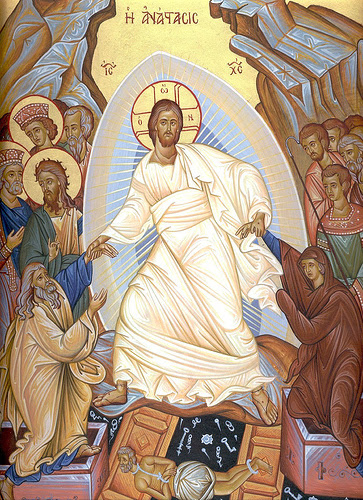
Christianity is the largest religion in the world, around a third of the Earth’s population, and since Easter is the most important day to Christians, this day could possibly be considered the most important day in the world!
The word “Easter” appears only once in the King James Bible, Acts 12:4. In every other place, and in every other Bible translation, the word used is “Passover.”
President Ronald Reagan stated April 2, 1983:
“This week Jewish families … have been celebrating Passover … Its observance reminds all of … the battle against oppression waged by the Jews since ancient times …
And Christians have been commemorating the last momentous days leading to the crucifixion of Jesus 1,950 years ago. Tomorrow, as morning spreads around the planet, we’ll celebrate the triumph of life over death, the Resurrection of Jesus.”
Passover is the first of the seven major Jewish Feasts, as listed in Leviticus 25. The feasts are in three groups:
In the Spring are the Feast of Passover; the Feast of Unleavened Bread; and the Feast of First Fruits.
Fifty days later is the Feast of Pentecost at the beginning of the harvest. “Pentecost” means 50th.
At the end of the summer harvest are celebrated the Feast of Trumpets, the Day of Atonement, and the Feast of Tabernacles.
Let’s look at these:
Passover was first observed around 1,400 BC, the night before the exodus from Egypt.
Egyptians had enslaved the Israelites. The Pharaoh ordered their infant boys thrown into the Nile River. In response, God sent plagues upon Egypt as judgments, the final one being similar to Pharaoh’s order, the angel of death sent to kill the firstborn of the Egyptians.
On the 15th day of the Hebrew month Nisan, each Israelite family was to kill a lamb and put its blood over the doorposts of their house so that the judgment of the angel of death would “pass over” their home, indicating their faith, that the lamb had taken the judgment in their place.
Exodus 12:8 gave instructions regarding the Passover lamb: “And they shall eat the flesh in that night, roast with fire, and unleavened bread; and with bitter herbs they shall eat it.”
A Jewish day began at sunset and lasted until the next sunset. In 33 AD, Jesus celebrated the Passover meal with his disciples in the evening and then in the morning he was crucified — on the day of Passover.
The Apostle Paul wrote in First Corinthians 5:7: “For even Christ our Passover is sacrificed for us.”
The lamb is considered the most innocent of animals. John the Baptist saw Jesus and exclaimed: “Behold, the Lamb of God, who taketh away the sin of the world!”
Justin Martyr, who live c.100 to 165 AD, described:
“That lamb … was commanded to be wholly roasted … a symbol of the suffering of the cross which Christ would undergo. For the lamb … is roasted and dressed up in the form of the cross. For one spit is transfixed right through from the lower parts up to the head, and one across the back, to which are attached the legs of the lamb.”
Crucifixion was the most painful Roman torture, reserved for slaves and rebels.
Dr. Alexander Metherell, M.D., Ph.D. wrote:
“The pain was absolutely unbearable … In fact, it was literally beyond words to describe; they had to invent a new word: ‘excruciating.’ Literally, excruciating means ‘out of the cross.’”
Cicero called crucifixion, “the most cruel and hideous of tortures.” Historian Will Durant wrote that “even the Romans … pitied the victims.”
Isaiah chapter 53 prophetically foretold the Messiah’s suffering:
“Surely he took up our pain and bore our suffering, yet we considered him punished by God, stricken by him, and afflicted. But he was pierced for our transgressions, he was crushed for our iniquities; the punishment that brought us peace was on him, and by his wounds we are healed …
The Lord has laid on him the iniquity of us all. He was oppressed and afflicted, yet he did not open his mouth; he was led like a lamb to the slaughter, and as a sheep before its shearers is silent …
He was cut off from the land of the living; for the transgression of my people he was punished … Yet it was the Lord’s will to crush him and cause him to suffer … The Lord makes his life an offering for sin …
My righteous servant will justify many, and he will bear their iniquities … For he bore the sin of many and made intercession for the transgressors.”
The next Jewish Feast after Passover was the Feast of Unleavened Bread. “Leaven” is another name for “yeast” and is symbolic of sin. On this feast, Jews would get all the leaven or yeast out of their homes.
On the exact Feast of Unleavened Bread, Jesus was in the tomb – He “who taketh away the sins of the world.”
Paul wrote in I Corinthians 5:6–8: “Know ye not that a little leaven leaveneth the whole lump? Purge out therefore the old leaven … Let us keep the Feast, not with the old leaven, neither with the leaven of malice and wickedness; but with the unleavened bread of sincerity and truth.”
Theologians have debated what Jesus may have experienced when He suffered. In Matthew 12, Jesus replied to those demanding a sign:
“None will be given it except the sign of the prophet Jonah. For as Jonah was three days and three nights in the belly of the great fish, so the Son of Man will be three days and three nights in the heart of the earth.”
The Book of Jonah recorded: “Jonah prayed unto the Lord his God out of the fish’s belly … out of the belly of hell cried I, and thou heardest my voice. For thou hadst cast me into the deep, in the midst of the seas; and the floods compassed me about: all thy billows and thy waves passed over me. Then I said, I am cast out of thy sight … the depth closed me round about, the weeds were wrapped about my head. I went down to the bottoms of the mountains; the earth with her bars was about me forever.”
Next is the Feast of First Fruits marking the earliest harvest of the spring, the winter barley, which is the first grain to ripen in Israel’s growing season.
As soon as it appeared above ground it was harvested and brought to the temple.
Leviticus 23:9-14: “When you enter the land … and reap its harvest, then you shall bring in the sheaf of the first fruits of your harvest … The priest … shall wave the sheaf before the Lord.”
Jesus rose from the dead on exact day of the Feast of First Fruits.
Paul wrote in I Corinthians 15:20–23: “But now is Christ risen from the dead and become the first fruits of them that slept … But every man in his own order: Christ the first fruits; afterward they that are Christ’s at his coming.”
Jonah declared: “Thou hast brought up my life from corruption, O Lord my God. When my soul fainted within me, I remembered the Lord; and my prayer went up to You, into Your holy temple … Salvation is of the Lord.’ So the Lord spoke to the fish, and it vomited Jonah onto dry land.”
The fact that the Gospels have women being the first to testify of Christ’s resurrection is evidence that the disciples did not make up the story, as women were not accepted as witnesses at that time. Josephus included in the Antiquities of the Jews this first century legal policy: “Let not the testimony of women be admitted.”
Anyone wanting to fabricate a story would certainly have had made it up with the most reputable men being the first witnesses, not uneducated fishermen and women.
Sir Lionel Luckhoo (1914-1997) was listed in the Guinness Book of World Records as world’s most successful criminal attorney. He wrote:
“The bones of Muhammad are in Medina, the bones of Confucius are in Shantung, the cremated bones of Buddha are in Nepal. Thousands pay pilgrimages to worship at their tombs which contain their bones. …
But in Jerusalem there is a cave cut into the rock. This is the tomb of Jesus. IT IS EMPTY! YES, EMPTY! BECAUSE HE IS RISEN! He died, physically and historically. He arose from the dead, and now sits at the right hand of God.”
Fifty days after First Fruits was the Feast of Pentecost, or Shavuot – Feast of Weeks (seven weeks of seven days), officially marking the beginning of the main harvest season (the end of barley harvest and the beginning of wheat harvest.)
Fifty days after Jesus rose from the grave was the Feast of Pentecost, when the Holy Spirit was poured out on the Apostles and the Church was born. The harvest of souls began.
Three thousand were saved the first day, and eight thousand by the end of the week. Then the new believers in Christ spread the harvest around the world.
If one zooms out and looks at all of recorded human history, it becomes clear that the world had been divinely set up for this moment.
c.1400 BC — Moses and the Children of Israel celebrated the first Passover, came out of Egypt and entered the Promised Land. The tradition of observing the Seven Feasts was instituted.
732 BC — The Ten Northern Tribes of Israel were taken captive by Assyria and scattered far and wide, resulting in pockets of Jewish communities being established around the known world.
509 BC – The Roman Republic was founded and began to expand with a road system connecting the known world.
335 BC — Alexander the Great conquered and spread the Greek language, which became the world-wide trade language.
285 BC – The Old Testament was translated into Greek, called the Septuagint.
27 BC — The Pax Romana began – a century of world peace.
33 AD — Jesus was crucified and resurrected. At the first Pentecost, Jewish believers were filled with the Holy Spirit. At the end of that week, they traveled from Jerusalem during the Pax Romana peace, on Roman roads, to Jewish communities scattered around the world, proclaiming that the Old Testament prophecies regarding the Messiah, which were internationally read in the Greek Septuagint, were fulfilled in the risen Christ. Romans 10:17, “Their voice has gone out into all the earth.”
While the great harvest of souls is continuing, the fulfillment of the last three Jewish feasts is still in the future.
In the Jewish year, the long months of harvesting continued as the Israelites worked in the fields, threshing, winnowing, sifting of the grain, as well as harvesting grapes, figs, almonds, and pomegranates, before the latter rain started.
At the end of the summer harvest, the Feast of Trumpets called the people to gather in from the fields to the Temple. The harvest was now complete.
Jesus prophesied in Matthew 24:40 “Two men will be in the field: one will be taken and the other left. Two women will be grinding at the mill: one will be taken and the other left.”
1 Thessalonians 4:16–17 “For the Lord himself shall descend from heaven with a shout, with the voice of the archangel, and with the trump of God.”
I Corinthians 15:52 “At the last trumpet. For the trumpet will sound, and the dead will be raised incorruptible, and we shall be changed.”
The next two feasts are the Day of Atonement, the most solemn of all feasts, which students of prophecy speculate may be fulfilled in the Great Tribulation or the Judgment Seat of Christ.
Finally, there is the Feast of Tabernacles, where the Israelites dwelt in booths or tents to remind them of their pilgrimage 40 years following the presence of the Lord in the Tabernacle in the Wilderness. This could foreshadow the saints dwelling with the Lord forever.
John 14:2-3 (Amplified Bible) “In My Father’s house are many dwelling places. If it were not so, I would have told you, because I am going there to prepare a place for you. And if I go and prepare a place for you, I will come back again and I will take you to Myself, so that where I am you may be also.”
One third of the Bible is prophecies, with over 300 prophecies specifically about the Messiah, 27 of which were fulfilled in one day.
Messianic prophecies include:
-He would be born in Bethlehem. Micah 5:2.
-He would be born of a virgin. Isaiah 7:14.
-He would be a descendant of David. Isaiah 9:7.
-He would be betrayed for 30 pieces of silver. Zechariah 11:12.
-He would be mocked. Psalm 22:7,8.
-He would be crucified. John 3:14.
-He would be pierced. Psalms 22:16.
-He would die with the wicked yet be buried with the rich. Isaiah 53:9.
That one person could fulfill just eight prophecies is considered a statistical impossibility.
Josh and Sean McDowell’s book, Evidence That Demands a Verdict (2017), quotes Professor Peter W. Stoner, Chairman of the Departments of Mathematics and Astronomy at Pasadena City College, who stated:
“We find that the chance that any man might have lived down to the present time and fulfilled all eight prophecies is 1 in 10 to the 17th power. That is one with 17 zeros behind it.”
The first prophecy was God telling the serpent that the seed of woman will crush his head.
Prophecies had to be not clear enough so Satan could not figure them out and try to stop them, like Herod tried when he was told the Messiah would be born in Bethlehem, he killed all the baby boys; yet at the same time the prophecies had to be clear enough so that after Jesus rose from the dead they could prove He was indeed the promised Messiah.
In Luke 24, after His resurrection, Jesus walked with disciples along the road to Emmaus, and said:
“How foolish you are, and how slow to believe all that the prophets have spoken! Did not the Messiah have to suffer these things and then enter his glory?” And beginning with Moses and all the Prophets, he explained to them what was said in all the Scriptures concerning himself.”
Robert Morris Page (1903-1992) was a physicist known as the “father of U.S. Radar for inventing pulsation radar used for the detection of aircraft. He served with the Naval Research Laboratory in Washington, D.C., held 37 patents, and received the U.S. Navy Distinguished Civilian Service Award, and the Presidential Certificate of Merit.
The son of a Methodist minister, Robert Morris Page wrote concerning the hundreds of Old Testament prophecies Jesus fulfilled:
“The authenticity of the writings of the prophets, though the men themselves are human, is established by such things as the prediction of highly significant events far in the future that could be accomplished only through a knowledge obtained from a realm which is not subject to the laws of time as we know them.
One of the great evidences is the long series of prophecies concerning Jesus the Messiah. These prophecies extend hundreds of years prior to the birth of Christ.
They include a vast amount of detail concerning Christ himself, His nature and the things He would do when He came–things which to the natural world, or the scientific world, remain to this day completely inexplicable.”
In addition to this, many non-Christian ancient sources confirmed details of Christ.
Dr. Gary Habermas catalogued over 3,400 sources, many of which are skeptical or even critical of Christians, adding to their veracity, including:
- Josephus 37-100 AD,
- Suetonius 70-160 AD
- Pliny the Younger 61-113 AD
- Tacitus 56-120 AD
- Mara Bar-Serapion 72 AD
- Lucian 125-180 AD
- Babylonian Talmud.
Piecing together these non-biblical sources, they confirm the key points of the gospel, such as:
Jesus died by crucifixion; He was buried; His death caused the disciples to despair and lose hope, believing that His life was ended; The tomb was empty a few days later; The disciples had experiences which they believed were literal appearances of the risen Jesus.
The twelve apostles went to their deaths holding their faith in the risen Christ.
The date of Easter even changed our calendar.
How?
In 45 BC, Julius Caesar wanted a common calendar used in all the countries conquered by Romans. He switched their various lunar calendars, based on the monthly cycles of the moon, to a solar calendar of 365 days with a leap day every four years.
In the 4th century, Emperor Constantine stopped the persecution of the Christians and made Christianity the defacto state religion. He wanted a common date to celebrate Easter throughout the Roman Empire and he wanted it on a Sunday.
This would settle the “Quarto-deciman Controversy.
Encyclopaedia Britannica (11th edition) explained how the “Quarto-deciman Controversy” ended with the switching of Easter from the traditional Jewish Passover to a particular Sunday determined by a new formula:
“Polycarp, the disciple of St. John the Evangelist and bishop of Smyrna, visited Rome in 159 to confer with Anicetus, the bishop of that see, on the subject; and urged the tradition, which he had received from the apostle, of observing the fourteenth day (of the Jewish month of Nisan) …
A final settlement of the dispute was one among the other reasons which led Constantine to summon the Council of Nicaea in 325 …
The decision of the council was unanimous that Easter was to be kept on Sunday, and on the same Sunday throughout the world, and ‘that none should hereafter follow the blindness of the Jews’.”
This ended the tradition of asking Jewish rabbis when Passover would be. Constantine then adopted a new formula for determining the date of Easter, namely, the first Sunday after first full moon after Spring Equinox.
Peter Schaff wrote in History of the Christian Church:
“At Nicaea … the Roman and Alexandrian usage with respect to Easter triumphed, and the Judaizing practice of the Quarto-decimanians, who always celebrated Easter on the fourteenth of Nisan [Passover] became thenceforth a heresy.”
This was a defining split between the Jewish Christian Church — as Jesus and his disciples were Jewish — and the emerging Gentile Christian Church.
Church scholars compiled precise tables of when future dates of Easter would be.
Not everyone was quick to use the new church tables, particularly the Irish. This was because in 433 AD, the night before Easter, according to the old calendar, Saint Patrick confronted the Druid chieftain King Leary, resulting in thousands of Irish converting.
In 567 AD, the Council of Tours moved the beginning of the year back to March 25, as Julius Caesar’s January 1st was considered pagan.
During the Middle Ages, France celebrated New Year Day on Easter.
The Church’s table of dates based on the Julian Calendar had a slight discrepancy of 11 minutes per year.
After a thousand years, in 1582, the church tables made Easter ten days ahead of Constantine’s formula — the first Sunday after the first full moon after the Spring Equinox — and even further from its origins in the Jewish Passover.
Pope Gregory XIII decided to fix the problem by eliminating ten days from the calendar and skipping a leap day in years divisible by 100 and also divisible by 400.
It sounds complicated, but it is so accurate that the Gregorian Calendar is still the calendar used internationally today.
The Gregorian Calendar also returned the beginning of the new year from March 25 back to January 1st.
Thus, setting the date of Easter is the reason the world is using the Gregorian Calendar!
In closing, one last question needs to be answered. Why did the Lamb have to die?
To answer that, we must ask:
Why did God make us?
First, we are creatures made in His image with a free will ability to love God.
Secondly, God has to hide himself behind His creation for us to have a free will, because if He ever revealed Himself in all of overwhelming, omnipotent, universe creating power, your response would be involuntary. And for love to be love it must be voluntary!
Thirdly, God is just and therefore must judge every sin. If He does not judge a sin, His silence would be giving consent to sin.
Numbers 30 explains silence equals consent. This is seen in a wedding ceremony, where the minister asks if anyone objects they should speak now or forever hold their peace. By staying silent, those in attendance are giving their consent. In law, this is called “the rule of tacit admission.”
If God is silent and does not judge a sin, even the smallest, His silence would effectively be giving consent to the sin, denying His just nature, denying Himself. And 2 Timothy 2:13 declares “God cannot deny Himself.” So He must judge every sin.
In mathematical equations, there are constants and variables.
In the equation of redemption, the constant is God is just, forever was, is, and forever will be just. The variable is who takes the judgment – you or a substitute.
The Lamb is our substitute. The Lamb is God’s way to love you without having to judge you. God is just in that He judges every sin, but God is love in that He provided the Lamb to take the judgment for our sins.
The sacrifice of the Lamb was foreshadowed by the coats of skins God made for Adam and Eve.
It was foreshadowed by the sacrifices made by Abel, Noah, and Abraham.
In Genesis 22:7-8:
“Isaac spoke up and said to his father Abraham, ‘Father?’ ‘Yes, my son?’ Abraham replied. ‘The fire and wood are here,’ Isaac said, ‘but where is the lamb for the burnt offering?’ And Abraham said, My son, God will provide himself a lamb for burnt offering.”
It was foreshadowed in the Law of Moses with the Passover lamb, and on the Day of Atonement when the High Priest brought the blood of lamb into Holy of Holies and sprinkled it on the mercy seat. The blood changed it from a “judgment” seat into a “mercy seat.”
It was foreshadowed by the sacrifices of David, Solomon, and Elijah.
Finally, John the Baptist pointed at Jesus and declared: “Behold the Lamb of God that taketh away the sins of the world.”
Believers in the Old Testament had faith in the Lamb to come; believers in the New Testament have faith in the Lamb that came, but salvation is through the Lamb.
The Lamb of God took the judgment for all of your sins.
“For God so loved the world that He gave his only begotten Son.”
Another question is, how was Jesus’ sacrifice enough to pay for the sins of all mankind?
Jesus is divine and experienced judgment in a dimension we will never understand.
2 Peter 3:8 says “A day with the Lord is as a thousand years and a thousand years as a day.” Jesus experienced the day on the cross as if it were a thousand years.
In God’s perfect justice:
the eternal Being, Jesus, who is innocent suffering for a finite–limited period of time
is equal to
all of us finite–limited beings who are guilty suffering for an eternal period of time.
Infinity times finite equals finite times infinity.
An unlimited Being suffering for a limited period of time equals all of us limited beings suffering for an unlimited period of time.
Jesus suffered the equivalent of eternal judgement in all or our places, and He is THE ONLY ONE who could have done it!
When someone believes the Gospel – that Jesus suffered in their place, that their sins have been taken away, and that they are accepted by God – they are filled with joy and gratefulness.
Experiencing the unconditional love of God brings a behavioral change from the inside–out, a polarity change in the heart — instead of avoiding God, you are drawn to God — a personal relationship with God the Father through Jesus the Son, then, filled with Holy Spirit, there is a desire to share the unconditional love of God with a lost and hurting world.
—
This article was reposted with permission from the American Minute.
Let the Pastors Speak by Maria Pia Perez

In celebration of Presidents Day, I’d like to share selected stories about our founding leaders and their pastors.
New England’s pulpits essentially paved the road to American freedom. Sermons from the colonial era helped to shape America’s understanding that resistance to tyranny is obedience to God.
Thus, the New England clergy helped lay the intellectual and theological foundation for liberty.
Liberty Thundered from the colonial pulpits, mainly in New England, ignited the war for independence (Kennedy, 1994 ).
One example is the work of reverend Jonas Clark. He was the minister of the church in Lexington. From 1762 to 1776, he was the most influential politician and a churchman in the Lexington Concord area. His home was a meeting place for many important patriots; on the night of Paul Revere’s ride, Clark entertained John Hancock and Samuel Adams. When asked if the men of Lexington would fight, he replied that he had trained them for that very hour (Kennedy, 1994).
(
History is replete with evidence of how pastors influenced our first founding leaders. I want to share how the pastors guided and influenced the founding of our nation, pastors like Jonathan Mayhew, who asserted that “rebellion against tyranny is obedience to God.” In the 1700s, Jonathan Mayhew was the most prominent dissenter against the Church of England in Massachusetts. His powerful sermons put forth radical ideas against the crown. Mayhew’s words are not just spiritual wanderings but outright treason.
 Rev. Jonathan Mayhew
One of his more prominent speeches became known as the “morning gun of the revolution,” fueling rebellion against the King in England. John Adams was so inspired by Mayhew’s sermons that even in his old age, he would give copies of the speech to friends as a gift. Adams would praise people of faith, stating, “Our constitution was made only for a moral and religious people; it is wholly inadequate to the government of any other.” He said, “The revolution was affected before the war commenced; it was in the minds and hearts of the people; a change in their religious sentiments of their duties and obligations.”
Another preacher who was used mightily by God was the reverend George Whitefield. Whitefield arrived in Philadelphia as part of an extended evangelical journey through the colonies. Benjamin Franklin was curious to learn about Whitefield, so he investigated whether Whitefield might be a charlatan. Uninterested in hearing Whitefield speak to small local congregations, Benjamin Franklin decided to hear him when he spoke in a large open-air meeting, which captivated Franklin’s attention. He was intrigued that the preacher was doing good work, like opening a large orphanage outside Savannah, Georgia. Franklin is taken in by the sincere message of faith and is so moved by the preacher’s message that he secures an arrangement to print Whitefield’s sermons. The two developed a deep civil friendship in Franklin’s words, and Whitefield became a frequent visitor to the Franklin household. Whitefield traveled to America seven times; his message of self-determination in religion and civil affairs would resonate throughout the colonies, inspiring rebellion against England.
 Rev. George Whitifield
An additional renowned pastor influential to our nation’s founders was the reverend Samuel Davies. Patrick Henry, one of the most influential fathers of our country, said of reverend Samuel Davies that “he was the greatest orator I have ever heard.” (O’Reilly & Dugard, 2023 )
The Presbyterian minister John Witherspoon had an unparalleled record as a leader and educator for over 25 years. He taught a large group of the founding fathers, and “his graduates included the president of the United States James Madison; Vice president, Aaron Burr; 10 cabinet members; Six members of the Continental Congress; 39 US Representatives: 21 US Senators; 12 Governor’s; 56 State Legislator’s; 30 judges; 3 US Supreme Court justices; 6 members of the Constitutional Convention; and 13 college presidents.” The Reverend John Witherspoon was a signer of the Declaration and a signer of the Articles of Confederation. Witherspoon was the quintessential founding father most people have never heard of. He was best described as the man who shaped the men who shaped America (Kennedy, 1994 ).
How about the Reverend William Rogers, who had a special time of daily prayer for the constitutional convention proceedings throughout the convention.
As Thomas Jefferson said at the time of the founding, “when governments fear the people, there is liberty. when the people fear the government, there is tyranny.”
Montesquieu believed that all law has its source in God. In his primary text, The Spirit of the Laws, he recognized the value of Christianity in fostering good laws and good government.
In the Old Testament, prophets such as Samuel, Nathan, Elijah, and Elisha were counselors to the kings. In America, the people are the king, and the pastors are the counselors to the king sitting in their pews. The church is the conscious of the state (Federer, 2017).
In 1820, Daniel Webster, in speaking against the African slave trader, gave a rebuke in which he stated and invoked “the ministers of our religion, that they proclaim its denunciation of these crimes, and add its solemn sanctions to the authority of human laws. ” He stated, “If the pulpit be silent whenever or wherever there may be a sinner bloody with this guilt within the hearing of its voice, the pulpit is false to its trust” (Federer, 2017).
Works Cited
Federer, W. J. (2017). Who is the King in America: And who are the counselors to the king? Fort Myers : Amerisearch Inc. .
Kennedy, D. J. (1994 ). What If Jeusus Had Never Been Born? Nashville : Thomas Nelson Inc. .
O’Reilly, B., & Dugard, M. (2023 ). Killing the Witches: The horror of salem, Massachusetts . New York : St. Martin’s Press .
Powell, S. S. (2022). Rediscovering America: How the national holidays tell an amazing story about who we are . New York: Post Hill Press .
A Return to Pagan Antiquity by Maria Perez

We are living in a time that’s ushering in a Dark Age. When the restraining influence of Christianity is removed from a country or culture, unmitigated disaster will naturally follow. This has been a repeated pattern of the last century.
In this century, many Christians seem clueless about God’s first command, the cultural mandate. We are to take all the potentialities of this world, all of its spheres and institutions, and bring them all to the glory of God. We are to use this world to the glory of God. In every aspect of the world, we are to bring glory to God, which means in all the world’s institutions.
Unfortunately, in the last 75 to 100 years, the church has often ignored the cultural mandate, and we wonder why we have so little impact on the world. The recent COVID-19 closing of the churches demonstrates that the church is irrelevant to modern society. The culture even deemed it non-essential. We have allowed ourselves to be irrelevant, and we’re reaping the consequences. We have been in retreat and have yet to seek to fulfill the cultural mandate.
In the physical realm, there is the second Law of Thermodynamics. This law says everything is running down, running out, and going from order to chaos. In the spiritual realm, there is also that tendency downward, away from God, in response to the work of Satan, who is continually trying to pull us down and is fighting against us.
We are seeing in our society a return to Pagan antiquity. Nietzsche said that history is the battle between Rome (the pagans) and Israel (the Jews and the Christians). Many of the ideas of Nietzsche were put into practice by his philosophy disciple, Hitler, and about 16 million died as a result.
The Christian Church seems to be in retreat. But we can be rest assured that truth and history are on our side. Let’s examine the positive contributions that Christianity has made through the centuries. These include hospitals, which essentially began during the Middle Ages, and universities, which also began during the Middle Ages. In addition, most of the world’s most outstanding universities were started by Christians for Christian purposes. Further examples include, literacy and education for the masses, capitalism and free enterprise, representative government, mainly as it has been seen in the American experiment, the separation of political powers, civil liberties, and the abolition of slavery, both in antiquity and in more modern times, modern science, the discovery of the new world by Columbus, the elevation of women, benevolence, and charity; the Good Samaritan ethic, higher standards of justice, the elevation of the common man, the condemnation of sexual perversions, high regard for human life, the civilizing of many barbarian and primitive cultures, the codifying and the setting of the writing of many of the world’s languages, greater development of art and music, the countless change lives transformed from liabilities into assets to society, and the eternal salvation of innumerable souls.
The Value of Human Life.
In Pagan antiquity, the pagans attributed little value to human life. Now in the post-Christian West, we have abandoned our Judeo-Christian heritage, and life is becoming cheap once again.
According to the centuries-old tradition of paterfamilias, the birth of a Roman was not a biological fact. Infants were received into the world only as the family willed. A Roman did not have a child; he took a child. Immediately after birth, if the family decided not to raise the child literally, lifting him above the earth, he was simply abandoned. There were special high places or walls where the newborn was taken and exposed to die. Before the explosive and penetrating growth of medieval Christian influence, the premortal evils of abortion, infanticide, abandonment, and exposure were a normal part of everyday life in Europe; afterward, they were regarded as the grotesque perversions that they are. Abortion disappeared in the early church. Infanticide and abandonment disappeared. The Justinian Code was explicit in declaring infanticide and abortion illegal.
The Value of Women
Before Christian influence, a woman’s life was also very cheap. In ancient cultures, the wife was the property of her husband. In Pagans and Christians, Robin Lane Fox points out that the killing of infant girls was so widespread it affected marriage customs. Adult girls were in shorter supply due to the habitual exposure of baby girls, which was a further break in the size of the family and the balance of the sexes.

In China, infanticide of little girls was a common practice. If a couple had more than one or two girls, they would be disposed of immediately. It was done in different ways. She could be put out as food for the wild dogs and wolves. The father would sometimes take her to a baby tower where she would die of exposure and starvation and be discovered by birds of prey. Others again would bury the little ones under the dirt floor in the room where they were born. If there is a river flowing by, the children would drown or be thrown in it. Adam Smith, writing in 1776, confirms this in his book The Wealth of Nations. He states, “In all great towns of China, several babies are every night exposed in the street, or drowned like puppies in the water. ”
In India, prior to Christian influences, widows were voluntarily or involuntarily burned on their husband’s funeral. Pyrus, a grizzly practice known as settee, Charles Spurgeon, told of a Hindu woman who said to a missionary, “Surely your Bible was written by a woman.” “Why” he asked, “because it says so many kind things for women.”
Polygamy has disappeared in numerous places around the world because of the impact of Christianity. This is significant because polygamy is inherently unfair to women.
The Elderly
Throughout history, many tribes and peoples killed off their elderly, much as they killed off their unwanted babies. The Eskimos used to kill their elderly by setting them adrift in ice floes, floating out to the sea.
As we move away from God and his principles in this country, we are reverting to a more Pagan view of life. We see the move afoot to kill off the elderly, whether it’s called mercy killing or euthanasia. Some today are advocating that those elderly persons who lack a certain quality of life should die and get out of the way for the younger population Today, there is a hideous way of abandoning the elderly that is common enough to warrant a name: “Granny dumping.” This refers to bringing an older adult to a hospital, racetrack, or someplace crowded with people and abandoning them there.
The Beauty of Sexuality
In the historical novel The Last Days of Pompeii, One character says of another, “Ione has but one vice, she is chased.” From a Christian perspective, sex is holy in the context of marriage. Any deviation from that is wrong. Christianity has helped to preserve the family as a basic unit of society. It has prevented millions of people from getting sexually transmitted diseases. It has prevented much unhappiness on the part of those who obey the biblical teaching.
One author, at the time of the collapse of the Old Kingdom of Egypt 4500 years ago, wrote that “sexual anarchy assumed extreme forms and spread through a large part of the population Side by side with an increase of sexual perversions, a shameless sexual promiscuity also greatly increased They seduce members of the same family, relations between father and daughter, son and mother, remained not unknown.” The authors especially stressed the cases “where a man lived sexually with two sisters, or with a mother and her daughter Adultery, rape, and prostitution greatly increased Homosexual love entered the mores of the population.”
The ancient pre-Christian world was rife with sexual immorality and perversion. A large picture book entitled Eros and Antiquity includes pictures of ancient paintings, marble, statuary of every kind, and vases adorned with ancient pictures. They are pretty obscene, and the male sexual organ is a constant theme. It was expected to find a phallic symbol adorning the outside of houses in the remains of Pompeii.
In AD 125, The Christian Aristides, an Athenian Philosopher, wrote a defense of the Christian faith to Emperor Hadrian. Here is what he said related to sexual matters: “They do not commit adultery or immorality. Their wives, Oh king, are as pure as virgins, and their daughters are modest. Their men abstain from all unlawful sexual contact and impurity in the hopes of recompense that is to come in another world.”
In general, Christianity continued and exaggerated the moral sternness of the Jews. Celibacy and virginity were recommended as ideal.
The Civilizing of the Uncivilized
Nothing in the annuals of history compares to what Christianity has done and can still do to civilize barbaric people. Much of the civilized attitudes we have in society ultimately come from our Judeo-Christian heritage. The moral code of Christianity is based on Judaism and the 10 Commandments, which have given us the standard of right and wrong for centuries. As Abraham Lincoln once said, “The Bible is the greatest gift God gave to man. Apart from it, we would not know right from wrong.”
Judaism gave the world a much higher view of morality than it had known before Jesus Christ took the Jewish base, expanded it, and sent it out into the whole world. Throughout history, many barbaric and cruel tribes and cultures have been civilized by the positive influence of Jesus Christ. Had Christ never come, we might well be drinking out of human skulls, as many of our ancestors did.
Anath, one of the goddesses of the Canaanites, was described “as the patron of war, in pursuing bloody orgies of destruction. She fiendishly butchers mankind young and old, in a most horrible and wholesale fashion, wading delightedly in human gore up to her knees, yes, up to her throat, all the while exalting sadistically.”
What happens when Christian restraints are removed?
Today, as the Christian influence, particularly in the West, is pushed back, we see more and more of what it was like before Christ. “Ours is a cut-flower civilization, said Dr. Elton Trueblood many years ago. A cut-flower civilization may, for the moment, have some beauty. Its technological advances are stirring, but it has been cut off from the source of its life and is inevitably decaying. Already we see the welting petals And the drooping of the leaves. Our nation is already in a state of advanced degeneration.”
General Weigand said, “When the Battle of France is over, I expect that the Battle of Britain is about to begin. Upon this battle depends the survival of Christian civilization.” The great statesman recognized the link between Christianity and civility, contrasting with neo-paganism and tyranny.
For the most part, the atrocities of the 20th century happened because modern man rejected God, as one wag put it:
- In the 18th century, the Bible was killed.
- In the 19th century, God was killed.
- In the 20th century, man was killed.
The humanist state inevitably leads to tyranny and despotism. As Dostoevsky said, “If God is dead, then all things are permissible.”
William Lynn, the first US House chaplain, stated on May 1st, 1789, “Let my neighbor persuade himself that there is no God and he will pick my pocket and break not only my leg but my neck. If there be no God, there is no future account.”
In 1799, Alexander Hamilton condemned the French Revolution’s attack on Christianity as “depriving mankind of its best consolations and most animating hopes, and to make a gloomy desert of the universe. He went on to affirm a civilized world is justly due to Christianity. He posited that the French, in renouncing Christianity, relapsed into barbarism. War resumes the same hideous, savage form which it wore in the ages of Gothic and Roman violence.”
Conclusion
Only the God of the Bible states that all men and women are equal, made in the image of the Creator, and to do unto others as you would have them do unto you.
Christianity has reference to the principles of right and wrong. It is the foundation of those morals and manners upon which our society is formed. Remove this, and they will fall.
Let me end with the words of Dwight Eisenhower, who addressed the American Legion Back-to-God program on February 20th, 1955, in which he said, “Without God, there could be no American form of government, nor an American way of life. Recognition of the Supreme Being is the first, the most basic expression of Americanism. Thus, the Founding Fathers saw it. And thus, with God’s help, it will continue to be.”
America’s founders planted the seed in soil rich in Judeo-Christian beliefs, and the harvest was the most accessible, prosperous nation with more individual liberty than any nation the world had seen (Federer, 2017).
Happy Birthday George Washington


Presidents’ Day is actually Washington’s birthday, recognized by an Act of Congress for government offices in Washington, D.C., in 1879, and for all federal offices in 1885.
In 1971, the Uniform Monday Holiday Act to create more three day weekends moved the observance of Washington’s birthday to the third Monday in February.

As Abraham Lincoln was also born in February, so many States include him in the observance, and still other States include all the Presidents.
George Washington was born FEBRUARY 22, 1732.
He was:
- unanimously chosen as the Army’s Commander-in-Chief;
- unanimously chosen as President of the Constitutional Convention;
- unanimously chosen as the first U.S. President;
- unanimously re-elected to a second term.
George Washington was an Anglican, and, after the Revolution, an Episcopalian.
George’s great-great-grandfather, Rev. Lawrence Washington, was an Anglican minister who taught at Oxford.
Lawrence and his wife, Amphyllis Twigen, had a son named John.
When the the Puritans won the English Civil War in 1651, Anglican ministers were demoted. Lawrence was reduced to being an assistant minister – a vicar – at an impoverished parish in Essex, England.
It was during this time that John Washington, George Washington’s great-grandfather, apprenticed as a merchant in London.
He sailed as second officer on a ship to the Colony of Virginia to purchase tobacco.
In 1657, when a storm partially sank their vessel in the Potomac River, John swam ashore.
While the ship was being repaired, John stayed at the home of a planter Colonel Nathaniel Pope, and fell in love with his daughter, Anne. John never returned to England.
John and Anne married, and her father gave them 700 acres in Westmoreland County.
John Washington became a successful planter and a member of the Virginia House of Burgesses.
He was a militia leader during Nathaniel Bacon’s Rebellion against Governor William Berkeley in 1676.
A local Anglican church was renamed “Washington” in honor of John Washington.
When John died, he left to the church a tablet of the Ten Commandments. His Will stated:
“In the Name of God, Amen. I, John Washington, of Washington Parish, in the County of Westmoreland, in Virginia, gentleman, being of good and perfect memory, thanks be unto Almighty God for it,
and calling to remembrance the uncertain state of this transitory life, that all flesh must yield unto death, do make, constitute, and ordain this my last will and testament …
… First, being heartily sorry, from the bottom of my heart, for my sins past, most humbly desiring forgiveness of the same from the Almighty God, my Savior and Redeemer, in whom and by the merits of Jesus Christ, I trust and believe assuredly to be saved, and to have full remission and forgiveness of all my sins,
and that my soul with my body at the general resurrection shall rise again with joy.”
The oldest of John Washington’s sons was Lawrence, the grandfather of George Washington.
Lawrence married Mildred Warner, the daughter of Col. Augustine Warner, Jr., an ancestor of Queen Elizabeth II.
Lawrence and Mildred had three children, the second being Augustine, who would become George Washington’s father.
When Lawrence died in 1698, Mildred married George Gale and moved back to England with her children.
When Mildred died, a relative in America petitioned to get custody of her children, including Augustine, and they were returned to Virginia in 1704.
Augustine Washington served as a vestryman in the Anglican Truro Parish.
He and his wife Jane Butler had two sons live to adulthood, Lawrence and Augustine Jr.
Both Lawrence and Augustine, Jr., went back to England to study at the prestigious Appleby Grammar School.
Jane died in 1729.
Augustine married Mary Ball in 1731, and together they had 6 children, with the oldest, George Washington, being born February 22, 1732.
Augustine died in 1743 when George was only 11-years-old.
George hand copied the Rules of Civility and Decent Behaviour in Company and Conversation, 1744, which included Rule #110:
“Labor to keep alive in your breast that little spark of celestial fire called conscience.”
George’s older half-brother Lawrence fought in the British navy under Admiral Edward Vernon, who had captured Porto Bello, Panama, from Spain in 1739.
When Lawrence returned to Virginia in 1742, he named his farm after his navy Admiral — Mount Vernon.
Lawrence married Anne Fairfax.
Her father, Col. William Fairfax, had been Collector of Customs in Barbados, and Chief Justice and Governor of the Bahamas, as well as a first cousin of Thomas Fairfax, who was the largest landowner in America with five million acres.
Lawrence arranged for George, at age 15, to begin a career in the British navy as a cabin boy, but his mother, Mary Ball Washington, refused.
George complied with his mother’s wishes and returned home.
In 1748, the 16-year-old George Washington was employed by Thomas Fairfax to survey the western area of his vast estate.
In 1751, Lawrence Washington contracted tuberculosis.
In hopes that a change of climate would help him recover, doctors recommended he travel to Barbados, where his father-in-law had been Collector of Customs.
He brought along his 17-year-old half-brother George.
This was the only time that George left the American continent.
In Barbados, George contracted smallpox, but recovered. This providentially inoculated George so that he was immune during the Revolutionary War, where it is estimated that more soldiers died of smallpox than in battle.
Lawrence died in 1752 and his Mount Vernon estate eventually was inherited by George, making him one of the youngest and largest landowners in Virginia.
George became vestryman in Truro Parish, and was godfather in baptism to several nephews and a niece.
From 1753-1758, George served in the French and Indian War.
He was a colonel under General Edward Braddock, Commander of the British forces in America.
George miraculously survived the Battle of Monongehela in 1755.Braddock was killed, leaving George in command.
On July 18, 1755, Washington wrote from Fort Cumberland to his brother, John A. Washington:
“By the All-Powerful Dispensations of Providence, I have been protected beyond all human probability or expectation; for I had four bullets through my coat, and two horses shot under me, yet escaped unhurt, although death was leveling my companions on every side of me!”
Colonel Washington wrote to Fort Loudoun, April 17, 1758:
“The last Assembly … provided for a chaplain to our regiment. On this subject I had often without any success applied to Governor Dinwiddie. I now flatter myself, that your honor will be pleased to appoint a sober, serious man for this duty. Common decency, Sir, in a camp calls for the services of a divine.”
In 1759, George fell in love Martha “Patsy” Dandridge Custis, a 26-year-old widow and mother with two children, John “Jacky” Parke Custis and Martha “Patsy” Parke Custis.
Martha had inherited five plantations totaling 17,500 acres.
Martha’s daughter Patsy died at age 16 of an epileptic seizure in 1773, while George held her in his arms. He wrote:
“The sweet, innocent girl entered into a more happy and peaceful abode than she had met in the afflicted path she had hitherto trod.”
In 1775, after the Battle of Bunker Hill, George Washington was commissioned as the General of the Continental Army.
He wrote to Martha, June 18, 1775:
“My Dearest … It has been determined in Congress, that the whole army raised for the defense of the American cause shall be put under my care, and that it is necessary for me to proceed immediately to Boston to take up command of it.
You may believe me, my dear Patsy, when I assure you, in the most solemn manner that, so far from seeking this appointment, I have used every endeavor in my power to avoid it …
But as it has been a kind of Destiny, that has thrown me upon this service, I shall hope that my undertaking it is designed to answer some good purpose …
I shall rely, therefore, confidently on that Providence which has heretofore preserved and been bountiful to me, not doubting but that I shall return safely to you in the fall.”
On July 4, 1775, General Washington ordered:
“The General … requires … observance of those articles of war … which forbid profane cursing, swearing and drunkenness; And … requires … punctual attendance of Divine Services.”
On October 2, 1775, General George Washington issued the order:
“Any … soldier who shall hereafter be detected playing at toss-up, pitch, and hustle, or any other games of chance … shall without delay be confined and punished …
The General does not mean by the above to discourage sports of exercise or recreation, he only means to discountenance and punish gaming.”
On February 26, 1776, General Washington issued the orders:
“All … soldiers are positively forbid playing at cards and other games of chance. At this time of public distress men may find enough to do in the service of their God and their country, without abandoning themselves to vice and immorality.”
Washington acknowledged God throughout the Revolution, as he wrote on May 15, 1776:
“The Continental Congress having ordered Friday the 17th instant to be observed as a day of fasting, humiliation, and prayer, humbly to supplicate the mercy of Almighty God,
that it would please Him to pardon all our manifold sins and transgressions, and to prosper the arms of the United Colonies, and finally establish the peace and freedom of America upon a solid and lasting foundation;
the General commands all officers and soldiers to pay strict obedience to the orders of the Continental Congress;
that, by their unfeigned and pious observance of their religious duties, they may incline the Lord and Giver of victory to prosper our arms.”
On July 2, 1776, from his Head Quarters in New York, General Washington issued his General Orders:
“The time is now near at hand which must probably determine whether Americans are to be freemen or slaves; whether they are to have any property they can call their own;
whether their houses and farms are to be pillaged and destroyed, and themselves consigned to a state of wretchedness from which no human efforts will deliver them.
The fate of unborn millions will now depend, under God, on the courage and conduct of this army.
Our cruel and unrelenting enemy leaves us no choice but a brave resistance, or the most abject submission. We have, therefore to resolve to conquer or die …”
He continued:
“Our own country’s honor calls upon us for a vigorous and manly exertion, and if we now shamefully fail, we shall become infamous to the whole world.
Let us rely upon the goodness of the cause, and the aid of the Supreme Being in whose hands victory is, to animate and encourage us to great and noble actions.”
When the Declaration of Independence was written, a copy was rushed out to Washington, who was fortifying New York City.
He had it read to his troops, then ordered chaplains placed in each regiment, stating July 9, 1776:
“The General hopes and trusts, that every officer and man, will endeavour so to live, and act, as becomes a Christian Soldier, defending the dearest Rights and Liberties of his country.”
As recorded in The Writings of George Washington (March 10, 1778, 11:83-84, U.S. Government Printing Office, 1934), George Washington ordered:
“At a General Court Marshall … Lieutt. Enslin of Colo. Malcom’s Regiment tried for attempting to commit sodomy, with John Monhort a soldier…and do sentence him to be dismiss’d the service with Infamy.
His Excellency the Commander-in-Chief approves the sentence and with Abhorrence and Detestation of such Infamous Crimes orders Liett. Enslin to be drummed out of Camp tomorrow morning by all the Drummers and Fifers in the Army never to return.”
General Washington wrote at Valley Forge, May 2, 1778:
“To the distinguished character of Patriot, it should be our highest Glory to laud the more distinguished Character of Christian.”
To the Delaware Indian Chiefs who brought three youths to be trained in American schools, General Washington stated, May 12, 1779:
“You do well to wish to learn our arts and ways of life, and above all, the religion of Jesus Christ.”
The tremendous victory at the Battle of Yorktown, October 19, 1781, securing America’s independence, was personally bittersweet for Washington, as his wife’s son, John Parke Custis, who had been an aide-de-camp, died there of camp fever, November 5, 1781.
Though never having children of his own, George agreed to adopt John Parke Custis’ two young children as his own: Eleanor “Nelly” Parke Custis and George Washington Parke Custis, whose daughter, Mary Anna, married Robert E. Lee.
When the Articles of Confederation proved inadequate for the new nation George Washington agreed to preside over the Constitutional Convention in 1787.
He opened the Constitutional Convention with the line:
“The event is in the hand of God.”
In 1789, he was sworn in as the first President of the United States.
President Washington thanked God for the Constitution, October 3, 1789:
“Whereas it is the duty of all nations to acknowledge the Providence of Almighty God …
I do recommend … rendering unto Him our sincere and humble thanks, for … the favorable interpositions of His Providence … we experienced in the course and conclusion of the late war … for the peaceable and rational manner in which we have been enabled to establish constitutions of government.”
On August 15, 1787, in a letter from Philadelphia to the Marquis de Lafayette, Washington wrote:
“I am not less ardent in my wish that you may succeed in your plan of toleration in religious matters.
Being no bigot myself to any mode of worship, I am disposed to indulge the professors of Christianity in the church with that road to Heaven which to them shall seem the most direct, plainest and easiest, and the least liable to exception.”
Washington sent a letters to the Jewish Congregation in Newport, Rhode Island, and in Savannah, Georgia, stating:
“May the same wonder-working Deity, who long since delivered the Hebrews from their Egyptian oppressors, planted them in a promised land, whose providential agency has lately been conspicuous in establishing these United States as an independent nation, still continue to water them with the dews of heaven.”
In 1794, during the Whiskey Rebellion, Washington became the only sitting President, as Commander-in-Chief, to lead the United States Army into the field.
Washington chose only to served two terms as President, leaving an example which every succeeding President follow till Franklin Roosevelt, necessitating the 22nd Amendment.
Washington continually had toothaches. By the time of his Inauguration, he had only one tooth.
Several dentists made make-shift dentures for him.
Washington had slaves from inheritance, marriage, and purchase, as did almost half of the founders.
As the influence of Baptists, Methodists and Quakers spread, many founders abandoned slavery — similar to today, how more and more pro-abortion supporters are becoming pro-life.
Washington freed his mulatto man William:
“And to my Mulatto man William (calling himself William Lee) I give immediate freedom … I allow him an annuity of thirty dollars during his natural life…& this I give him as a testimony of my sense of his attachment to me, and for his faithful services during the Revolutionary War.”
In his Will, Washington freed the rest of his slaves upon his wife Martha’s death. Martha freed them the year after Washington died.
In his Will, George also made provision that elderly and sick slaves were to be supported by his estate in perpetuity.
On May 10, 1786, George Washington wrote from to Marquis de Lafayette:
“Your late purchase of an estate in the colony of Cayenne, with a view of emancipating the slaves on it, is a generous and noble proof of your humanity …
Would to God a like spirit would diffuse itself generally into the minds of the people of this country.”
As the early country took shape, partisan politics became increasingly vicious, with Washington even being the victim of ungracious attacks.
He warned how ambitious politicians would be tempted to use crises as opportunities to usurp power.
In his Farewell Address, 1796, Washington warned of those who would usurp power and rule through executive orders:
“Disorders and miseries, which result, gradually incline the minds of men to seek security and repose in the absolute power of an Individual … (who) turns this disposition to the purposes of his own elevation, on the ruins of Public Liberty …
The spirit of encroachment tends to consolidate the powers of all the departments in one, and thus to create, whatever the form of government, a real despotism …
Let there be no change by usurpation; for though this, in one instance, may be the instrument of good, it is the customary weapon by which free governments are destroyed.
The precedent (of usurpation) must always greatly overbalance in permanent evil any partial or transient benefit which the use can at any time yield.”
Earlier, in 1783, the American-born painter Benjamin West was in England painting the portrait of King George III.
When the King asked what General Washington planned to do now that he had won the war.
West replied:
“They say he will return to his farm.”
King George exclaimed:
“If he does that, he will be the greatest man in the world.”
Poet Robert Frost once wrote:
“I often say of George Washington that he was one of the few men in the whole history of the world who was not carried away by power.”
Charles Francis Adams, the grandson of John Adams, wrote:
“More than all, and above all, Washington was master of himself. If there be one quality more than another in his character which may exercise a useful control over the men of the present hour, it is the total disregard of self when in the most elevated positions for influence and example.”
George Washington added a warning in his Farewell Address, 1796:
“Of all the dispositions and habits which lead to political prosperity, Religion and Morality are indispensable supports.
In vain would that man claim the tribute of Patriotism, who should labor to subvert these great Pillars of human happiness.”
—
(This article was reposted with permission from American Minute, a registered trademark of William J. Federer. His website https://americanminute.com/
Origin of Saint Valentine’s Day – American Minute with Bill Federer


Origin of Saint Valentine’s Day

The origin of Saint Valentine’s Day goes back to early Christian history.
Today, at a time when governments are increasing their persecution of Christians, it is important to remember that the Church was born into a one-world anti-Christian government – the Roman Empire.
In the Book of Acts 1:8, Jesus told His disciples: “But you shall receive power when the Holy Spirit has come upon you; and you shall be witnesses to Me in Jerusalem, and in all Judea and Samaria, and to the end of the earth.”
According to Easton’s Bible Dictionary, the word for “witness” in Greek is “martus,” which is the root word for “martyr.”
Eleven of the twelve apostles were martyred, with John boiled in a pot of oil but miraculously surviving and banished to the Island of Patmos.
During the first three centuries of Christianity, there were ten major persecutions, along with innumerable smaller ones. Initially, Romans persecuted Jews and Christians together.
Government agents threw believers to the lions in the Colosseum, boiled them alive, had their tongues cut out, or worse:
64-68 A.D.: Emperor Nero blamed fire in Rome on Christians and began first persecution;
69-79 A.D.: Emperors Vespasian and Titus persecuted Christians, in addition to destroying the Jewish Temple in Jerusalem;
89-96 A.D.: The persecution under Emperor Domitian included boiling the Apostle John in oil then banishing him to Patmos, in addition to hunting down and killing descendants of David;
108-117 A.D.: The persecution under Emperor Trajan;
117-138 A.D.: The persecution under Emperor Hadrian crushed the Jewish Bar Kokbah Revolt and renamed the Roman province of Judea to Syria Palaestina;
161-180 A.D.: The persecution under Emperor Marcus Aurelius killed Polycarp, the disciple of John;
192-211 A.D.: Persecution under Emperor Septimius Severus;
235-238 A.D.: Persecution under Emperor Maximinus the Thracian;
249-251 A.D.: Persecution under Emperor Decius;
253-260 A.D.: Persecution under Emperor Valerian;
268-270 A.D.: Persecution under Emperor Claudius the Second, during which Saint Valentine was reportedly martyred;
274-285 A.D.: Persecution under Emperor Aurelian;
285-305 A.D.: Persecution under Emperor Diocletian, considered the worst of them all, decimating the entire Roman Theban Legion, which had become Christian, in addition to imprisoning Saint Nicholas;
305-313 A.D.: Finally, the persecution under Emperor Galerius.
Christians met in catacombs, which were caves carved underground, for their church meetings, and risked their lives every time they gathered together. A pietist movement began of withdrawal from the corrupt society, with some believers living in caves as hermits or joining monasteries.
Roman soldiers raided meetings and arrested believers, dragging them before corrupt judges, and also confiscated and destroyed Christian writings, scriptures and church records. As a result of this, records of the life of Saint Valentine are scant.
What little is known is from the works of Eusebius of Caesarea, and the Martyrologium Hieronymianum – Martyrology of Jerome, compiled around 460-544 A.D.
Passio Marii et Marthae, published in the 5th or 6th century includes a story of the martyrdom of Saint Valentine of Rome.
Venerable Bede’s Martyrology, compiled in the 8th century, described St. Valentine being arrested and interrogated by Emperor Claudius the Second. Claudius was impressed with Valentine and tried to convert him to paganism to save his life. Valentine refused and tried to convert Claudius to Christianity instead. Because of this, he was executed.
The 8th-century Gelasian Sacramentary recorded the celebration of the Feast of Saint Valentine on February 14.
St. Valentine is mentioned in the Legenda Sanctorum by Jacobus de Voragine in 1260 and in the Nuremberg Chronicle, 1493.
Though several individuals may have had that name, it appears Saint Valentine was either a priest in Rome or a bishop in Terni, central Italy.
In the third century after Christ, the Roman Empire was being invaded by Goths.
At the same time, the Plague of Cyprian, probably smallpox, broke out killing at its height 5,000 people a day. So many died that the Roman army was depleted of soldiers.
Roman Emperor Claudius the Second needed more soldiers to fight the invading Goths. He believed that men fought better if they were not married, so he banned traditional marriage in the military.
Valentine risked the Emperor’s wrath by standing up for traditional marriage, secretly marrying soldiers to their brides.
Rome was also being torn from internal rivalries which continued since the assassination of the previous Emperor Gallienus.
Emperor Claudius the Second quelled political tensions by requesting the Roman Senate deify Emperor Gallienus, so he would be worshiped along with the other Roman gods.
Government mandates were issued forcing citizens to worship them by placing a pinch of incense on a fire before their statues.
It was a simple act, and some Christians caved, but since it clearly “an act of worship,” others chose rather to die in the Colosseum before they would worship anything other than the one true God.
Those who refused worship of the Roman gods were considered “politically incorrect” or “unpatriotic” enemies of the state. They were cancelled and killed.
Emperor Deccan’s persecution intentionally targeted Christians by issuing government mandates and executive orders forcing them to deny their consciences or die.
When Emperor Claudius demanded that Christians worship pagan idols and statues of deified Emperors, Saint Valentine refused.
The name Valentine is derived from the word “valor,” which means, strength of mind or spirit that enables a person to encounter danger with firmness and personal bravery.
Valentine was arrested and dragged before the Prefect of Rome, who condemned him to die.
While awaiting execution, he preached to guards and other prisoners. His jailer, Asterius, asked Saint Valentine to pray for his blind daughter. When she miraculously regained her sight, the jailer converted and was baptized, along with his entire family.
Right before his execution, Saint Valentine wrote a note to the jailer’s daughter, encouraging her in the faith, signing it, “from your Valentine.”
Saint Valentine was beaten with clubs and stones, and when that failed to kill him, he was beheaded outside the Flaminian Gate on FEBRUARY 14, 269 A.D.
I John 4:18 “Perfect love casteth out fear.”
I Timothy 4:8: “Henceforth there is laid up for me a crown of righteousness, which the Lord, the righteous judge, shall give me at that day: and not to me only, but unto all them also that love his appearing.”
In 496 A.D., Pope Gelasius is credited with designating FEBRUARY 14th as “Saint Valentine’s Day.”
How did St. Valentine’s Day get associated with love?
In the High Middle Ages, circa 1393, Geoffrey Chaucer, called the father of English literature, wrote a poem called Parliament of Foules – Assembly of Fowls, or Birds. “Fowl” is an old word for “bird.”
It it he described how many bird species birds, chose their mates in mid-February:
“For this was Saint Valentine’s day, when every bird of every kind that men can imagine comes to this place to choose his mate.”
He made another mention in the final chapter of The Cantebury Tales:
“The book of the Duchesse; the book of Seint Valentynes day of the Parlement of Briddes – Birds.”
The association of birds with fidelity in marital love came about because a large percent of bird species are monogamous.
Many bird species mate for life, such as varieties of:
Swans,
Geese,
Ravens,
Cranes,
Blue Jays,
Owls,
Hawks,
Woodpeckers,
Ospreys,
Raptors,
Puffins,
Pigeons,
Dove,
Penquins, and
Bald Eagles.
After elaborate courtships, depending on the species, these birds remain together until one partner dies.
Birds that mate for life often take turns sitting on the eggs, females at night and males during the day. They have offspring that require more extensive care and instruction from parents.
These species mate earlier in the season which allows their young more time to develop before the fall and winter seasons of long migrations or harsh winter weather.
After Chaucer’s poems, more references appeared in literature associating Saint Valentine’s Day with courtly love, such as John Donne’s Marriage Song; and William Shakespeare’s “Hamlet” and “Midsummer Night’s Dream.”
This eventually developed into the 18th-century English traditions of presenting flowers, offering confectionery, and sending St. Valentine’s Day greeting cards.
People often sign Valentine cards with X’s and O’s. Where did this come from?
To answer this, we must go back to Rome. Remember Emperor Diocletian’s terrible persecution?
Believers prayed and Diocletian was struck with an intestinal disease so painful he abdicated the throne on May 1, 305 A.D.
The next Emperor, Gallerius, continued the persecution and was also struck with an intestinal disease, dying in 311 A.D.
Four Roman generals fought it out as to who would be the next emperor.
Two were defeated and it came down to Constantine and Maxentius and the Battle of the Milvian Bridge in 312 AD.
Reportedly, the day before the battle, Constantine saw the sign of Christ in the sky, put it on his shields and banners, and won the battle. Afterwards he stopped the persecution of Christians.
What was the sign of Christ?
It is said to be the first two letters of the Greek name for Christ. Just like we often abbreviate states with the first two letters, Greek abbreviated names with the first two letters.
The Greek name for Christ is Xριστό.
The first letter which makes the “kha” sound is written as an “X” and is called “Chi.” The second letter, that makes the “rrr” sound is written as a “P” and is called “rho.” These two letters were called the “Chi-Rho.”
Over the centuries, it got shortened just to the Chi or X. “X” became a common abbreviation for the name Christ.
This is why Christ-mas is abbreviated as X-mas.
In Medieval times, the “X” was called the Christ’s Cross, or “Criss-Cross.”
In colonial America, young students were taught the alphabet, but before it was an “X.” Children would begin their recitation of the alphabet with the saying, May Christ’s cross grant me speed – or success. It reminded students that “the fear of the Lord is the beginning of wisdom.”
One of the colonial school books had the rhyme: “Mortals ne’er shall know —
More than contained of old the Chris’-cross row.”
The Christ’s Cross was a form of a written oath. This came down to us as, “put your X here”; or “sign at the X,” or saying, “I swear, cross my heart.”
Similar to the ancient practice of swearing upon a Bible, saying “so help me God,” then kissing the Bible, people would sign a document with or next to the Christ’s Cross to swear before God they would keep the agreement, then kiss it to show sincerity.
This is the origin of signing a Valentine’s card with an “X” to express a pledge before God to be faithful, and an “O” to seal the pledge with a kiss of sincerity.
History is intertwined with Valentine’s references:
On February 14, 1688, William and Mary were placed by Parliament on the English throne.
On February 14, 1778, John Paul Jones, sailing the USS Ranger, was given a nine-gun salute by French Admiral Lamotte-Picquet. This was the first time the Stars and Stripes flag was formally recognized by a foreign nation.
On February 14, 1779, British Captain James Cook is killed in Hawaii.
On February 14, 1817, Frederick Douglass, the Republican advisor to President Lincoln, was born a slave on a southern Democrat plantation. He was separated from his mother as a child and only remembers that his mother would call him, “my little valentine,” leading him to assume he was born on Valentine’s Day.
On February 14, 1844, John C. Fremont was the first explorer to discover Lake Tahoe. He later became the first Republican candidate for President.
On February 14, 1859, Oregon became a state.
On February 14, 1876, Alexander Graham Bell applied for a patent for the telephone.
On February 14, 1884, Theodore Roosevelt’s wife and mother died on Valentine’s Day. Depressed, he dropped out of New York politics, left his infant daughter with his sister, and went off to ranch in the Dakotas. He later came back to New York, took his daughter back, remarried and had five more children, then ran for President.
On February 14, 1912, Arizona became a state.
On February 14, 1929, the St. Valentine’s Day Massacre took place during the Prohibition era. Al Capone’s Chicago mob murdered seven members of Bugs Moran’s Irish gang.
Al Capone’s hitman Frank Nitti was accompanied by the young Saul Alinsky, who later incorporated gang tactics into his political technique of “community organizing.” Alinsky wrote in Rules for Radicals, 1971: “The organizer must first rub raw the resentments of the people of the community … fan the latent hostilities of many of the people to the point of overt expression.”
On February 14, 1949, the first Jewish Knesset meeting was held, with Israel’s first President Chaim Weizmann.
Since the Roman persecutions, Christianity has become the most persecuted faith in the world, with over 300 being martyred each day, or one every five minutes, mostly in communist and fundamentalist Islamic countries.
The Center for Studies on New Religions reported that in 2016, 90,000 Christians killed, 30 percent by sharia Islamic terrorists. Several organizations keep track of this, such as Voice of the Martyrs, and SavethePersecutedChristians.
Saint Valentine’s willingness to be a martyr for Christ and his loving example of heroic valor still inspires believers to follow the scriptures:
Matthew 5:44: “Love your enemies, bless them that curse you, do good to them that hate you, and pray for them that despitefully use you, and persecute you; That ye may be the children of your Father which is in heaven.”
John 13:35: “By this shall all men know that ye are my disciples, if ye have love one to another.”
John 15:13 “Greater love hath no man than this, that a man lay down his life for his friends.”
I John 4:10 “Herein is love, not that we loved God, but that he loved us, and sent his Son to be the propitiation for our sins.”
I John 4:19 “We love him, because he first loved us.”
–
American Minute is a registered trademark of William J. Federer. Permission granted to forward, reprint, or duplicate.