D-Day, June 6, 1944 & Nazi aggression that led up to it; “A Struggle to Preserve our Republic, our Religion & our Civilization” – American Minute with Bill Federer
1944? FDR “A Struggle to Preserve our Republic June 6 our Religion & our Civilization” What led up to D-Day

After World War I, Germany’s economy suffered from depression and a devaluation of their currency.
On January 30, 1933, Adolph Hitler was elected Chancellor of Germany by promising hope and universal healthcare.

Less than a month later, on February 27, 1933, a crisis occurred — the Rheichstag, Germany’s Capitol Building, was suspiciously set on fire, with evidence pointing to Hitler’s supporters.
Hitler, though, blamed the attack on his political opponents and used the power of the state to falsely accused and arrest them.
Hitler used the panic of the “crisis” as an opportunity to suspend citizens’ rights and systematically undermine Germany’s Weimar Republic.
He had radical homosexual activist Ernst Röhm and his feared Brownshirts, called “Sturmabteilung” (storm troopers), to storm into the meetings of his political opponents, disrupting and shouting down speakers.
Brownshirts organized protests and street riots, similar to modern day BLM/Antifa-style protests, smashing windows, blocking traffic, setting fires, vandalizing, and even beating to death innocent bystanders to spread fear and panic.
Nazis implemented boycotts of Jewish businesses.
The riots destabilized the country and led to the overthrow old political leaders.
On Kristallnacht (Night of Broken Glass), they broke windows, looted and set on fire over 7,500 Jewish stores and 200 synagogues.
Once securely in power, Hitler had his SS and Gestapo secret police kill the Brownshirts in the Night of the Long Knives, thus eliminating competition and giving the public impression that he was cracking down on lawbreakers.
Nazis had old military leaders falsely accused and forced to retire.
Some were imprisoned and even shot without a trial.
He pushed a type of critical race theory, whereby all other races were taught that they were inferior to the Aryan race.
Hitler then confiscated weapons from law-abiding citizens.
An SA Oberführer warned of an ordinance by the provisional Bavarian Minister of the Interior:
“The deadline set … for the surrender of weapons will expire on March 31, 1933. I therefore request the immediate surrender of all arms …
Whoever does not belong to one of these named units (SA, SS, and Stahlhelm) and … keeps his weapon without authorization or even hides it, must be viewed as an enemy of the national government and will be held responsible without hesitation and with the utmost severity.”
Heinrich Himmler, head of Nazi S.S. (“Schutzstaffel”-Protection Squadron), announced:
“Germans who wish to use firearms should join the S.S. or the S.A. Ordinary citizens don’t need guns, as their having guns doesn’t serve the State.”
In 1938, when a suspected homosexual youth shot a Nazi diplomat in Paris, it was used as an excuse to confiscate all firearms from Jews.
German newspapers printed, November 10, 1938:
“Jews Forbidden to Possess Weapons by Order of SS Reichsführer Himmler, Munich …
‘Persons who, according to the Nürnberg law, are regarded as Jews, are forbidden to possess any weapon. Violators will be condemned to a concentration camp and imprisoned for a period of up to 20 years.'”
The New York Times, November 9, 1938, reported:
“The Berlin Police … announced that … the entire Jewish population of Berlin had been ‘disarmed’ with the confiscation of 2,569 hand weapons, 1,702 firearms and 20,000 rounds of ammunition.
Any Jews still found in possession of weapons without valid licenses are threatened with the severest punishment.”
Of the Waffengesetz (Nazi Weapons Law), March 18, 1938, Hitler stated at a dinner talk, April 11, 1942 (Hitler’s Table Talk 1941-44: His Private Conversations, 2nd Edition, 1973, p. 425-6, translated by Norman Cameron and R. H. Stevens):
“The most foolish mistake we could possibly make would be to allow the subject races to possess arms.
History shows that all conquerors who have allowed their subject races to carry arms have prepared their own downfall by so doing …
So let’s not have any native militia or native police. German troops alone will bear the sole responsibility for the maintenance of law and order.”
Hitler’s Minister of Propaganda, Joseph Goebbels, pioneered the use of fake news to sway public opinion so that the entire nation accepted the lies of the deep-state:
“If you tell a lie big enough and keep repeating it, people will eventually come to believe it …
The truth is the greatest enemy of the state.”
In socialist countries, a person’s life is only of worth if it benefits the state:
“No life still valuable to the state will be wantonly destroyed.” (German Penal Code, October 10, 1933)
Those not promoting the deep-state narrative were driven from their jobs, publicly ridiculed, and eventually removed from society and sent to labor and concentration camps.
Anti-socialist John Basil Barnhill stated in a debate with Henry M. Tichenor, 1914 (National Rip Saw Publishing Co., St. Louis, MO):
“Where the people fear the government you have tyranny. Where the government fears the people you have liberty.”
This is similar to Robert F. Kennedy, Jr., who warned at Hillsdale College, April 11, 2023:
“1. Any power that government takes from the people, it will never return voluntarily;
2. Every power that government takes, it will ultimately abuse to the maximum extent possible;
3. Nobody ever complied their way out of totalitarianism. The only thing we can do is resist.”
2. Every power that government takes, it will ultimately abuse to the maximum extent possible;
3. Nobody ever complied their way out of totalitarianism. The only thing we can do is resist.”
National Socialist Workers Party operated over 1,200 concentration camps where millions of Jews, Poles, Gypsies, handicapped, and others were experimented upon, tortured, or were killed in gas chambers.
German churches were silent, as they had for centuries taught pietism – a version of separation of church and state where Christians were instructed to only focus on their own personal spiritual life and withdraw from involvement in worldly politics.
As a result, the church stood by silent as the National Socialist Workers Party usurped power, leaving the work of stopping Hitler to done by the sacrifice of millions of courageous Allied soldiers.
By the time a few courageous Germany church leaders spoke out, such as Dietrich Bonhoeffer, it was too late — the government had grown so powerful it simply arrested and executed them.
Hitler’s National Socialist Workers’ Party used diplomatic intimidation, deception, and Blitzkrieg “lightning war” attacks to take control of:
- Austria,
- The Sudeten Region,
- Bohemia,
- Moravia,
- Poland,
- Denmark,
- Norway,
- Luxembourg,
- Belgium,
- Holland,
- France,
- Monaco,
- Greece,
- The Channel Island (UK),
- Czechoslovakia,
- Baltic states,
- Serbia,
- Italy,
- Hungary,
- Romania,
- Bulgaria,
- Slovakia,
- Finland,
- Croatia, and more.
Other Axis Powers were also aggressively expanding:
- Italy had invaded Ethiopia in 1935, and
- the Empire of Japan had invaded China in 1937.
The United States entered World War II on December 7, 1941, when Pearl Harbor was bombed by Imperial Japan, a Tripartite Pact partner with Nazi Germany and Italy’s Benito Mussolini.
The turning point in the Pacific War was the Battle of Midway, June 4, 1942.
The turning point in Europe was D-Day, JUNE 6, 1944.
Over 160,000 troops from America, Britain, Canada, free France, Poland, and other nations landed along a 50-mile stretch of the Normandy coast of France.
In his D-Day Orders, JUNE 6, 1944, Supreme Allied Commander General Dwight Eisenhower sent nearly 100,000 Allied troops marching across Europe to defeat Hitler’s National Socialist Workers Party:
“You are about to embark upon the Great Crusade … The eyes of the world are upon you.
… The hopes and prayers of liberty loving people everywhere march with you …
You will bring about … the elimination of Nazi tyranny over the oppressed peoples of Europe …
… Your task will not be an easy one. Your enemy is well trained, well equipped and battle hardened, he will fight savagely …
And let us all beseech the blessings of Almighty God upon this great and noble undertaking.”
It was the largest seaborne invasion force in world history, supported by 13,000 aircraft, 5,000 ships with 195,700 navy personnel.
Prior to the invasion, Allies attempted to mislead the Nazis as to where the attack would take place.
The invasion was supposed to take place June 5, but the weather was so bad aircraft could not fly. General Eisenhower gave the risky order to delay the attack 24 hours to allow the weather and tide to improve.
The night before, Allied aircraft launched an enormous air assault on Nazi defenses, batteries, and bridges.
Then paratroopers were sent in behind enemy lines to cut off their supplies.
President Ronald Reagan stated at the 40th Anniversary of D-Day:
“Something else helped the men of D-day: their rockhard belief that Providence would have a great hand in the events that would unfold here; that God was an ally in this great cause.
And so, the night before the invasion, when Colonel Wolverton asked his parachute troops to kneel with him in prayer he told them:
‘Do not bow your heads, but look up so you can see God and ask His blessing in what we’re about to do.’
Also that night, General Matthew Ridgway on his cot, listening in the darkness for the promise God made to Joshua: ‘I will not fail thee nor forsake thee.'”
Then elite Army Rangers went in to scale the cliffs and take out Nazi machine gun positions.
President Reagan stated:
“40 years ago at this moment, the air was dense with smoke and the cries of men, and the air was filled with the crack of rifle fire and the roar of cannon.
At dawn, on the morning of the 6th of June, 1944, 225 Rangers jumped off the British landing craft and ran to the bottom of these cliffs.
Their mission was one of the most difficult and daring of the invasion: to climb these sheer and desolate cliffs and take out the enemy guns.
The Allies had been told that some of the mightiest of these guns were here and they would be trained on the beaches to stop the Allied advance.
… The Rangers looked up and saw the enemy soldiers — the edge of the cliffs shooting down at them with machineguns and throwing grenades.
And the American Rangers began to climb.
They shot rope ladders over the face of these cliffs and began to pull themselves up. When one Ranger fell, another would take his place.
When one rope was cut, a Ranger would grab another and begin his climb again. They climbed, shot back, and held their footing.
… Soon, one by one, the Rangers pulled themselves over the top, and in seizing the firm land at the top of these cliffs, they began to seize back the continent of Europe. Two hundred and twenty-five came here.
After 2 days of fighting, only 90 could still bear arms.”
At 6:30am, Allied forces began landing.
Troops ran across the heavily fortified beaches of:
- Utah Beach
- Pointe du Hoc
- Omaha Beach
- Gold Beach
- Juno Beach
- Sword Beach
Ocean water ran red with the blood of almost 9,000 killed or wounded.
In the next two and a half months, over two million soldiers arrived on the shores.
Paris was liberated on August 25, 1944, and the Nazi war machine was pushed back over the Seine River
It was a major turning point in World War II.
Reagan continued:
“The men of Normandy had faith that what they were doing was right, faith that they fought for all humanity, faith that a just God would grant them mercy on this beachhead or on the next.
It was the deep knowledge — and pray God we have not lost it — that there is a profound, moral difference between the use of force for liberation and the use of force for conquest.”
Shortly after D-Day, on July 20, 1944, a courageous German resistance movement was formed which attempted to assassinate Hitler, but he survived.
Hitler retaliated by killing over 7,000 Germans.
President Franklin Roosevelt stated JUNE 6, 1944:
“My fellow Americans: Last night, when I spoke with you about the fall of Rome, I knew at that moment that troops of the United States and our allies were crossing the Channel in another and greater operation …
I ask you to join with me in prayer:
Almighty God, Our sons, pride of our Nation, this day have set upon a mighty endeavor, a struggle to preserve our republic, our religion, and our civilization …
Give strength to their arms, stoutness to their hearts, steadfastness in their faith. They will need Thy blessings. Their road will be long and hard.
For the enemy is strong. He may hurl back our forces … We know that by Thy grace, and by the righteousness of our cause, our sons will triumph …
Some will never return. Embrace these, Father, and receive them, Thy heroic servants, into Thy kingdom …”
Of those who “never returned” was Orval Wilford “Billy” Epperson, the uncle of the writer of this article.
He was a 2nd Lieutenant in the U.S. Army Air Corp, (525th Bomber Squadron, 379th Bomber Group, Heavy, A.P.O. 550 (#0-768946), Recipient of the Purple Heart.)
Oval W. “Billy” Epperson was killed during Operation Overlord one month after D-Day.
His B-17 Flying Fortress, nicknamed “Pansy Yokum,” was shot down on July 9, 1944, about 8 ½ miles northwest of Le Havre (over the English Channel.)
His name is on the monument near Omaha Beach, at the Cimitière Amèrican de Normandie (in Colleville-sur-Mer, France) at the Killed in Action Wall (“Tablet of the Missing”).

FDR concluded his D-Day Prayer:
“Help us, Almighty God, to rededicate ourselves in renewed faith in Thee in this hour of great sacrifice …
I ask that our people devote themselves in a continuance of prayer. As we rise to each new day, and again when each day is spent, let words of prayer be on our lips, invoking Thy help to our efforts.
Give us strength … and, O Lord, give us Faith. Give us Faith in Thee … With Thy blessing, we shall prevail over the unholy forces of our enemy …
And a peace that will let all of men live in freedom, reaping the just rewards of their honest toil. Thy will be done, Almighty God. Amen.”
FDR’s D-Day Prayer has been added to the World War II Memorial in Washington, D.C., thanks to the tireless efforts of Chris Long of the Ohio Christian Alliance who initiated The D-Day Landing Prayer Act (S 1044).
A bipartisan bill was introduced in the House by Ohio Congressman Bill Johnson, introduced in the Senate by Ohio Senator Rob Portman, and signed into law in 2014.
The website for this historic project is: www.ddayprayerproject.org
President Donald Trump read a portion of Franklin Roosevelt’s D-Day Prayer at the 75th anniversary memorial event held in Portsmouth, England, with England’s Queen Elizabeth II, Prime Minister Theresa May, French President Emmanuel Macron, and other world leaders.
FDR stated in his D-Day Prayer that the war was “a struggle to preserve our republic, our religion, and our civilization.”
A Democrat, President Roosevelt shared his Christian nationalist sentiments during a Fireside Chat, April 28, 1942:
“THIS GREAT WAR effort must be carried through … It shall not be imperiled by the handful of noisy traitors — betrayers of America, betrayers of Christianity itself.”
FDR stated at Madison Square Garden, NY, October 28, 1940:
“WE GUARD AGAINST the forces of anti-Christian aggression, which may attack us from without, and the forces of ignorance and fear which may corrupt us from within.”
FDR stated in Brooklyn, New York, November 1, 1940:
“THOSE FORCES HATE democracy and Christianity as two phases of the same civilization. They oppose democracy because it is Christian. They oppose Christianity because it preaches democracy.”
FDR stated in a Labor Day Address, September 1, 1941:
“PRESERVATION OF THESE rights is vitally important now, not only to us who enjoy them, but to the whole future of Christian civilization.”
As Franklin Roosevelt was an outspoken defender the nation as well as Christian civilization, one wonders if the modern mainstream media would label him a “Christian nationalist.”
FDR addressed Congress, March 1, 1945:
“I SAW SEVASTOPOL and Yalta! And I know that there is not room enough on earth for both German militarism and Christian decency.”
Eleven months after D-Day, the war in Europe ended with an Allied victory on May 8, 1945.
FDR stated May 27, 1941:
“THE WHOLE WORLD is divided between … pagan brutality and the Christian ideal. We choose human freedom which is the Christian ideal.”
—
American Minute is a registered trademark of William J. Federer. Permission granted to forward, reprint, or duplicate.
The Weekly Sam: The NEA Trojan Horse in American Education

The following is from a description of Sam’s book on Amazon:
When Sam Blumenfeld was finishing his 1984 book on the NEA his manuscript was refused by all publishers. Reason: They all believed he and they would be dragged into court frivolously by the NEA Union to prevent him form getting his extensive research in the book out into the public. In other words, publishers were being intimidated by the powerful Teacher’s Union. Finally, he found a brave small group who formed a new publishing company and risked everything to get his blockbuster revelations into print. Fortunately, the NEA was more busy at that time dealing with newly elected Ronald Reagan and his administration to bother squashing Sam’s publisher. The rest is history: the book sold tens of thousands of copies and was in print for many years. It was, and still is, the seminal book on the professional group which ultimately dropped all pretenses of being devoted only to the kids and their education. As recently as 2009 the NEA’s top attorney, Bob Channin [July 9, 2009, NEA Representative Assembly, San Diego] in a speech to his members, stated in effect that the interests of the members came ahead of the interest of the kids.
“Although this book was first published in 1984, everything in it is as relevant today as when it was first published. If anything, the NEA has simply moved even further to the left than it was back them. It has simply adopted all of the politically correct trends of the far left. The history behind all of this has not changed. Thus, the NEA’s influence in American education as a force of the left is still a fact that parents of children in the public schools must deal with.” — Samuel L. Blumenfeld – Preface to 2011 Edition
Here is a link to a free PDF version of the book:
http://blumenfeld.campconstitution.net/Books/NEA-Trojan%20Horse%20In%20American%20Education.pdf

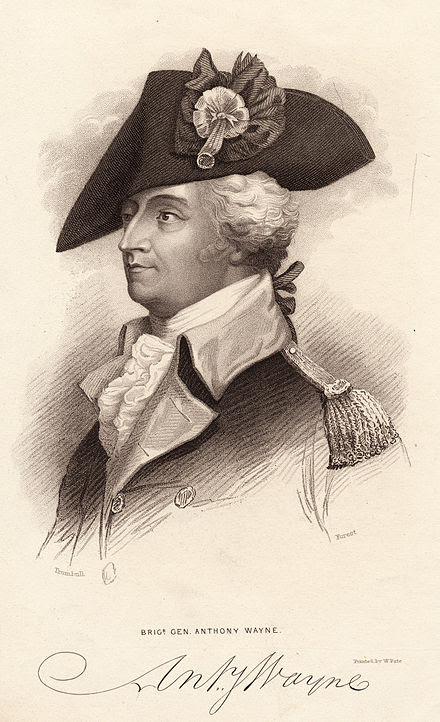
General “Mad Anthony” Wayne, Bruce Wayne, & John Wayne “I’d like to know why they make excuses for cowards …” – American Minute with Bill Federer


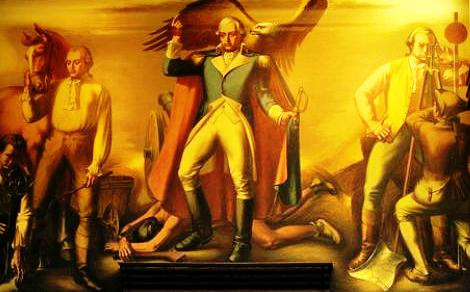
General “Mad Anthony” Wayne raised a militia unit at the beginning of the Revolutionary War and participated in the invasion of Canada.
He fought in the Battle of Trois-Rivières, and led forces at Fort Ticonderoga and Mount Independence.
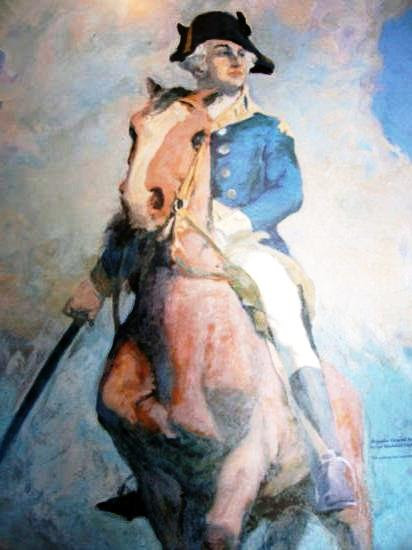
“Mad Anthony” Wayne fought at Brandywine in 1777, then harassed British General Howe as his troops marched towards Pennsylvania.
In 1778, Wayne attacked at the Battle of Monmouth.
He fought at Germantown, and quartered the winter at Valley Forge.
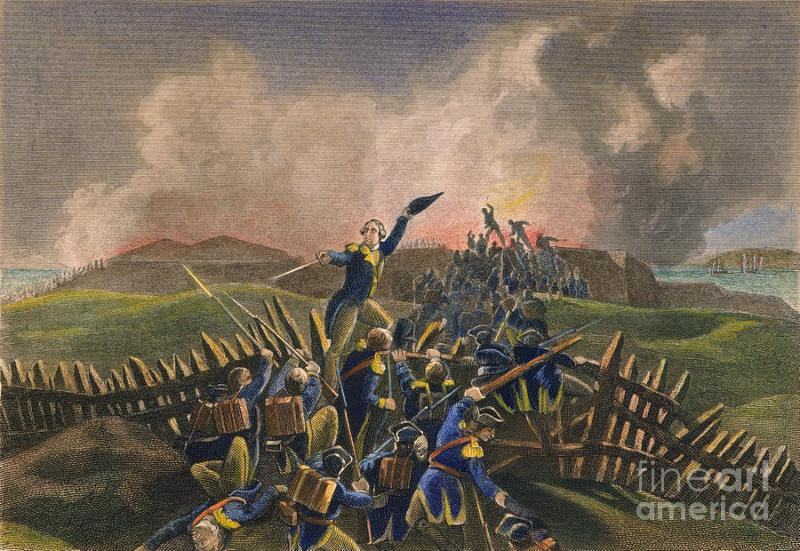
In July of 1779, when General George Washington asked if he could capture Stony Point, New York, Wayne replied:
“Issue the orders Sir, and I will storm hell.”
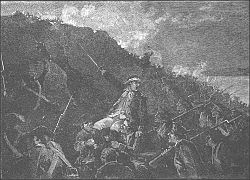
Wayne then led a well-planned and executed stealth, bayonet-only night attack and captured Stony Point.
In relaying the victory, Wayne wrote to Washington:
“Dear Gen’l, — The fort and garrison with Col. Johnston are ours. Our officers and men behaved like men who are determined to be free.”
Wayne was later awarded a medal by the Continental Congress.
When the Pennsylvania Line of the Continental Army threatened mutiny for being paid with worthless “continental currency,” Wayne was able to keep the army together.
Wayne led Lafayette’s forces in the 1781 Green Springs action and led a bayonet charge against British Lord Cornwallis’ troops in Virginia.
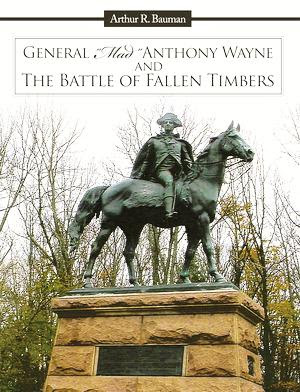
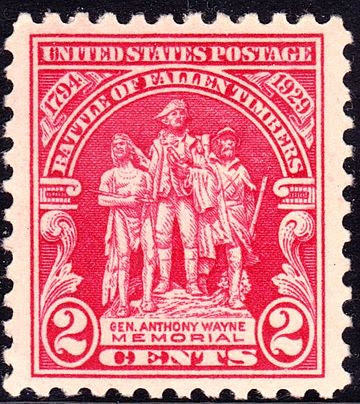
After the Revolution, Wayne was recalled by Washington to fight a British and Indian confederacy in the Battle of Fallen Timbers, 1794.
Major William Eaton, who later fought the Barbary Pirates, wrote of General Wayne:
“He endures fatigue and hardship with fortitude uncommon for a man of his years. I have seen him, in the most severe night of the winter of 1794, sleep on the ground, like his fellow-soldiers, and walk around the camp at four in the morning, with the vigilance of a sentinel.”
One of the officers under Wayne’s command was Captain Stephen Barton, father of Clara Barton who founded the American Red Cross.
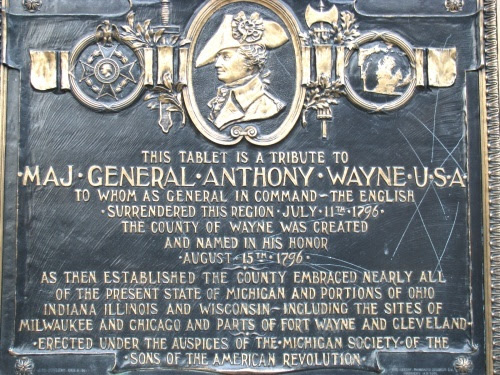
Many places in the United States are named for General”Mad Anthony” Wayne, including:
- Fort Wayne, Indiana
- Wayne, Illinois
- Wayne, Maine
- Wayne, Michigan
- Wayne, Nebraska
- Wayne, New Jersey
- Wayne, Ohio
- Wayne, Oklahoma
- Wayne, Pennsylvania
- Wayne, New York
- Wayne, West Virginia
- South Wayne, Wisconsin
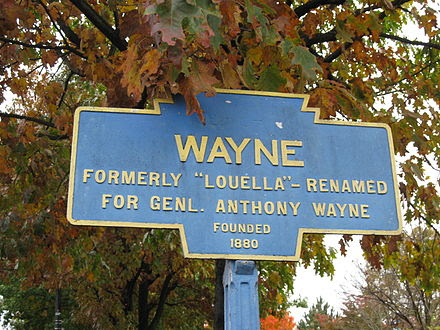
- Waynesboro, Georgia
- Waynesboro, Mississippi
- Waynesboro, Pennsylvania
- Waynesboro, Tennessee
- Waynesboro, Virginia
- Waynesville, Illinois
- Waynesville, Missouri
- Waynesville, North Carolina
- Waynesville, Ohio
- Waynesfield, Ohio
- Waynesburg, Ohio
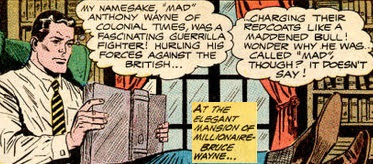
In 1939, “Detective Comics,” DC Comics, Issue number 27, introduced a crime-fighting character, with the dialogue:
“At the elegant mansion of millionaire Bruce Wayne — ‘My namesake, “Mad” Anthony Wayne of Colonial times, as a fascinating guerrilla fighter! Hurling his forces against the British, charging their redcoats like a maddened bull!”

Bruce Wayne’s crime-fighting name was Batman – the caped crusader who captured criminals in Gotham City.
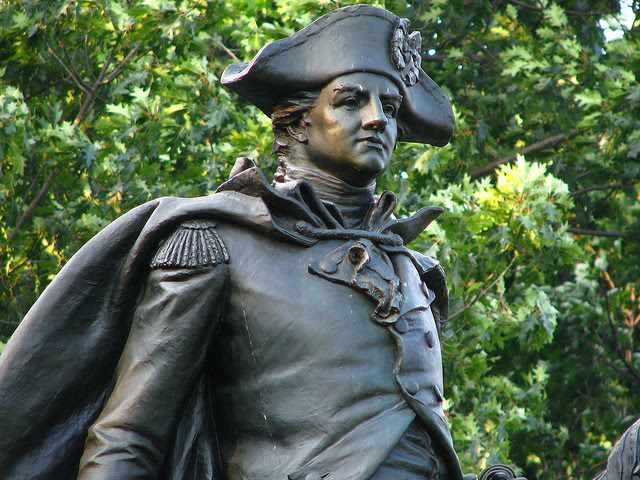
“Mad Anthony” Wayne’s courageous reputation was the model for actor John Wayne.

John Wayne was born May 26, 1907.
His given name was Marion Mitchell Morrison, grandson of a Scots-Irish Presbyterian veteran of the Civil War.

He played football for University of Southern California. and worked behind-the-scenes at Fox Studios.

Raoul Walsh, director of film The Big Trail (1930), first suggested his screen name be “Anthony Wayne” after Revolutionary War general “Mad Anthony” Wayne, but settled upon “John Wayne.”

He became an Academy Award winning actor for portraying cowboys and soldiers in action western and war films, appearing in over 200 films, and holding the Hollywood record of starring in 142 films.
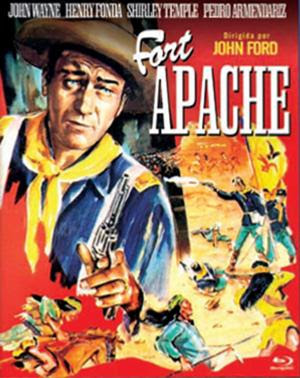
John Wayne’s career took off when director John Ford cast him in epic western films such as:
- Fort Apache (1948);
- She Wore A Yellow Ribbon (1949); and
- Rio Grande (1950).

The immensely popular 1952 movie, The Quiet Man, depicting the humorously stubborn traditions of Irish courtship, is memorialize by a statue in the town of Cong, Ireland, with John Wayne carrying his fiery-tempered redhead co-star, Maureen O’Hara.

John Wayne became an icon of the U.S. Armed Forces for depicting the strength and sacrifice of American military personnel during World War II, Korea and Vietnam:
- The Flying Tigers (1942);
- The Fighting Seabees (1944);
- They Were Expendable (1945);
- Back to Bataan (1945);
- The Sands of Iwo Jima (1949);
- The Flying Leathernecks (1951);
- Operation Pacific (1951);
- The Longest Day (1962);
- In Harm’s Way (1965); and
- The Green Berets (1968).

These films had the international effect of publicizing America’s military might and moral values, as demonstrated when Japanese Emperor Hirohito visited the United States in 1975 and asked to meet John Wayne.

Wayne stated:
“Courage is being scared to death, but saddling up anyway.”
“All battles are fought by scared men who’d rather be some place else.”
“Life it tough, but it’s tougher if you’re stupid.”

Regarding socialism, John Wayne stated in an interview, May 1971:
“In the late Twenties, when I was a sophomore at University of Southern California, I was a socialist myself – but not when I left.
The average college kid idealistically wishes everybody could have ice cream and cake for every meal.
But as he gets older and gives more thought to his and his fellow man’s responsibilities, he finds that it can’t work out that way – that some people just won’t carry their load …
I believe in welfare – a welfare work program. I don’t think a fella should be able to sit on his backside and receive welfare.I’d like to know why well-educated idiots keep apologizing for lazy and complaining people who think the world owes them a living.
I’d like to know why they make excuses for cowards who spit in the faces of the police and then run behind the judicial sob sisters.
I can’t understand these people who carry placards to save the life of some criminal, yet have no thought for the innocent victim.”
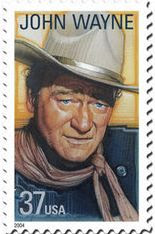
Wayne stated:
“… Government has no wealth, and when a politician promises to give you something for nothing, he must first confiscate that wealth from you — either by direct taxes, or by the cruelly indirect tax of inflation.”
“… I would think somebody like Jane Fonda and her idiot husband would be terribly ashamed and saddened that they were a part of causing us to stop helping the South Vietnamese. Now look what’s happening. They’re getting killed by the millions. Murdered by the millions. How the hell can she and her husband sleep at night?”
“… My hope and prayer is that everyone know and love our country for what she really is and what she stands for.”

On May 26, 1979, the U.S. Congress awarded him the Congressional Gold Medal.
President Jimmy Carter, who later awarded John Wayne the Presidential Medal of Freedom posthumously, stated:
“I have today approved … a specially struck gold medal to John Wayne. For nearly half a century, the Duke has symbolized the American ideals of integrity, courage, patriotism, and strength and has represented to the world many of the deepest values that this Nation respects.”

In 1998, the U.S. Navy Memorial Foundation honored John Wayne with the Naval Heritage Award for his support of the U. S. Navy and military.
A Harris Poll, January 2011, ranked John Wayne third among America’s favorite film stars.
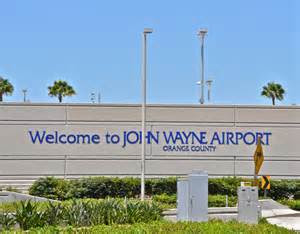
In 1979, California’s Orange County airport was named John Wayne Airport.

Ronald Reagan said November 5, 1984:
“I noted the news coverage about the death of my friend, John Wayne. One headline read ‘The Last American Hero’ …
No one would be angrier than Duke Wayne at the suggestion that he was America’s last hero.
Just before he died, John Wayne said in his unforgettable way, ‘Just give the American people a good cause, and there’s nothing they can’t lick.'”

John Wayne stated in a 1971 interview:
“Tomorrow is the most important thing in life.
Comes into us at midnight very clean. It’s perfect when it arrives and it puts itself in our hands. It hopes we’ve learned something from yesterday.”

In his album, America-Why I Love Her, 1977, John Wayne stated:
“Face the Flag, son, and face reality.
Our strengths and our freedoms are based in unity.
The flag is but a symbol, son, of the world’s greatest nation,
And as long as it keeps flying, there’s cause for celebration.
So do what you’ve got to do, but always keep in mind,
A lot of people believe in peace … but there are the other kind.
If we want to keep these freedoms, we may have to fight again.
God forbid, but if we do, let’s always fight to win,
For the fate of a loser is futile and it’s bare:
No love, no peace … just misery and despair.
Face the Flag, son … and thank God it’s still there.”
–(Reposted with permission from American Minute.)
American Minute is a registered trademark of William J. Federer. Permission granted to forward, reprint, or duplicate.
Memorial Day –Honoring American Heroes of Courage, Sacrifice, & Faith – American Minute with Bill Federer

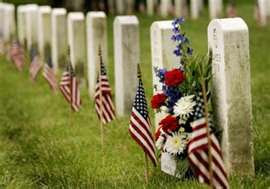
Memorial Day in America, as an annual observance, can be traced back to the end of the Civil War, a war in which over a half-million died.
Southern women scattered spring flowers on graves of both northern Union and southern Confederate soldiers.
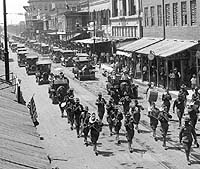
Many places claimed to have held the original Memorial Day, such as:
- Warrenton, Virginia;
- Columbus, Georgia;
- Savannah, Georgia;
- Gettysburg, Pennsylvania;
- Boalsburg, Pennsylvania;
- Waterloo, New York.
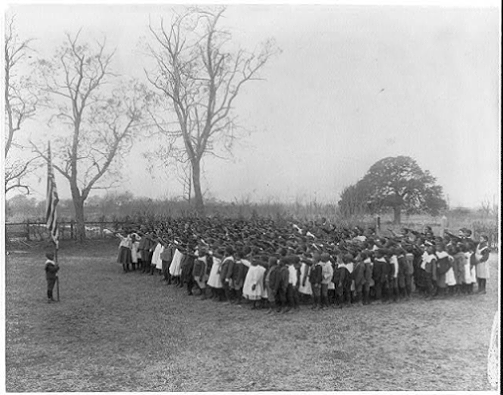
One such place was Charleston, South Carolina, where a mass grave was uncovered of 267 Union soldiers who had died in a prison camp.
On May 1, 1865, former slaves organized a parade, led by 2,800 singing black children, in which they prayed, read Bible verses, sang spirituals, and reburied the soldiers with honor as an act of gratefulness for their ultimate sacrifice which gave them freedom.
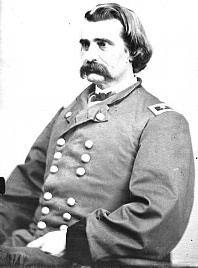
In 1868, General John A. Logan, commander of the Civil War veterans’ organization “The Grand Army of the Republic,” called for a Decoration Day to be observed annually on May 30.
An estimated 180,000 Black soldiers served in the Union Army during the Civil War.
Republican abolitionist Frederick Douglass gave a Decoration Day address at Arlington National Cemetery in 1871:
“We must never forget that the loyal soldiers who rest beneath this sod flung themselves between the nation and the nation’s destroyers.”
President James Garfield’s only executive order was in 1881 where he gave government workers May 30th off so they could decorate the graves of those who died in the Civil War.
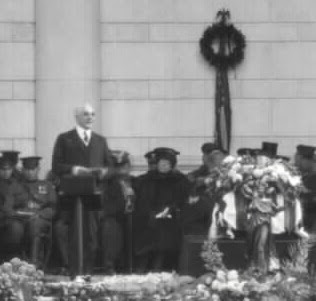
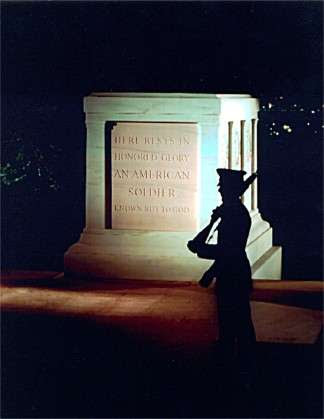
In 1921, President Warren Harding had the remains of an unknown soldier killed in France during World War I buried in the Tomb of the Unknown Soldier at Arlington Cemetery.
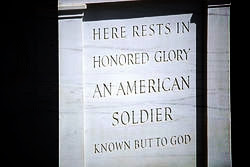
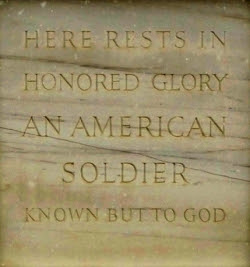
Inscribed on the Tomb is the phrase:
“HERE RESTS IN HONORED GLORY AN AMERICAN SOLDIER KNOWN BUT TO GOD.”
Since 1921, it has been the tradition for Presidents to lay a wreath on the Tomb of the Unknown Soldier, which is guarded 24 hours a day, 365 days a year.
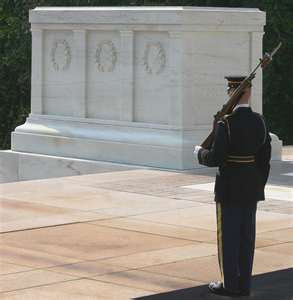
The number 21 being the highest salute, the sentry takes 21 steps, faces the tomb for 21 seconds, turns and pauses 21 seconds, then retraces his steps.
The number 21 is explained on the U.S. Army Center of Military History website (history.army.mil/index.html):
“Warriors … demonstrated their peaceful intentions placing their weapons in a position that rendered them ineffective …
Rendering a salute by cannon originated in the 14th century as firearms and cannons came into use. Since these early devices contained only one projectile, discharging them once rendered them ineffective.
Originally warships fired seven-gun salutes–the number seven probably selected because of its astrological and Biblical significance … The Bible states that God rested on the seventh day after Creation, that every seventh year was sabbatical and that the seven times seventh year ushered in the Jubilee year.
Land batteries, having a greater supply of gunpowder, were able to fire three guns for every shot fired afloat, hence the salute by shore batteries was 21 guns …
Early gunpowder, composed mainly of sodium nitrate, spoiled easily at sea, but could be kept cooler and drier in land magazines. When potassium nitrate improved the quality of gunpowder, ships at sea adopted the salute of 21 guns.
The 21-gun salute became the highest honor a nation rendered …
Great Britain, the world’s preeminent seapower in the 18th and 19th centuries, compelled weaker nations to salute first …
Eventually, by agreement, the international salute was established at 21 guns, although the United States did not agree on this procedure until August 1875.”
On Memorial Day, 1923, President Calvin Coolidge stated:
“There can be no peace with the forces of evil. Peace comes only through the establishment of the supremacy of the forces of good.
That way lies through sacrifice … ‘Greater love hath no man than this, that a man lay down his life for his friends.'”
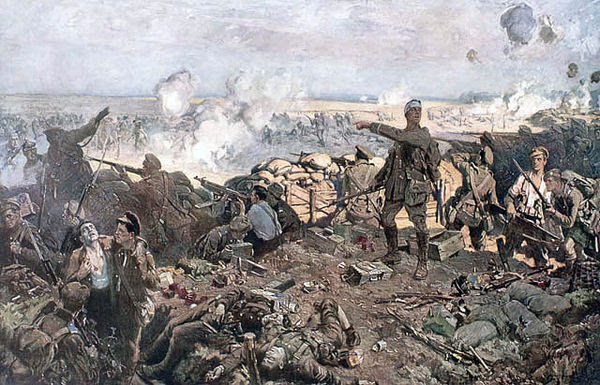
The Memorial Day poem, “In Flanders Fields,” was composed during World War I, by a Canadian Expeditionary gunner and medical officer named John McCrae, who fought in the Second Battle of Ypres near Flanders, Belgium.
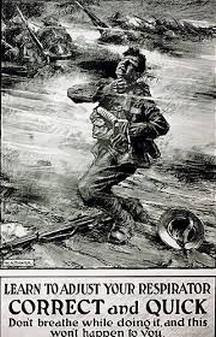
Describing the battle as a “nightmare,” as the enemy carried out one of the first chlorine gas attacks, McCrae wrote:
“For seventeen days and seventeen nights none of us have had our clothes off, nor our boots even, except occasionally. In all that time while I was awake, gunfire and rifle fire never ceased for sixty seconds …
And behind it all was the constant background of the sights of the dead, the wounded, the maimed, and a terrible anxiety lest the line should give way.”
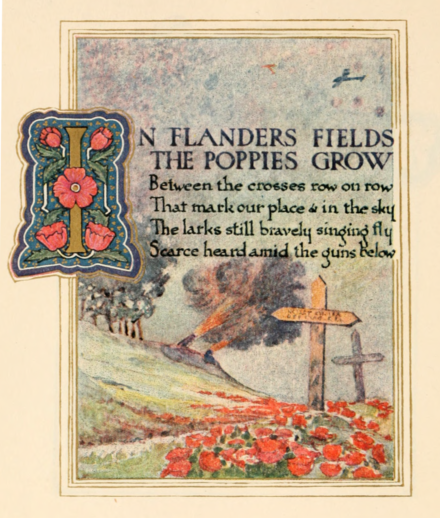
Finding one of his friends killed, McCrae helped bury him along with the other dead in a field.
Noticing the field covered with poppy flowers, he wrote:
“In Flanders fields the poppies blow
Between the crosses, row on row,
That mark our place; and in the sky
The larks, still bravely singing, fly
Scarce heard amid the guns below.
We are the Dead. Short days ago
We lived, felt dawn, saw sunset glow,
Loved and were loved, and now we lie
In Flanders fields.
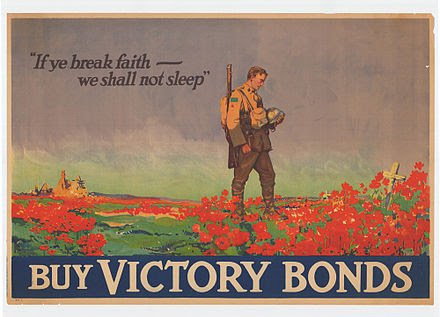
Take up our quarrel with the foe:
To you from failing hands we throw
The torch; be yours to hold it high.
If ye break faith with us who die
We shall not sleep, though poppies grow
In Flanders fields.”
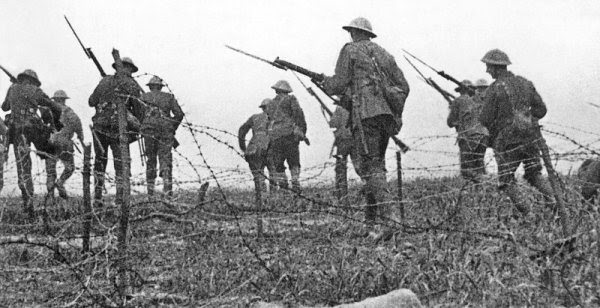
Notable individuals who fought in World War I include:
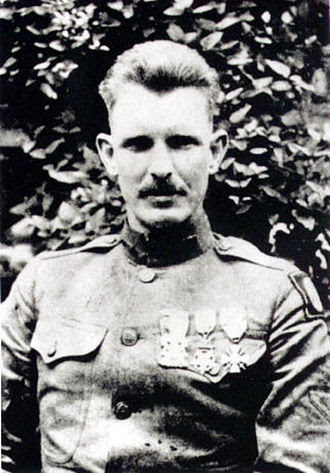
- Sergeant Alvin York, who single-handedly took out 35 machine guns and captured 132;
- John J. Pershing, General of the Armies;
- Douglas MacArthur, Brigadier General;
- George S. Patton, tank commander;
- Leonard Wood, future Army Chief of Staff;
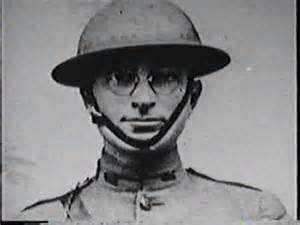
- Harry S Truman, artillery officer and future 33rd President;
- Eddie Rickenbacker, commander of 94th Areo Squadron;
- Quentin Roosevelt, a pilot, son of President Theodore Roosevelt, was shot down and died;
- Charles Whittlesey, commander of the “Lost Battalion” behind lines;
- Frank Luke -“balloon buster”;
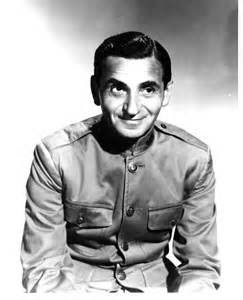
- Irving Berlin, composer of “God Bless America”;
- Edouard Izac, naval office captured on a U-Boat, who escaped;
- Henry Johnson of the “Harlem Hellfighters”;
- Dan Daly, Marine Sergeant charged and captured machine gun nests;
- Ernest Hemingway, author of A Farewell to Arms;
- J.R.R. Tolken, British author of The Lord of the Rings;
- C.S. Lewis, British author of The Chronicles of Narnia.
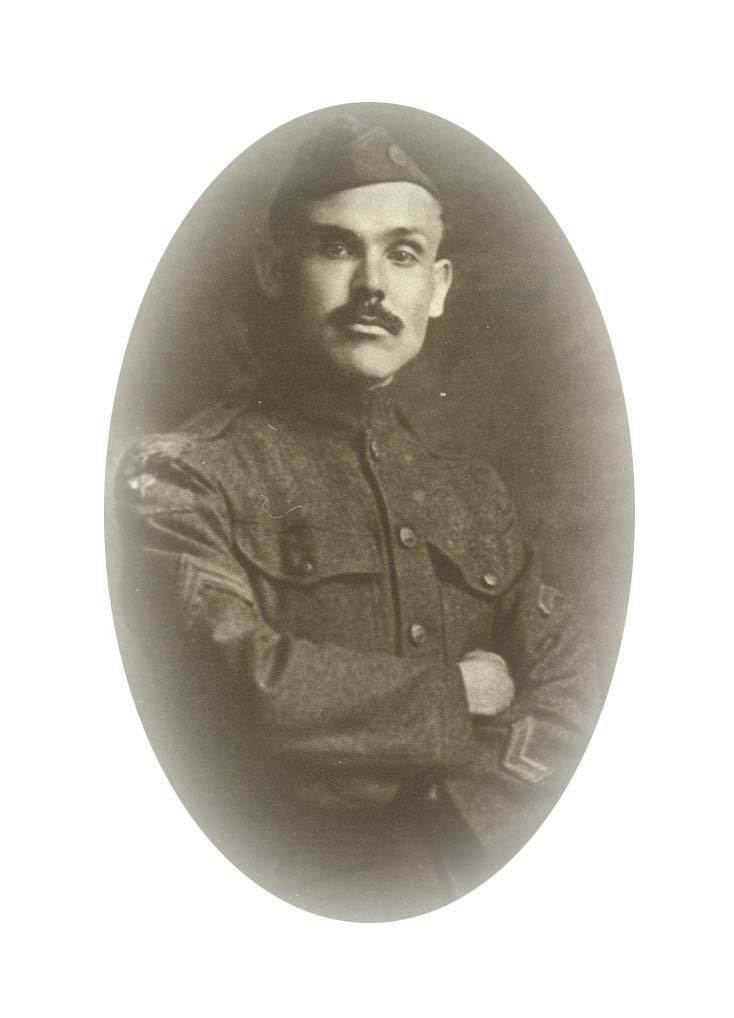
One soldier was Orval William Epperson.
Born on a rugged Ozark farm near Anderson, Missouri, he fought in France, being assigned to the 338th Machine Gun Battalion 88th Division.
Upon returning to America, he married Therese DeBrosse, and had three children: Joan, Orval Wilford, and Tirzah, the mother of the author of this article.
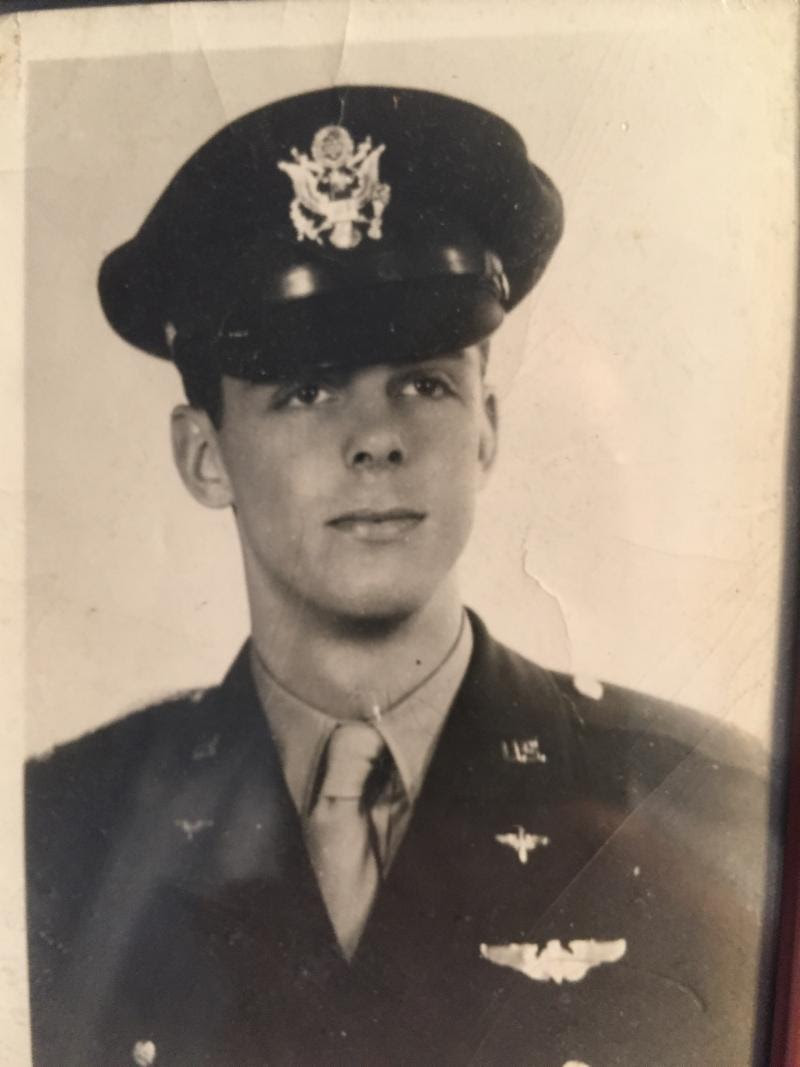
Orval and Therese’s only son was Orval Wilford “Billy” Epperson.
He served in World War II as a bombardier on a B17 Flying Fortress, 525th Squadron, 379 Bomb Group A.P.O. 550 (#0-768946).
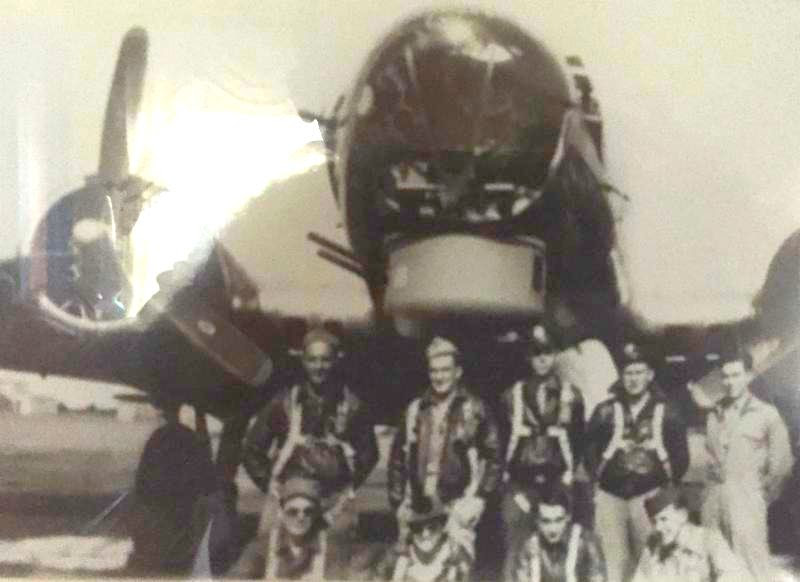
23-year-old “Billy” Epperson flew from Camp Crowder in southwest Missouri to Kimbolton, England.
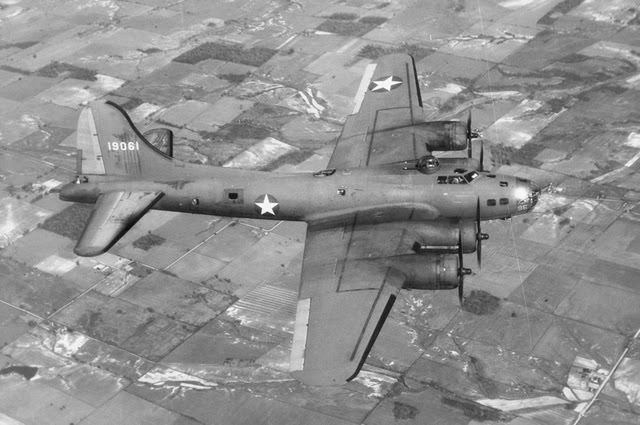
He had written a Mother’s Day note to his mom, tied it with a handkerchief to a small weight and dropped it from the plane as it flew over his hometown of Neosho, Missouri.
A neighbor got it and brought to his mother, who lived at 344 S. Hamilton.
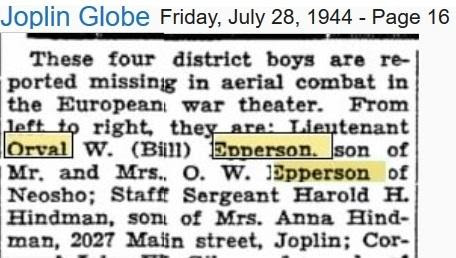
Little did either know that that would be the closest they would be again, as Billy was shot down by the Nazis over the English Channel near Holland on July 9, 1944.
His name is on the monument near Omaha Beach, at the Cimitière Amèrican de Normandie (in Colleville-sur-Mer, France) at the Killed in Action Wall (“Tablet of the Missing”).

On June 6, 1944 President Franklin Roosevelt offered a D-Day Prayer, which is now part of the World War II Memorial in Washington, D.C., thanks to the effort led by Chris Long of the Ohio Christian Alliance, as documented in his book For Their Honor:
“My fellow Americans: … I ask you to join with me in prayer:
Almighty God, Our sons, pride of our Nation, this day have set upon a mighty endeavor, a struggle to preserve our republic, our religion, and our civilization …
Give strength to their arms, stoutness to their hearts, steadfastness in their faith. They will need Thy blessings. Their road will be long and hard. For the enemy is strong. He may hurl back our forces …
We know that by Thy grace, and by the righteousness of our cause, our sons will triumph … Some will never return. Embrace these, Father, and receive them, Thy heroic servants, into Thy kingdom.”

In 1958, President Eisenhower placed soldiers in the tomb from World War II and the Korean War.
In 1968, one hundred years after the first observance, Memorial Day was moved to the last Monday in May.
In 1984, President Ronald Reagan placed a soldier from the Vietnam War in the tomb.
DNA test later identified him as pilot Michael Blassie, whose A-37B Dragonfly was shot down near An Loc, South Vietnam.
He had graduated from the U.S. Air Force Academy in 1970, and prior to that, graduated from St. Louis University High School in 1966, ten years before the author of this article.
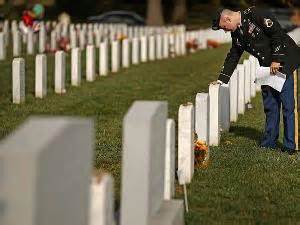
In 1998, Michael Blassie’s remains were reburied at Jefferson Memorial Cemetery, St. Louis, Missouri.
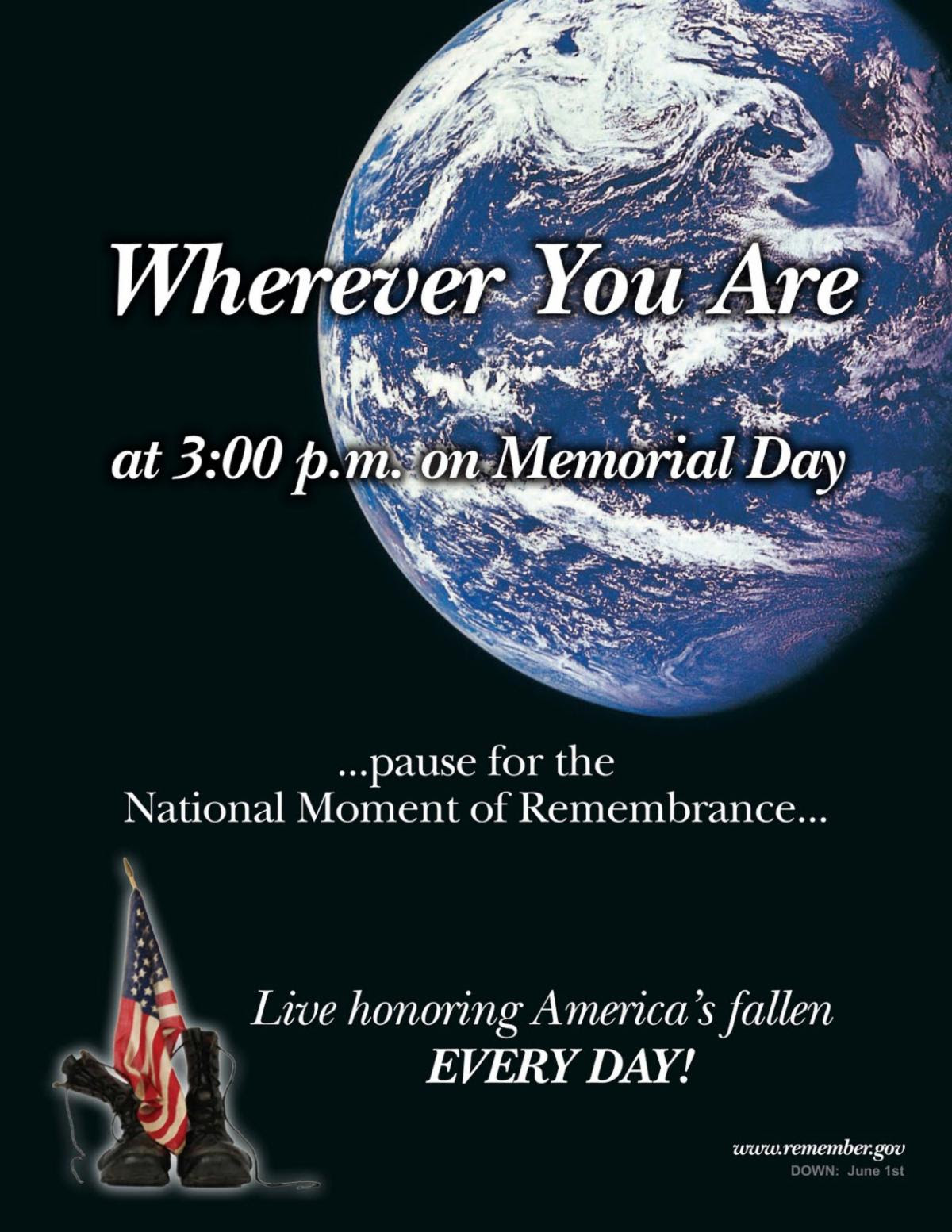
In 2000, Congress passed The National Moment of Remembrance Act (Public Law 106-579), whereby on each Memorial Day, at 3:00pm, citizens should pause for a moment of prayer:
“Congress finds that … it is essential to remember and renew the legacy of Memorial Day … to pay tribute to individuals who have made the ultimate sacrifice in service to the United States …
Greater strides must be made to demonstrate appreciation for those loyal people … whose values, represented by their sacrifices, are critical to the future of the United States …
and to encourage citizens to dedicate themselves to the … principles for which those heroes of the United States died …
A symbolic act of unity … to honor the men and women of the United States who died in the pursuit of freedom and peace … as a day of prayer for permanent peace.”
Memorial Day grew to honor all who gave their lives defending America’s freedom in every war, including:
- Revolutionary War (1775-1783) 25,000;
- Barbary Wars (1801-1805; 1815) 45;
- War of 1812 (1812-1814) 20,000;
- Mexican-American War (1846-1848) 13,283;
- Civil War (1861-1865) 625,000;
- Spanish-American War (1898) 2,446;
- World War 1 (1917-1918) 116,516;
- World War 2 (1941-1945) 405,399;
- Korean War (1950-1953) 36,516;
- Vietnam War (1955-1975) 58,209;
- Persian Gulf War (1990-1991) 258;
- Operation Enduring Freedom in Afghanistan (2001-2014) 2,356;
- Operation Iraqi Freedom (2003-2012) 4,489; and
- subsequent wars against Islamic terrorism, securing our borders, and in Ukraine.
At the Memorial Day Ceremony, May 31, 1993, President Bill Clinton remarked:
“The inscription on the Tomb of the Unknown Soldier says that he is ‘Known but to God.’
But that is only partly true. While the soldier’s name is known only to God, we know a lot about him.
We know he served his country, honored his community, and died for the cause of freedom. And we know that no higher praise can be assigned to any human being than those simple words …
In the presence of those buried all around us, we ask the support of all Americans in the aid and blessing of God Almighty.”
Charles Michael Province, U.S. Army, wrote the poem:
“It is the Soldier, not the minister
Who has given us freedom of religion.
It is the Soldier, not the reporter
Who has given us freedom of the press.
It is the Soldier, not the poet
Who has given us freedom of speech.
It is the Soldier, not the campus organizer
Who has given us freedom to protest.
It is the Soldier, not the lawyer
Who has given us the right to a fair trial.
It is the Soldier, not the politician
Who has given us the right to vote.
It is the Soldier who salutes the flag,
Who serves beneath the flag,
And whose coffin is draped by the flag,
Who allows the protester to burn the flag.”
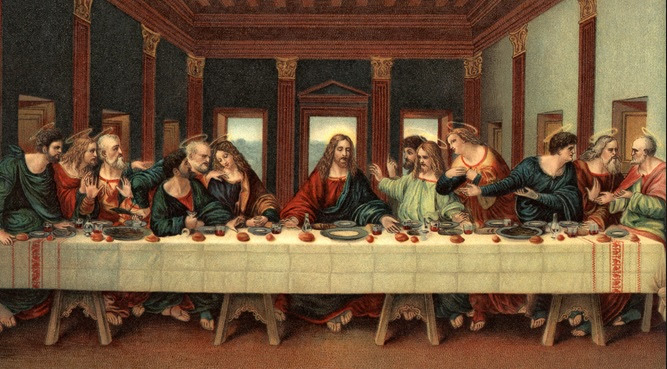
Noah Webster’s 1828 Dictionary stated in its definition of “MEMORIAL”:
“That which preserves the memory of something … A monument is a memorial of a deceased person, or of an event. The Lord’s supper is a memorial of the death and sufferings of Christ.”
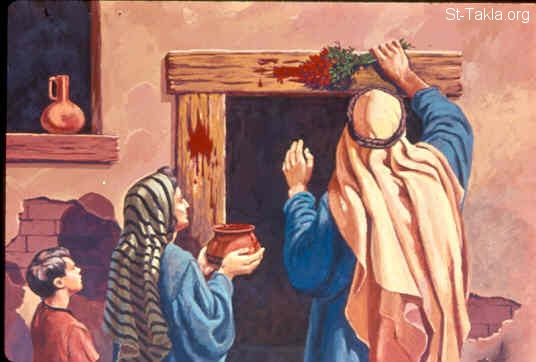
Memorials are important in Scripture. The Lord told Moses in Exodus 12:
“Speak ye unto all the congregation of Israel …
In the tenth day of this month they shall take to them every man a lamb, according to the house … Your lamb shall be without blemish … And ye shall keep it up until the fourteenth day … and the whole assembly of the congregation of Israel shall kill it in the evening.
And they shall take of the blood, and strike it on the two side posts and on the upper door post of the houses … For I will pass through the land of Egypt this night, and … execute judgment … and when I see the blood, I will pass over you, and the plague shall not be upon you to destroy you …
And this day shall be unto you for a MEMORIAL … throughout your generations … an ordinance for ever.”
Memorial is mentioned in Joshua, chapter 4:
“When all the people were clean passed over Jordan … Joshua called the twelve men … out of every tribe …
And Joshua said unto them, Pass over before the ark of the LORD your God into the midst of Jordan, and take ye up every man of you a stone upon his shoulder …
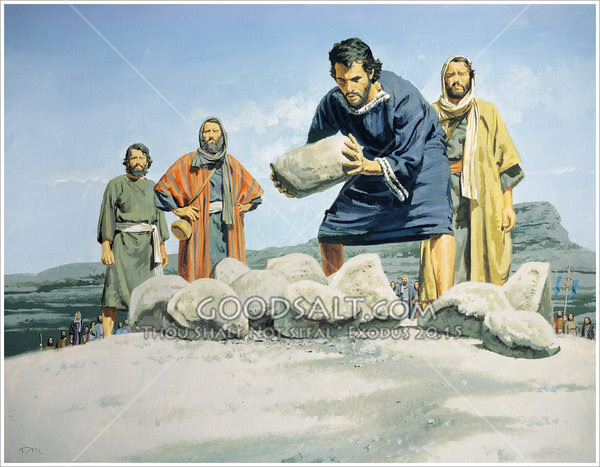
… That this may be a sign among you, that when your children ask their fathers in time to come, saying, What mean ye by these stones?
Then ye shall answer them, That the waters of Jordan were cut off before the ark of the covenant of the LORD; when it passed over Jordan … and these stones shall be for a MEMORIAL unto the children of Israel for ever.”
In his Memorial Day Address, May 31, 1923, President Calvin Coolidge said:
“Settlers came here from mixed motives … Generally defined, they were seeking a broader freedom.
They were intent upon establishing a Christian commonwealth in accordance to the principle of self-government …
It has been said that ‘God sifted the nations that He might send choice grain into the wilderness.'”
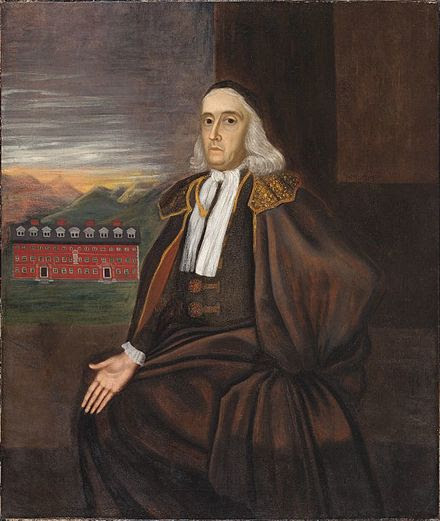
Coolidge was citing an Election Sermon given in Boston, April 29, 1669, by Massachusetts Governor Judge William Stoughton, who described the Puritans fleeing persecution in England to settle in the New World:
“God sifted a whole nation that he might send choice grain over into this wilderness.”
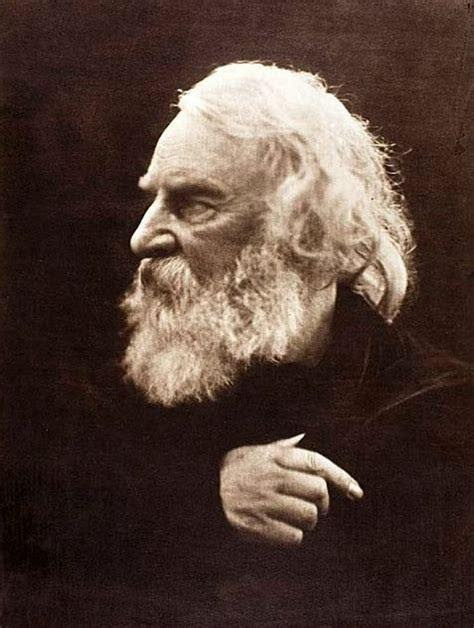
Henry W. Longfellow used a similar line in his classic Courtship of Miles Standish:
“God had sifted three kingdoms to find the wheat for this planting.”
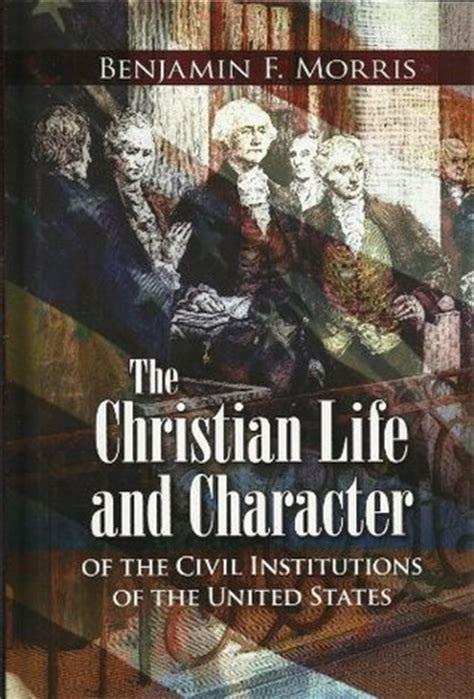
This was explained further in Benjamin Franklin Morris’ classic The Christian Life and Character of The Civil Institutions of The United States (1864):
“The persecutions of the Puritans in England for non-conformity, and the religious agitations and conflicts in Germany by Luther, in Geneva by Calvin, and in Scotland by Knox, were the preparatory ordeals for qualifying Christian men for the work of establishing the civil institutions on the American continent.
‘God sifted’ in these conflicts ‘a whole nation that He might send choice grain over into the wilderness’; and the blood and persecution of martyrs became the seed of both the church and the state …
It was in these schools of fiery trial that the founders of the American republic were educated and prepared for their grand Christian mission …
They were trained in stormy times, in order to prepare them to … establish the fundamental principles of civil and religious liberty and of just systems of civil government.”
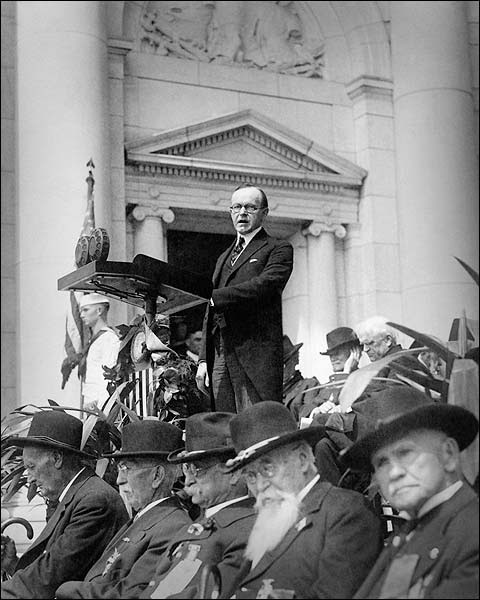
Concluding in his Memorial Day Address that America’s republic is worth preserving, President Calvin Coolidge stated May 31, 1923:
“They had a genius for organized society on the foundations of piety, righteousness, liberty, and obedience of the law …
Who can fail to see in it the hand of destiny? Who can doubt that it has been guided by a Divine Providence?”
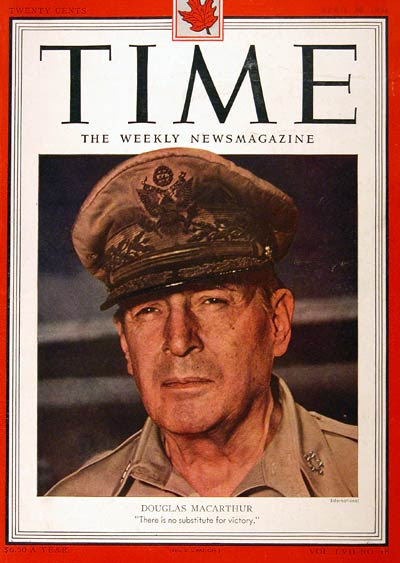
Douglas MacArthur told West Point cadets, May 1962:
“The soldier, above all other men, is required to practice the greatest act of religious training-sacrifice.
In battle and in the face of danger and death, he discloses those Divine attributes which his Maker gave when He created man in His own image …
No physical courage and no brute instinct can take the place of Divine help which alone can sustain him.
However horrible the incidents of war may be, the soldier who is called upon to offer and to give his life for his country is the noblest development of mankind.”
—
American Minute is a registered trademark of William J. Federer. Permission granted to forward, reprint, or duplicate.
(Reposted with permission from The American Minute.)
I want to go into the “not raising hogs” business next year.
This is a classic. We are not sure of its origination, but it clearly points out the how wasteful government programs have been over the years.
Honorable Secretary of Agriculture
Washington, D.C.
Dear Sir;
My friend, Ed Peterson, over at Wells Iowa,
received a check for $1,000 from the government for not
raising hogs. So, I want to go into the “not raising
hogs” business next year.
What I want to know is, in your opinion, what is the
best kind of farm not to raise hogs on, and what is the
best breed of hogs not to raise? I want to be sure that
I approach this endeavor in keeping with all
governmental policies. I would prefer not to raise
razorbacks, but if that is not a good breed not to
raise, then I will just as gladly not raise Yorkshires
or Poland Chinas.
As I see it, the hardest part of this program will be in
keeping an accurate inventory of how many hogs I haven’t
raised.
My friend, Peterson, is very joyful about the future of
the business. He has been raising hogs for twenty years
or so, and the best he ever made on them was $422 in
1968, until this year when he got your check for $1000
for not raising hogs.
If I get $1000 for not raising 50 hogs, will I get $2000
for not raising 100 hogs? I plan to operate on a small
scale at first, holding myself down to about 4000 hogs
not raised, which will mean about $80,000 the first
year. Then I can afford an airplane.
Now another thing, these hogs I will not raise will not
eat 100,000 bushels of corn. I understand that you also
pay farmers for not raising corn and wheat. Will I
qualify for payments for not raising wheat and corn not
to feed the 4000 hogs I am not going to raise?
Also, I am considering the “not milking cows” business,
so send me any information you have on that too.
In view of these circumstances, you understand that I
will be totally unemployed and plan to file for
unemployment and food stamps.
Be assured you will have my vote in the coming election.
And a video of this letter read by Peter Grace:
Net Zero Makes No Sense: Study Questions Role of Human Emissions in Climate Models and Policy
This is a news release from Camp Constitution instructor Professor Willie Soon:
A groundbreaking study published in Science of Climate Change challenges the validity and reliability of the U.N. Intergovernmental Panel on Climate Change (IPCC) climate models, the projections from which underpin the Paris Climate Agreement and the adoption of “Net Zero” policies.
The research by Dr. Kesten C. Green—a forecasting expert at the University of South Australia and co-author of The Scientific Method: A Guide to Finding Useful Knowledge (Cambridge University Press, 2022)—and astrophysicist Dr. Willie Soon of the Institute of Earth Physics and Space Science, Hungary, found models that included the IPCC’s anthropogenic (human causation) variable failed badly in temperature forecasting comparisons with models that included independent measures of variation in the Sun’s radiation, and even with forecasts that the temperature would be the same as the historical average.
The study, titled “Are Climate Model Forecasts Useful for Policy Making? Effect of Variable Choice on Reliability and Predictive Validity,” tested alternative hypotheses on causes of temperature change in the form of models that included the IPCC anthropogenic variable—mainly carbon dioxide emissions—with and without the IPCC preferred solar variable, and two models with independent solar variables. The models were used to forecast annual Northern Hemisphere land temperature averages with and without urban temperatures—the latter to avoid heat island effects—for various subsets of temperature data from 1850 to 2018.
The results were striking: Models using the IPCC anthropogenic and solar variables produced forecast errors as large as 4°C in forecasting Northern Hemisphere land temperatures that had not been used in estimating the models, and as large as 20°C in forecasting rural temperatures. The independent solar variable models’ errors were mostly much less than 1°C in forecasting the all-land temperatures, and almost always much less than 1°C in forecasting the rural temperatures.
The authors found that while the independent solar variables individually exhibited relationships consistent with physical causality—temperatures tending to increase as solar irradiance increases—that was not the case with the IPCC variables. The IPCC solar variable hardly changed over the 1850 to 2018 period, and higher temperatures were associated with lower irradiance from 1970, a time when fears of a new ice age were replaced by fears of global warming. In a challenge to physics, the IPCC anthropogenic variable similarly failed to exhibit a relationship with temperature prior to 1970 but displayed a strong positive relationship thereafter.
Dr. Green emphasized the policy implications: “Our findings suggest that IPCC modelling fails to support the hypothesis that human carbon dioxide emissions have a meaningful impact on global temperatures. Uncomfortable as it may be for policy makers, unpredictable and uncontrollable variations in radiation from the Sun and volcanic eruptions will continue to determine changes in the Earth’s climate. Policies that deny that reality cannot avoid imposing great costs on the many, to the benefit of very few”.
|
For More Information: |
Armed Forces Day – Saluting Our Defenders! by William Federer

|
|


|

|

|

|

|

|

|

|

|

|

|
|

|

|

|

|

|
|

|

|
|
Report on Camp Constitution Ladies’ “Spring Fling” by Kathy Mickel

— This was perhaps one of our largest attended CC Ladies’ Retreat/Advance. Enrollment was confirmed at 18! but half, exactly nine, were first-timers!!

Friday evening: the potluck provided enough delicious food for a small army..
Our “campfires” had to be held inside the living room. Wonderful singing and great stories.
— Paulie and special missionary friend, Belinda, led the Ladies into very spirited worship sessions. Both Ladies are skilled in the field of music; Belinda played the guitar as well as sang. We were truly blessed during worship times.
— All of our Speakers gave us great ‘food for thought:’ Sue talked about her faith getting her through the January 6 nightmare; Karen Testerman also shared how her faith and trust in God has carried her through all of her journeys of life, even facing new challenges, her faith and trust in God continues; Charmaine beautifully tied her gardening skills and lessons into spiritual lessons which will sustain us all.
— Times of Prayer on the hour, every hour, instituted by Sapphire, really kept us grounded in the Presence of God throughout the day. The atmosphere and the landscape certainly added to ‘soaking up’ God’s Presence during times of Prayer. Some Ladies perhaps prayed publicly for the first time.
— Our Craft Time was outstanding! Our gift of Maura, who turns ‘twigs’ into works of art while making a spring wreath, blessed us all again with her exceptional talent.
— Building upon your marksmanship skills at a shooting range, with skilled professionals, was more than worth the twenty-minute drive.


— The cafeteria staff, food, and service were offered with kindness, professionalism, and ‘down-home’ goodness.
— Another great CC Ladies’ Retreat and a huge ‘THANK YOU!’ to all the generous donors and gifts received by all.
We brainstormed about our next meeting…. some great ideas. tentatively planned for Columbus Day weekend in October.
(The next Ladies’ “Spring Fling” will be from Friday May 1 to Sunday Ma3 3, 2026 at the Alton Bay Christian Retreat Center.
Kathy serves as the camp nurse at our annual family camp and is the co-founder of our Junior Camper Education Program.)
Former Acting D.C. Attorney General Interviews Camp Constitution Director
Prior to being the acting D.C. Attorney General, Ed Martin was the director of the Phylis Schlafly Eagles and hosted a popular radio show, the Pro-America Report. Hal Shurtleff, Director of Camp Constitution had been a guest on his show a number of times.
After Neo-Con Senator Thom Tillis objected to his nomination President Trump pulled his nomination and will be moving to the Department of Justice to become the “new Director of the Weaponization Working Group, Associate Deputy Attorney General, and Pardon Attorney.” We wish Ed al the best in his new assignment.
Mother’s Day Origins

|
|


|
|
|
|
|
|
|
|
|
|
|
|
|
|
|
|
|
|
|
|
|
|
|

|
|
|
|
|
|
|
|
|

|
|

|